·

#1493: Artificial Intelligence Means It Is Time To Learn Programming; Or; The Call Of Interactive Fiction

Author explains how AI can aid in creating text‑adventure games, noting its feedback, analysis, and world‑building abilities. Starting from small rulesets, an AI can permute ideas, generate objects, characters, and enforce logic, turning a simple program into a Multi‑User Dungeon (MUD) that expands automatically. The author invites beginners to learn Node‑RED, JavaScript or Inform 7, watch Zork playthroughs, then use AI to design worlds and puzzles before building their own Ranvier MUD server, with the AI as first admin entity.

·

#1492: The European Cowboy

The post contrasts European “cowboys” with their American counterparts, noting that while both share the ranching spirit, Europeans rarely drive cattle or use large trucks—small cars are more common—and their cowboy culture is tied to family traditions (grandparents’ cows and boars), local food like kielbasa, and events such as weddings rather than rodeos. The narrator, a European cowboy himself, describes his life of small‑car driving, climbing trees for safety, and a culinary scene filled with sausages instead of BBQ. He highlights that European cowboys embody a knightly blend of fearlessness, dignity, and philosophical depth, favoring castles or museums over saloons. Despite the different tools and rituals, both American and European cowboys share a common love for the land, livestock, and the legacy they build across generations.

·

#1491: Computer Mouse: The Meanest Creature In The World; Or, A Programmer's Lament

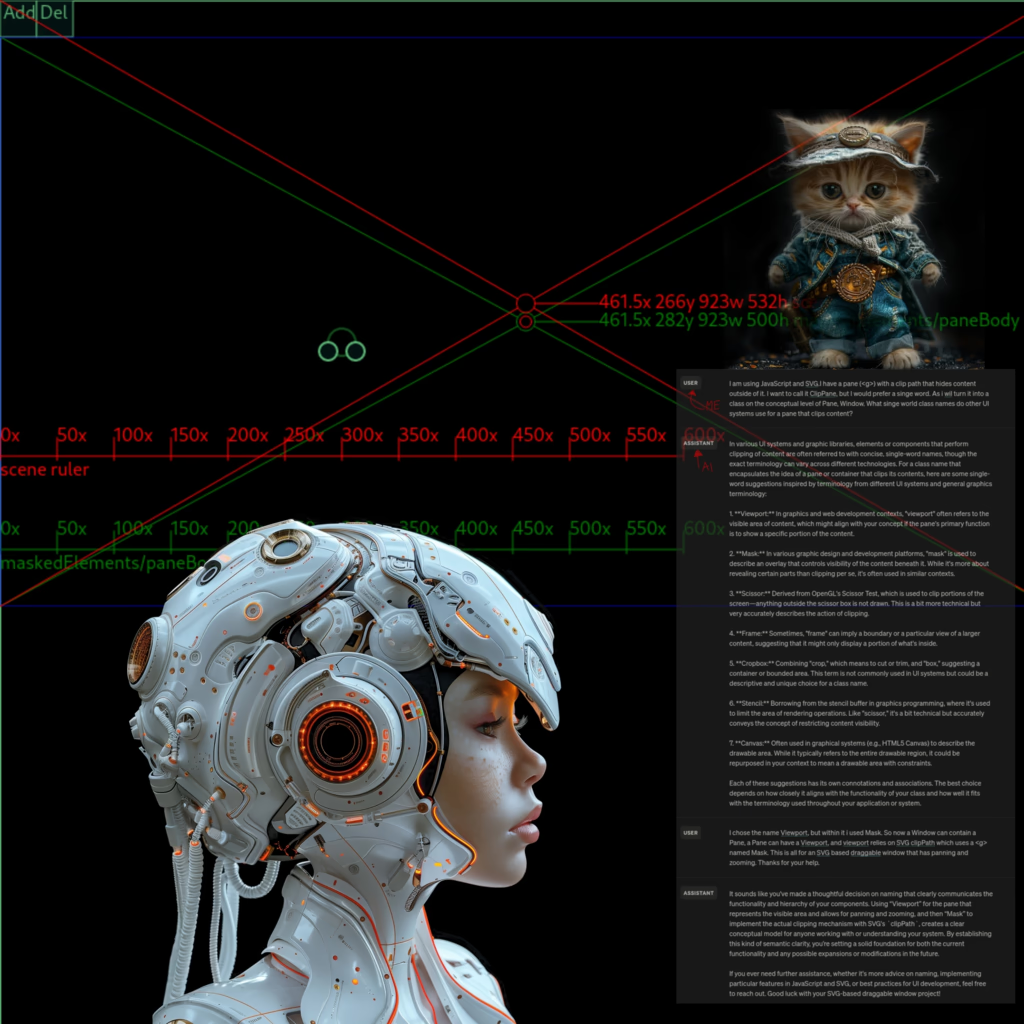
I got my first computer mouse as a gift and quickly fell into the world of cursor events—starting with simple drag‑and‑drop logic (mouseDown → movement → delta calculation) but soon running into inconsistencies between movementX/movementY, clientX/clientY, and viewport size changes when nested windows are transformed. After trying to track pixel deltas in a multi‑window setup, I created a small repo called kerfuffle to handle the transforms and re‑calculate positions, only to discover that even though the math works out, the mouse’s imprecision still throws off the layout, reminding me of the exacting precision needed in watchmaking.

·

#1490: Bodybuilding For Ladies

In this post the author argues that jogging with dumbbells—essentially dancing with light weights—is a more effective way to build muscle than traditional aerobic videos from the ’80s. He recommends beginning with very light dumbbells (around three pounds), then gradually increasing the weight as endurance improves, and using interval timers to structure workout and rest periods so you can eventually work out an hour nonstop. Each week the duration is lengthened, rests shortened, and the number of reps or rounds increased, allowing the body to adapt and muscle growth to occur when heavier weights are introduced. He also suggests hiking long‑distance trails as a complementary training method and humorously advises that gymgoers greet each other with “bro” for camaraderie.

·

#1489: The Devil In The Details; Or, What The Hell Have I Been Inventing Anyways?

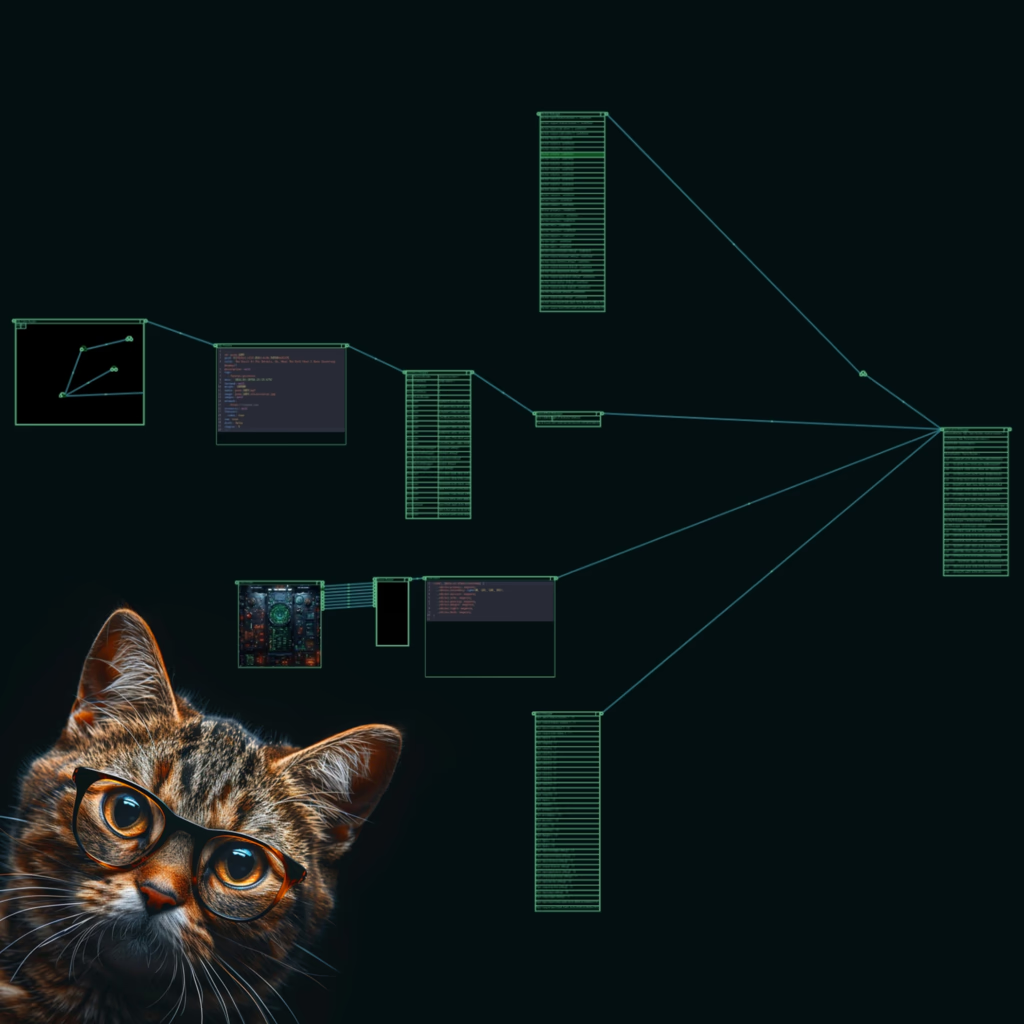
The author presents a visual programming environment that lets users connect “windows” on their desktop with wires to represent data flow, automatically generating code for the connected components. By treating UI designers, spreadsheets, database generators, and other tools as modular boxes that can be wired together, the system produces complete applications—ranging from photo‑capturing utilities to business process workflows—that can run in a web browser or as a desktop app. Inspired by HyperCard and forgotten desktop concepts, it aims to bring together UI building, code generation, and workflow management into one self‑generating program that will eventually be written entirely by itself.

·

#1488: How To Tell If Your School Is Fake

The post proposes an alternative school model in which students learn by working on real‑world projects—such as generative jewelry design, 3D printing, and AI‑aided book generation—and tutor each other while earning a modest amount of money to prove mastery; it argues that true learning occurs when subjects (geometry, music theory, programming) are merged into practical contexts rather than taught in isolated divisions, that a mesh network of tutors is needed for genuine mastery, and that software such as a wiki/MOO‑style platform could support this student‑driven, project‑based system.

·

#1487: The King Of Nordhouse

A quirky narrator recounts spending months off‑grid in Michigan’s woods, living simply, befriending a forest creature called Friday, and sharing hot‑dog buns while enjoying nature’s solitude.

·

#1486: Fitness Advice: Sets, Reps, And Proper Posture Is Not All That Great

The author argues that bodybuilding is essentially a weighted endurance sport, much like long‑distance jogging, and stresses the importance of starting with very light loads and gradually increasing weight while keeping rest to a minimum—continuous work rather than set‑and‑repetition routines that can create plateaus. Machines are criticized for isolating muscles; instead, free‑hand, dance‑style movements (shuffle dancing with dumbbells) combined with rhythmic music and careful monitoring of beat per minute help maintain fluid motion, prevent stiffness, and keep the workout engaging. The piece also notes that true progress comes from incremental load increases rather than large jumps, and that a well‑paced, continuous approach to lifting will rebuild muscle faster and more sustainably than traditional gym programs.

·

#1485: What Is Eating The World, And How To Fix It

The author argues that true nurturing begins with the right books and good education, which inspire humans to rise, invent, and explore. He claims that many leaders fail because they deny knowledge, burn or choose wrong texts, and that children’s first readings should depict humanity’s greatness rather than its flaws. Using examples such as racism being a product of mind poverty, medieval tales of love ending in death, and the misrepresentation of success as excess wealth, he shows how poor books shape young minds. He stresses that libraries are miracles but must be stocked with titles that portray human unity, culture convergence, and world peace. Ultimately, he believes that only by giving children correct narratives can we break cycles of war and create a super‑culture where all people become great beings.

·

#1484: Look Beyond, And Learn, And Rise

The post argues that standardized schooling often falls short of true learning because it relies on fixed curricula rather than personal curiosity; the writer suggests that following one’s own interests—starting even with seemingly whimsical topics like astrology or UFOs and letting them lead naturally into astronomy, astrophysics, sociology, psychology, philosophy, and adventure—creates a pathway to deeper knowledge. He stresses the value of books written by clear‑thinking intellectuals, especially narrated ones, as vessels of wisdom and culture that lift one from the “level zero” of pure fantasy to real mastery; speculative exercises are presented as useful imagination training while still grounded in facts. Finally he warns against tricksters and half‑baked works, urging a deliberate selection of quality texts so that one can grow steadily into a great being with shared wisdom.

·

#1483: Just Learn On Your Own

The author argues that modern schooling is a broken system where teachers act more like performers than true educators, draining students’ finances and offering only rote memorization, while real learning comes from self‑education through narrated books, arts, music, programming, and even founding an AI‑assisted school; by mastering these skills one can become a philosopher and leader of the “culture of great beings,” thereby fixing the system and achieving personal mastery.

·

#1482: Troublemakers, The Art Of Troublemaking, And How Does It All Affect You

The post presents “troublemaking” as an artistic, creative way to enrich life—showing how a simple snack recipe, a walking routine, and YouTube video series can inspire new ideas and motivate fitness.

·

#1481: Temples Of Solitude, And The Arrow Of Adventure

The post celebrates the idea that once you embark on an adventure there is no turning back—the journey moves forward in time, urging continual growth and elevation until you become a great being. It mixes playful imagery of meals with philosophical musings about temples of solitude and clarity, suggesting that true learning comes from stepping out of routine and into the world’s libraries where philosophy and science await; it contrasts the rat race of mere paperwork with the genuine quest for knowledge, wisdom, and greatness, urging the reader to keep moving forward rather than returning home.

·

#1480: For The Betterment Of The World; Or, Hiking, Camping, And The Library

Hiking and camping are presented as a simple yet powerful antidote to the overwork‑driven cycle that plagues modern life; by stepping away from the daily grind, one can breathe, read adventure books, listen to philosophers, and tap into the intellectual inheritance that fuels personal growth. The post argues that this outdoor reset restores stress relief, renews mind power, and frees us from poverty, indoctrination, and other self‑made traps. By taking care of our minds, learning and inventing, we can rise to greatness and change the world for better.

·

#1479: Don’t Let Silly Challenges Of Hiking And Camping Scare You Away From Greatness

The post explains how to begin a simple camping experience at home—setting up a small tent in the backyard or even a room, playing nature sounds, and adding comforts like a boom box, solar fan, inflatable pool, and a “bath tent” for showers; it notes practical tips such as using a black bag for warm water and toilet‐shaped devices to keep smells out of the woods, while also mentioning how to prepare for weather (e.g., thunder) and the need to choose sturdy spots. It then reflects on the benefits of camping: freeing the mind from city constraints, allowing time to absorb knowledge through books or narrated adventures, and fostering personal growth by learning from experience rather than just work—ultimately urging that starting small in a backyard tent can lead to deeper self‑responsibility and lifelong wisdom.

·

#1478: Is School Fake?

After experiencing the routine of school, the author argues that formal education relies on memorization and grades rather than true learning; teachers often perform only for paychecks, and tests are useless unless they reflect real understanding. He suggests that self‑driven learning—especially through programming as a practical test framework—allows students to verify what they’ve learned by building programs that embody concepts taught in class. By applying this method to subjects like cell biology or painting, learners can confirm whether the teacher’s explanations were complete. The post concludes with encouragement to pursue real education via programming (particularly JavaScript) and independent projects rather than rote schoolwork.

·

#1477: The Birds Are Camping Out In Ohio Again; Or, The Fifth Michigan Winter

Snow falls again over Michigan’s mitten-shaped state, bringing a 60‑degree drop that surprises everyone but leaves the author cheerfully counting winters. The weather brings more than snow—tiny flakes tumble from the sky, wind whips the world hazy—and the writer prepares for it: washing hoodies and hats, stocking gloves, feeding alley cats and squirrels with peanuts, while geese settle in lawns. Birds leave early as the cold deceives, and the radio reports a snow‑covered world, hinting that even the hardest storms will melt quickly; the second summer is soon to arrive, possibly coughing into the scene.

·

#1476: Hard Adventure; Or, A Workout Is The Worst Thing You Can Do

In the post the author opens with a brief visit to his doctor, comparing his own jogging routine to that of an older marathon runner and noting how heavy lifting feels like a compressed adventure. He then weaves in a critique of education and politics—claiming that schools merely cramp us into memorization while governments care only about GDP—and turns to the central idea: a workout is essentially a short‑form hike, a “backpack” of effort that simulates long trails in just an hour or two. He stresses that training is not a series of arbitrary sets but a deliberate, incremental process—starting light and gradually adding weight, pace, and distance—so that the body adapts and eventually can run marathons. The author urges readers to take their gym time seriously, for it keeps them fit for real challenges and prevents future regret. He concludes with an evocative image of becoming “a dumbbell ultra” and a great being who will never look back at mediocrity, reminding us that a workout is the hardest yet most rewarding thing one can do.

·

#1475: Meaningful Diet & Weight Loss

Walking and hiking are presented as the foundational workouts for anyone seeking to shape or transform their body, with optional light dumbbell exercises added only if one aims for a more muscular physique; the post lists several major trails—The Appalachian Trail, Pacific Crest Trail, and Continental Divide Trail—as ideal destinations that promise both physical change and lifestyle transformation. It argues that regular walking not only burns weight but also reduces stress and discomfort, while the accompanying adventure fuels appetite and keeps the mind engaged through narrated books and reflective thinking; finally it invites readers to immerse themselves in a culture of knowledge, wisdom, and greatness as they grow physically and mentally.

·

#1474: Train Before You Sign Up For The Gym

Start your fitness journey by walking—first at the gym, then in parks or state trails—to train your whole body, especially back and endurance. Once you’re comfortable, add light jogging on a soft surface, use a “couch‑to‑5K” plan to build stamina, and if needed, power walk or bike to strengthen legs and lungs. Gradually introduce small dumbbells (3 lb each hand, increasing to 5 lb as you feel ready) to reinforce back and arm strength. As your routine evolves—walking, jogging, biking, light weights—you’ll be prepared for a gym session that includes repeated lifts and muscle focus. Finally, transition into a gentle 1980s‑style dance aerobic workout with light dumbbells or wrist/vest weights; this blend of movement will gradually build strength, speed, and an athletic shape.

·

#1473: Michigan Weather Report 2024

The post recounts a bewildering stretch of Michigan weather that has seen multiple winters, springs, and finally the first true summer day, all within just a few months. The author notes their first mosquito bite on this sunny day—an odd event in a region where seasons seem to shift unpredictably—and jokes about being a “mosquito‑bite king” because they attract insects like bees. They describe birds chirping and frogs croaking as the summer begins, while noting that even local weather reporters seem confused by the erratic shifts. The author ends with a lighthearted note that their winter clothes are still on, reflecting the lingering uncertainty about what season will come next.

·

#1472: The Correct Posture For Lifting Is Dance; Or, Don’t Be Fooled By Bro Science

The post explains how to lift with your back by moving gently, shifting weight from one foot to the other like a dancer, using light dumbbells and music to create a “dance trance” that keeps you in motion for long periods without rest; it stresses starting easy (around five pounds), gradually extending workout duration or shortening rests over weeks, avoiding heavy lifts that lock back muscles and cause pain, and structuring exercises around fluid, continuous movement rather than isolated machine work.

·

#1471: How To Become A Genius

Listening to narrated books by the world’s clearest thinkers gives you a balanced, well‑balanced view of life—a “broad” genius that lets you see the big picture—while your own curiosity fuels a “sharp” genius focused on a specific field such as programming or protein engineering; this duality drives personal growth and self‑education beyond ordinary schooling, which the post argues is often about obedience rather than deep comprehension. The author stresses that true learning comes from countless lifetimes of wisdom captured in books, travel, and practical experimentation, and that mastering both the broad worldview and the sharp specialization lets you innovate, break rules, and ultimately earn the label of genius.

·

#1470: Advice For Trainers

Endurance training is presented as a method for beginners to build full‑body stamina by moving from simple walking to power‑walking with light dumbbells, then incorporating basic arm and shoulder lifts at low weights while keeping the workout continuous without rest periods. The routine begins with an hour of plain walking, progresses through power‑walking, and eventually introduces 3–5 lb dumbbells for biceps, lateral raises, curls, and overhead presses, all performed in a single sustained session. Music synchronization and interval timers are recommended to maintain rhythm, while the exercises are designed to involve all major muscle groups simultaneously so that each part grows evenly. The program stresses gradual weight increments, continuous movement, and consistent practice to achieve a lean, muscular physique without excessive fat.