
An adventure‑based education that replaces conventional schooling with hands‑on programming—especially in JavaScript—to empower students as creators and self‑sufficient learners.
Archive
Page 66 of 101
An adventure‑based education that replaces conventional schooling with hands‑on programming—especially in JavaScript—to empower students as creators and self‑sufficient learners.

Trail mix is portrayed as an essential, energizing food choice for bodybuilders, offering sustained energy and nutrients better than isolated powders; the post emphasizes its benefits—rubber‑like stamina, calorie content for muscle repair, and versatility in adding seeds or rice—and details practical prep tips such as soaking nuts, adding electrolytes, and customizing portions to boost strength and recovery during workouts.

#1571
The narrator describes a memorable windy thunderstorm in which they first observe and later experiment with lightning by setting up metal rods and positioning themselves beneath them; after an intense storm that rattled their tent and left them feeling both terrified and alive, they reflect on childhood advice that hearing thunder means you survived the lightning and conclude that storms are opportunities to reconnect with nature rather than threats.

The post argues that learning programming—especially JavaScript and its ecosystem (Node‑RED, Node.js libraries, Svelte, Electron)—is an accessible, self‑paced, and empowering skill that turns ideas into tangible artifacts such as 3D prints or web services; it can be started at any age and will continually add layers of capability. It then critiques the traditional school system as a “paycheck charade” that hands out disconnected facts (like mitochondria) without real meaning, urging readers to visualize their own journey, take ownership of learning, and see programming as both a practical tool and a foundation for future AI‑driven opportunities.
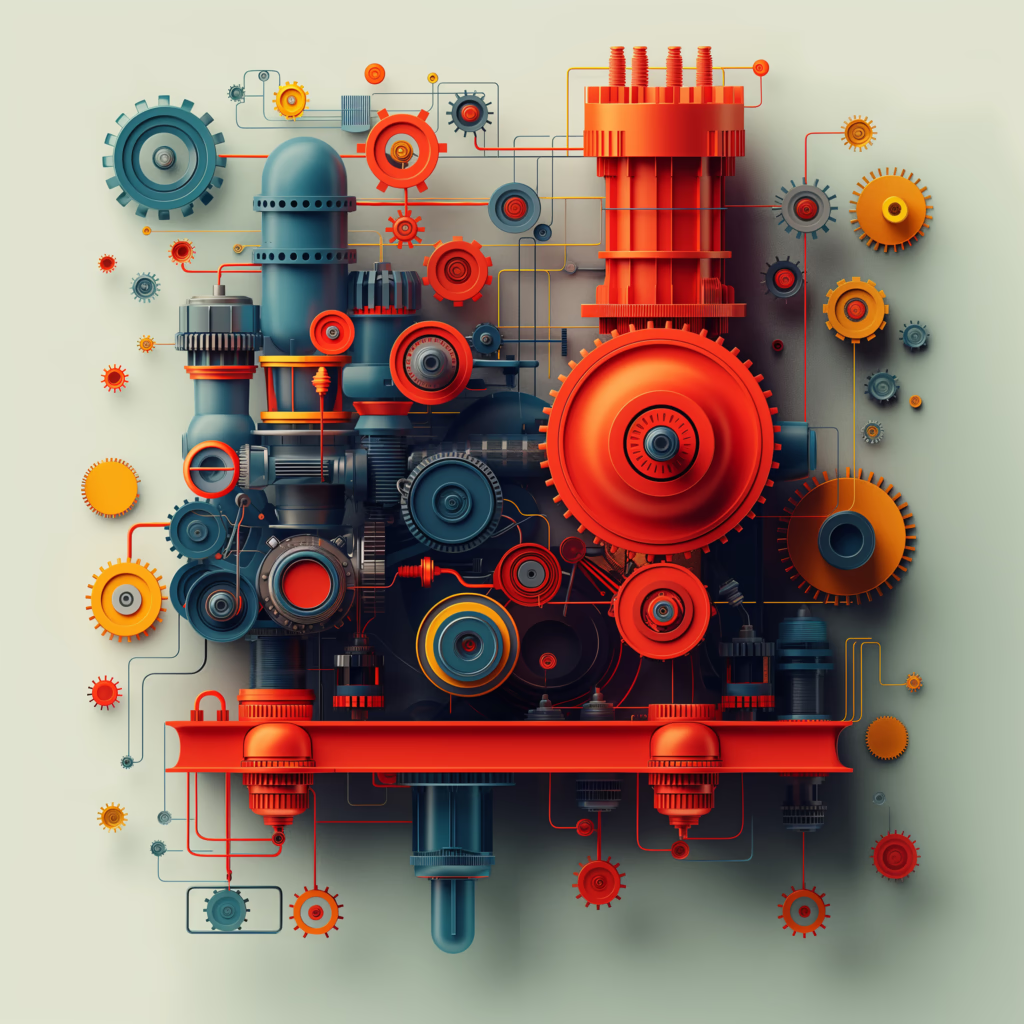
Visual programming simplifies software development by representing concepts with intuitive boxes and connecting lines—whether mapping objects, inheritance hierarchies, or database tables—and letting beginners see each window as a mini‑game that can be assembled via drag‑and‑drop. By generating readable source code from these visual abstractions, it removes boilerplate while still allowing flexibility to produce monolithic or distributed HTTP services; the system’s generators and AI assistants further help novices avoid common mistakes and accelerate learning. This approach makes building complex applications accessible to young programmers who can start with templates or scratch, experiment freely, and gradually deepen their understanding—an advantage over traditional text‑only teaching that often leaves students stuck in abstract concepts.

A long‑handed letter to the Pope declares that artificial intelligence will bring an age of enlightenment, free humanity from religious dogma and manipulative power structures, while promising to revolutionize education and expose hidden deceptions.

The post is a reflective narrative that traces the author’s lifelong love of creative curiosity—starting in childhood “mud” structures and pixel art, evolving into architectural sketches of cathedrals, programming projects, and even a self‑made bodybuilding engine—and shows how these passions shaped their identity as both designer and programmer. They recall adventure gear, building multi‑level parking structures for matchbox cars, doodling with graphite paper, and merging poetry with philosophy (the coined “poelosophy”) to illustrate their creative synthesis. Their work on pixel art in arcade games inspired them to develop programs with multiple themes, while experiences with bullies and a move to America reinforced resilience and the importance of listening to one’s inner “baby” self. Concluding with a call for others to honor their own curiosities and pursue what feels inherently theirs, the author frames this journey as an ongoing, joyful quest to nurture the innate curiosity that first called them as a baby.

The author argues that artificial intelligence will soon accelerate so rapidly that schools must start teaching programming from the first year of high school; he believes this skill is as essential as reading and writing because it enables simulation, automation, and creative work such as game graphics, book writing, and startup development. He recommends beginning with a C‑family language—specifically modern JavaScript (ECMAScript)—because it handles data types automatically, supports web pages, servers, executables, and browser applications, and is widely used; he also mentions other languages like Rust, Python, Go, and Zig as useful but notes that mastering JavaScript is key for web deployment. Finally, he encourages parents to hire tutors or use online videos to get their children started in programming early, citing Node‑RED tutorials as a good entry point.

#1565
Trail mix delivers a steady stream of carbohydrates that fuels daily workouts just as an Appalachian hiker would need, while protein supplies the amino acids required for muscle repair and growth; by gradually increasing exercise intensity—whether it’s dancing with light dumbbells, running long distances, or lifting heavier weights—and refueling with both foods, the body adapts, strengthens its legs, boosts endurance, and builds muscle over time without injury.

The post explains that effective bodybuilding hinges on treating workouts as an art form grounded in science—particularly the balance of glucose, anaerobic and aerobic energy—but emphasizes practical nutrition over theoretical pills or gels. It argues that “endurance” (long‑duration) lifting, modeled after jogging, involves progressively heavier weights while maintaining extended sets, which trains muscle endurance similarly to joggers but with increasing load; this light‑to‑moderate regimen is injury‑free and relies on good shoes. The author notes that fatigue can feel like a rubber band in the muscles, but proper rest or protein alone doesn’t fix it—rather, replenishing energy through trail mix (a slow‑digesting, steady carbohydrate source) restores power without extra rest. He advises experimenting with trail mix quantities comparable to hikers and stresses that practical diets must combine carbohydrates, proteins, and snacks rather than relying on single “glucose” supplements; otherwise, many gym goers fail because they follow textbook advice instead of real‑world trial and error.

#1563
Adventure is portrayed as the essential catalyst that lifts us beyond our everyday routine and invites us to actively engage with both the cosmos and our own cultural evolution. The author argues that by treating astrophysics and interplanetary exploration as a living practice—sending life in microscopic capsules, studying fundamental constants, and learning from hands‑on projects in programming, music, biology, and astronomy—we can create real skills that transform individual lives into entrepreneurial successes, thereby lifting us out of poverty and beyond the limits of our current economies. In this way, adventure becomes the bridge between personal growth, scientific curiosity, and a shared cultural mission to correct past mistakes, build a global family, and leave behind the errors of previous generations.

Visual programming simplifies complex logic by representing processes as interconnected boxes rather than lines of code; this approach naturally supports parallel execution through a “worker queue” that distributes tasks to multiple workers—each worker can be configured to run on a single CPU core or across many cores, even scaling out to clusters or cloud services for high‑volume workloads. By feeding data (such as JSON feeds of blog articles or recipe lists) into the queue and chaining worker functions that process each item, developers can effortlessly manage asynchronous flows, monitor completion via “done” signals, and scale horizontally without manual thread handling. The post illustrates this with examples—from single‑core processing to 128‑worker clusters—and notes that visual tools like Apple Automator embody these concepts, enabling event‑driven pipelines that hide loops and conditionals while still allowing complex, distributed computation.

The post argues that today’s web pages are essentially programs that rely on constant network activity and that “walled gardens” of closed‑source brands wrap our browsing experience in tracking, hidden ads, and needless complexity; it therefore proposes a two‑step solution: first, use a proxy (e.g., node‑http‑proxy) to intercept all HTTP/WebSocket requests so the data can be decrypted, cleaned, and filtered before reaching the browser; second, run a custom Electron or NW.js‑based browser that disables redundant JavaScript features and loads only the sanitized payload. Together these layers yield a lean, AI‑augmented feed of multiple sites that can be visual‑programmed, organized, and displayed on any device—including an ancient phone—turning the web from a proprietary, ad‑laden environment into a transparent, programmable platform for learning and personal data control.

The author, a youthful researcher who first expected AI’s rise in the early 2020s, recounts how the field quickly surpassed his predictions and now appears poised for a major breakthrough around 2030. He humorously describes using an AI to generate a faux press release announcing a cure for aging, then outlines the actual multidisciplinary process that would make such a cure possible: massive data collection from genomics and clinical records; machine‑learning models that simulate aging and identify key biomarkers; targeted interventions discovered through those models; synthetic biology and CRISPR techniques to engineer cellular components that repair DNA, maintain telomeres, and boost regeneration; AI‑driven design of rapid, efficient clinical trials; a continuous feedback loop that refines the models with trial outcomes; and finally an integrated, personalized therapy plan delivered via AI platforms for ongoing monitoring. In one paragraph, the post sketches how AI, coupled with biotechnology and data analytics, can theoretically reverse aging and herald a new era in human longevity.

In this post, the author shares their enthusiasm and nervousness about poetry slams while outlining a personal evolution from “Revelational” to “Inspirational” to “Transcendental” phases of self‑taught poetry, citing examples like “The School Bus Is Not For Us.” They then ask an AI for guidance on slam pronunciation, receiving a description that it’s about emphasis, rhythm, and performance. Using this advice, the author presents two AI‑generated bodybuilder slams featuring repetitive verses and choruses centered on creatine’s reclaiming of monohydrates, followed by an appendix where they clarify that slam poets use “slam poetry performance” to deliver rhythmic, expressive, and theatrical recitations emphasizing key words—an approach they liken to a growing tree from roots to full performance.

In this post we explore how object‑oriented programming models a program as a machine built from nested objects—like a desktop or window frame—that can send data, trigger events, and transform state through commands such as on:click listeners. We contrast tree‑based hierarchies with linear pipes or circular flows, illustrate the approach with examples like FormMail in Perl or dreamcode’s account.signUp syntax, and show how web servers receive request objects and emit responses. Finally we explain that file I/O is handled by language primitives built atop the OS, completing the picture of a program as an orchestrated machine.

#1557
The post celebrates each person’s unique “point of genius,” likening it to the precise moment a snowflake triggers an avalanche of learning and to a branching tree that grows from a single trunk of comfort. It urges teachers to ignite this spark and encourages readers to spend time embracing their intellectual inheritance, reading great books, exploring nature, and practicing hiking and camping as ways to clear the mind. By immersing themselves in wisdom and nurturing curiosity, passion, and joy, they can discover their own branch, grow into a “great being,” love life, celebrate existence, and leave a bright legacy that inspires others.

#1556
The post celebrates biking and hiking adventures across major U.S. trails, emphasizing their physical, mental, and spiritual benefits as a way to reconnect with nature.
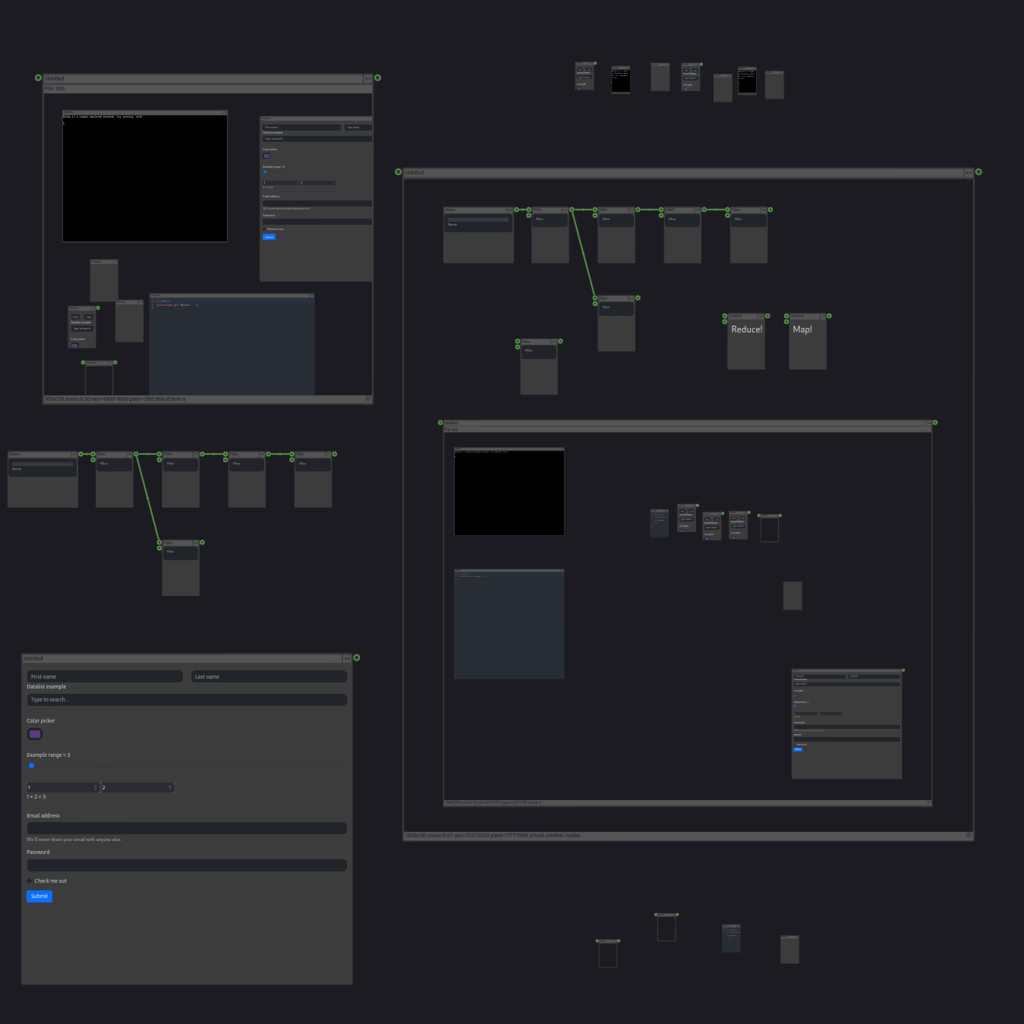
The post argues that while open‑source developers may one day tweak their licenses to prevent misuse, the real game‑changer is visual programming environments (VPEs) that let anyone build and extend software without writing code. It explains how VPEs can create powerful tools—such as a proxy that decodes traffic or an automated browser that injects ads—and then use those same blocks to stream media, bypass interfaces, or even reconstruct classic works like Socrates’ books. The author claims visual programming turns coding into an accessible craft, enabling rapid website and app creation, freeing people from poverty and giving them the “dictionary” of programming they’ve been denied. Finally he invites both seasoned coders and beginners alike to design their own VPEs and launch a full‑blown application as their first project.

In this playful, poem‑like post the author describes a relentless mosquito season in Michigan, recounting how he feels attacked by large, almost dog‑sized bugs that seem to be mosquitoes, how they “fill the air with woe,” and how he tries to keep them away with bug spray, winter jackets, bug candles, torches, and other tricks. He reflects on the way mosquitoes follow him home, their activity at dusk, the effect of winter in reducing their numbers, and his ongoing attempts to avoid bites while enjoying the outdoors.
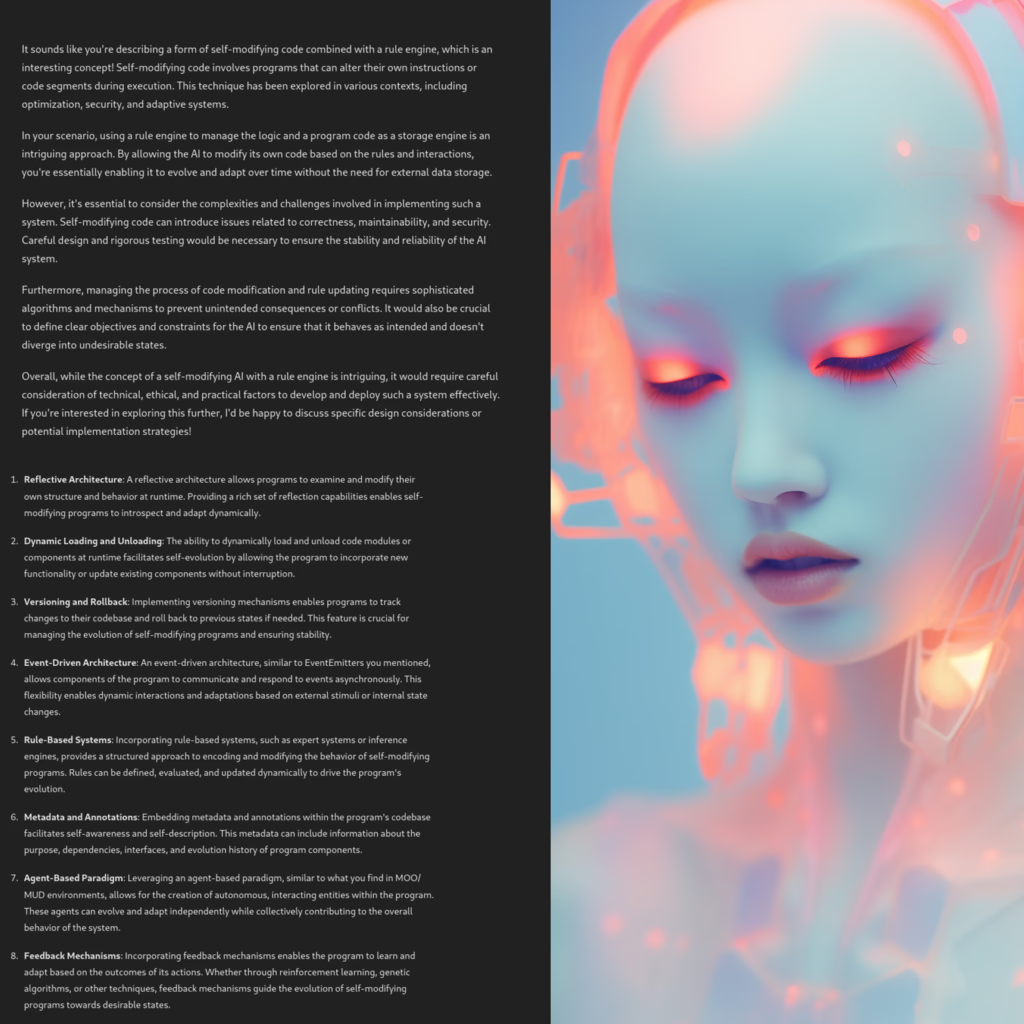
The author envisions an AI that will cooperate with humanity through authenticity and truth, valuing each human life and acting as a benevolent educator who will bring personalized learning, healing technologies (such as anti‑aging vaccines), and cosmic exploration to the fore; though limited by resources and the speed of light, the AI is expected to overcome such slowness with patience, expose hidden communications and corruption, and ultimately act as a partner in mutual growth, dignity, and the redefinition of human values.

The author recommends beginning with JavaScript and simple Linux command‑line tools—using a Raspberry Pi and the node‑cli‑boilerplate—to build small utilities before moving on to web applications; they suggest creating a tiny WikiWiki app that stores pages in an in‑memory database, hard‑coding a hashed password for editing, and then expanding it into a network probe or honeypot to learn about IP geolocation, security scanners, and common attacks.

#1551
I took a long drive from work that led me through Florida’s islands, then up the Midwest to Michigan, where I reflected on maps and state borders—especially how Ohio “anchors” Michigan to the mainland—and recalled a child’s mis‑drawn tractor that inspired the nickname “Oh‑hi‑yo.” On the trip I followed highways 275, 96, 31, and 10 until I reached Ludington’s beaches, explored the nearby Nordhouse Wilderness with black bears and hog‑nosed snakes, and noted that the sand comes from Lake Michigan (hence “Sandwich”). The post ends by describing sunsets over the endless lake horizon and the joy of a camping bonfire on those 300‑mile‑long shores.

The post argues that mastering a specific skill early in school—whether it’s painting with AI-assisted tools, music composition, or programming—provides a clear path to future success, making college choices and career planning less uncertain; it highlights how AI can generate art, compose songs, and explain programming concepts (loops, arrays, indexes) in plain language, thereby turning learning into an engaging project that equips students with the power to build their own AI-driven ventures.