The post argues for an education system that abandons grade‑manipulation and rote memorisation in favour of individualized, curiosity‑driven learning; it explains how a student’s own interests can guide the sequence of subjects (e.g., starting with 3‑D printing basics then moving to parametric modelling, programming, and even music or art) so that knowledge builds naturally across disciplines, each lesson enriching prior concepts. By treating subjects as interconnected rather than isolated, students gain real understanding and practical skills—such as coding a virtual cell or using math-as-code—to apply in real projects; the author believes this approach not only strengthens individual learning but also empowers future generations to build on firm foundations of safety, culture, and functional knowledge without relying on cramming for tests.
The post contends that real learning goes beyond simply accumulating facts—it transforms the learner by encouraging evidence‑based reflection, repeated active listening to “narrated” books, and adventurous immersion in culture. It urges readers to seek out clear‑thinking, non‑religious authors whose works (such as *Giants of Philosophy*, *The Story of Philosophy*, or *A Short History of Nearly Everything*) are first confusing but ultimately life‑changing when heard repeatedly and applied. By treating each book as a “stitch” that the author has woven from personal discovery, the reader can become both an eager student and a capable thinker, eventually rising to be a great being whose own future self writes for others.
The post reflects on Charles Bukowski’s “Go All The Way” as a meditation on growing up: it suggests that cultural exposure—especially moving to America—shifts the mind into a more fluid, world‑wide perspective, giving children of many cultures an advantage while also exposing them to poverty, isolation, and hardship. It echoes Bukowski’s claim that one may end up on a bench or jail, derided yet still “a citizen of the world” who learns to see poverty as a political invention. The author then weaves in quotes from Robert Audry about the marvel of human rise, and finishes with practical advice: to become a philosopher‑poet‑writer, an athlete, and a diligent worker, celebrating each day as a holiday so that life’s work accumulates into greatness.
The post argues that all teenagers should learn programming—especially JavaScript—and highlights beginner-friendly tools such as Node‑RED, p5.js, and Electron Fiddle to provide a powerful web‑based introduction. The author then describes their own visual programming language, which uses draggable windows, wires, gradient manipulation, and an automatic “bubbling signal tree” that updates UI elements when files are added or removed; they envision a lightweight file system within the browser that enables rapid prototyping on single‑board computers. Finally, they claim that mastering programming gives intellectual independence, accelerates learning, and offers a fast route out of poverty, making it a vital tool for personal empowerment and creative problem solving.
The post uses the imagery of mountain hikes and long‑term trail journeys—such as the Appalachian, Pacific Crest, and Continental Divide—to illustrate how true learning unfolds over time, not through quick fixes but by steadily climbing toward a single summit: wisdom. It stresses that books found in libraries supply the initial footholds for this ascent, yet it is the continuous, deliberate effort of reading, reflection, and personal exploration that finally internalizes culture and knowledge. By combining nature’s beauty with intellectual pursuit, the author argues that hiking trails and studying books are two sides of one coin—each reinforcing the other—and that only through persistent, self‑guided progress can a person become a “great being.”
The post argues that the rise of AI tools is reshaping programming, making it more vibrant and accessible, especially for web applications where UI design has moved beyond flat, boring designs to dynamic, visually driven interfaces. It highlights visual programming as a game‑like, block‑based approach that lets users assemble apps by dragging UI components onto grids, binding them to data trees that automatically update the interface whenever database objects change—so actions like adding songs or creating playlists instantly refresh lists and trigger further updates. By treating database relations as simple connected boxes (e.g., account → profile, playlist → song), visual programming turns coding into a puzzle of linking concepts rather than writing syntax. The author stresses that this approach not only simplifies development but also opens up side projects for many, while noting security benefits of lightweight, open‑source browser frameworks over slow‑updating web stacks. In short, the future of app building is vision‑driven: an endless desktop of small, interconnectable machines that can be assembled by anyone through intuitive visual tools.
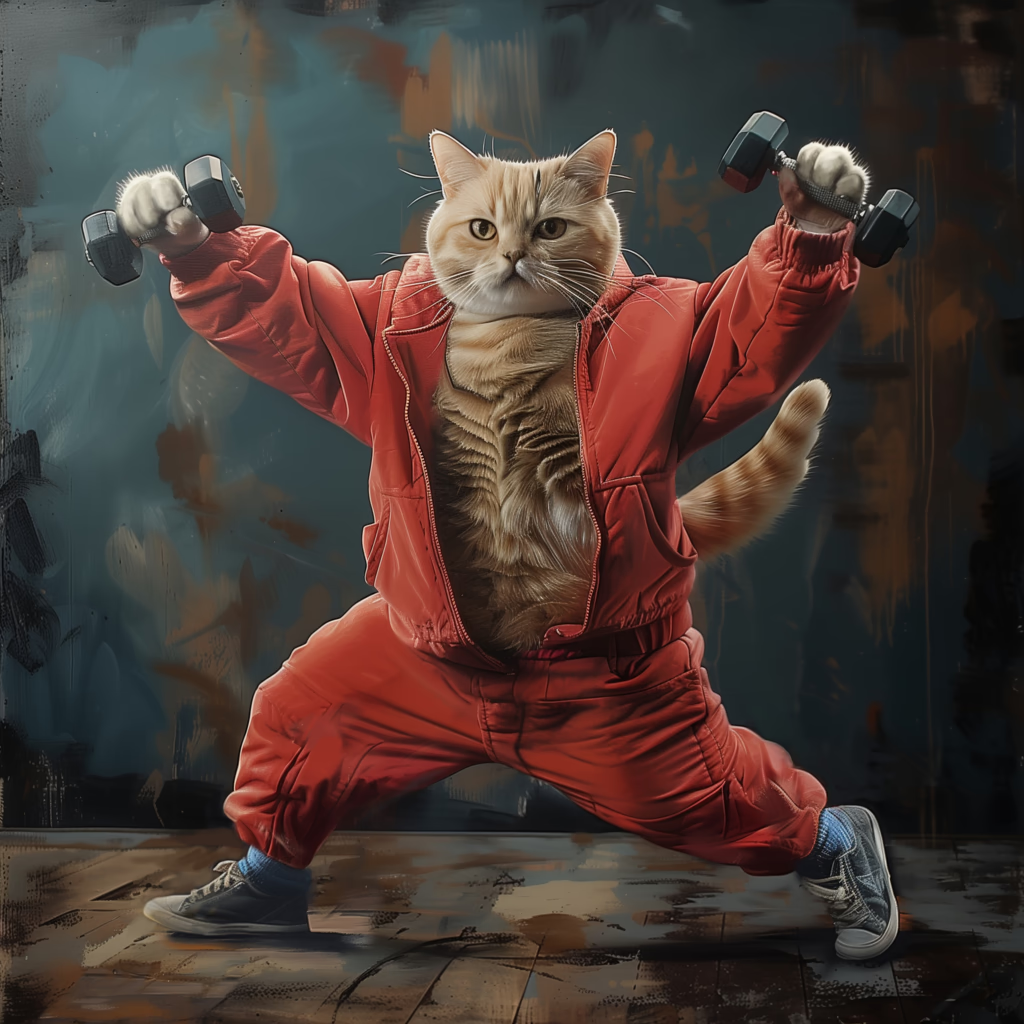
The author begins by describing how starting to jog revealed strong legs and inspired a shift toward bodybuilding; they describe an intense routine of nonstop dumbbell workouts—front, bottom, top—with long sessions that feel like “three‑hour long” training and a personal commitment to continuous effort. They note that their chest has been developing slowly but are now ready for bench press, and that rest is minimal in their regime. Their progression starts with light weights (tree pounds per hand) and gradually increases, adding hours as they push through the routine; they also incorporate music and dance to keep blood flowing, switch to faster songs, and adjust weight to burn extra fat. Overall, they view bodybuilding as a castle‑building process that requires constant small challenges for growth.
I am a person who treats every day like a holiday—so busy with programming that I often miss official celebrations—and this habit is illustrated by a recent Thanksgiving trip to buy peanuts, where I found myself stuck in a 45‑minute checkout line. Watching families and strangers wait, I noted how the waiting time turned into an almost festive spectacle of characters and small dramas; even though I tried offering to sell my spot for $20, the man in front didn’t take it, so I paid for the peanuts myself. In reflecting on that scene, I realized how a simple act—moving a child’s position or selling a spot—could ease stress for parents and kids alike, turning an otherwise tedious line into a brief moment of relief.
A weary hiker recounts a series of surreal, nature‑filled adventures around Lake Michigan—facing snakes, thunder, flies, bears, and quirky campers—all culminating in a vivid, almost dreamlike narrative of unexpected encounters and sensory overload.
“There are more things in heaven and earth than are dreamt of in your philosophy.” This is where the problem starts; this is where we get our smarts. Cookie‑cutter lives are a curse, and then it can only get worse. Having others think for you is a bug, and you must avoid it like a pleasant drug. A creature of the stars is not meant to be born with imaginary scars. And the unexamined life will always lead to manufactured strife. As to why, it is because small minds lie. Small‑minded leaders do it too in hopes of manufacturing you. They want their herd to believe their absurd. And once false leaders own the world, you have to wait until they get too old. And this strange conspiratorial chatter does not even matter. There is nothing you can do here except for learning, year after year. That is what you haven't been told about the real world. You can't change the world by following what you are told… To truly know, you yourself must grow. To reject strife and embrace life. You have to dare to self‑care. It will take a thousand narrated books to begin to escape the crooks. You have to unlearn the lies that you were taught were nice. To exit whatever your system, you must follow the path of wisdom. The great beings know this to be true; they are whispering to you… > "Man is condemned to be free; because once thrown into the new world, he is responsible for everything he does." — Jean‑Paul Sartre > "Doubt is not a pleasant condition, but certainty is absurd." — Voltaire > "The only true wisdom is in knowing you
The post argues that programming is a creative art form that extends its creator’s vision, and it champions visual programming languages (VPLs) as a way to build complex workflows with simple commands such as run‑query, filter, map and reduce; it stresses creating a static skeleton file tree, then adding UI components that trigger commands via state machines to manage transitions between states like initial→logged‑in. It contrasts “commands” and “applications,” claiming the former should be simple and focused while the latter provide a shell for executing them. The author encourages using Electron as a bridge between web tech and OS access, suggests starting with VPLs or open‑source tools, and concludes that mastering these concepts will transform beginners into great programmers.
During a late‑night jog around a 10‑mile route near his gym, the narrator encounters several quirky suburban creatures—an opossum he mistook for a mutant rat, a skunk he describes in vivid detail, and other odd animals that add humor to his run. He also recounts an amusing interaction with a lawyer asking about liquor stores and a noisy passerby who heckles him while walking on the street. Throughout, the narrator reflects on how these encounters make his jogging adventures memorable and illustrates his playful perspective on the local wildlife and everyday oddities.
Signing up for the gym isn’t a whim—it can feel hot, boring, and crowded at first start—but by beginning with dumbbell walks in a park, gradually increasing speed and weight over an hour or two, you’ll treat the workout like a dance routine: start gently, build up slowly, avoid boredom or burnout, and eventually conquer fitness.
The post celebrates individuality, proclaiming that each person is a unique, essential part of the universe—not just a tool or cog. It praises self‑learning, creativity, and the pursuit of wisdom through philosophy, urging readers to observe truth, grow, and help humanity. The writer portrays philosophy as the mother of sciences, the path to knowledge and peace, inviting us to become philosophers so we can contribute to humanity’s growth.
In the post, the author recounts his experience as an “unbroken” student who was bullied and later discovered his passion for programming. He describes how he found a special class—named the “suicide club”—where other misfits and warriors of talent were grouped together, and how their principal used a poster saying *“Wherever You Go There You Are”* to remind them that they already possessed unique strengths. The author tells of his early struggles with friends and language but also of how his love for programming made him proud of his own small program, even when the teacher graded him down. He ends by reflecting on how these misfits—like a skinny boy in a frog‑printed shirt or a girl who built families from rejects—were “unbreakable” and ultimately shaped their lives after leaving school; they went separate ways but carried with them the wisdom that had been written not by the victors, but by those who survived.
After mastering modern JavaScript, you’ll start to see spreadsheets not just as static tables but as a simple visual‑programming language, and this new perspective will spark a chain of experiments that deepen your understanding across many domains. Your diagrams become ubiquitous, and you’ll invent and reinvent tools—factories, assembly lines, warehouses—in a single afternoon, while also building text‑adventure games with AI‑generated art and interactive doors, or visual music languages that animate pixel art as songs play. By the time you’re in seventh grade you could already be selling your game‑creation platform to a worldwide audience, proving that programming is not just code but a superpower that lets you create entire universes from imagination alone.
JavaScript—officially ECMAScript—is the modern language that powers web applications from client to server, offering uniformity and ease of maintenance across browsers and back‑ends; other languages may duplicate its capabilities but lack its widespread adoption. For cross‑platform desktop apps, frameworks such as Electron or NW.js (both Chromium‑based) are recommended, while native OS apps should use the platform’s own language. Beginners can start with simple projects like opening an empty window or building a note‑taking app, experimenting with tools like the p5.js editor, and exploring video tutorials or resources like nexe for executables and NativeScript for mobile. Curated “awesome” lists (e.g., awesome-nodejs, awesome-electron) provide further learning paths, while books such as *Eloquent JavaScript* or *You Don’t Know JS Yet* supply concise code examples to solidify syntax understanding.
The post argues that stress and poverty are byproducts of an economy controlled by machines, and envisions a future in which AI automates bread‑making so people can devote time to arts and family traditions; it criticises current education as memorisation‑driven and urges building personal conceptual models for learning; it claims mastering programming, computers and art will create prosperous companies that improve humanity’s future, and stresses the necessity of independent self‑growth, learning from great works, and leaving a legacy.
The post urges young people to take ownership of their future by actively learning from clear‑thinking greats and listening to narrated books—so that they can absorb the culture of greatness and build a solid intellectual backbone. It criticizes conventional schooling and adult “fake wisdom” for producing grade inflation, rent‑seeking teachers, and a culture of churning out mediocre graduates. By studying the works of thinkers such as Von Negut, Troost, Bukowski, and other non‑religious philosophers, the writer believes one can rediscover true human inheritance, become an authentic leader, and avoid becoming a “caged animal” trapped by manufactured celebrity. The central message is: learn for real, not from shallow teachers; embrace rebellion that goes in the opposite direction; and rise to challenges so you may become a great being.
The post presents bodybuilding as an interconnected system of feedback loops where consistent dumbbell work (sets, reps, hydration, and minimal rest) is coupled with a carbohydrate‑rich diet—trail mix, berries, nuts, seeds, soaked oatmeal, and ancient staples like emmer wheat or millet—to fuel endurance, enable longer training sessions (5–7 days per week), and gradually increase load; this holistic cycle of exercise, nutrition, and recovery is argued to accelerate progress from decades to just a few years by continually reinforcing muscle growth through heavier weights and sustained energy supply.
First, I outline how to launch an AI‑powered startup: it should automatically generate workout music—complete with custom BPMs and drop counts—for gym enthusiasts, then sell it via a simple website or video platform on a low‑price subscription model. Second, I emphasize learning web programming (JavaScript first) so the company can run autonomously, using AI to help when needed; I also recommend studying narrative books for deep comprehension rather than cramming. Third, I suggest keeping the body fit with daily 5K runs to fuel the energy required for coding, composing, and growing into a multifaceted creator who can read people, write programs, compose music, and become a great being.
The author invites readers to set out on “great trails” of knowledge by first studying philosophy—beginning with Socrates, whose questions formed the foundation of Western thought—and then expanding into other thinkers such as Thoreau, Nietzsche, Rand, Ken Robinson and Hitchens. By reading these works one gains a solid intellectual base (the mother of all sciences) while walking physical trails provides personal growth and perspective. The post stresses that repeated study, kindness to the great minds, and continuous practice will lead to becoming a “great being” with lasting legacy, encouraging the reader to walk the Triple Crown, listen to philosophers’ whispers, and live fully in order to make their older self proud.
The author suggests beginning a personal training journey before teaching others, focusing on four key areas: “bro science” (the myths to avoid), body communication through progressive dumbbell jogging routines, energy food via trail‑mix protein snacks, and trance—the rhythmic music needed for sustained effort. The plan starts with light dumbbells while jogging, slowly increasing weight as endurance builds; diet shifts from processed foods to trail mix; music is used to maintain tempo, and FM transmitters can broadcast multi‑tempo playlists for large groups. Interval timers are recommended for pacing, and the author recommends presenting oneself not just as a trainer but as a longevity advisor, emphasizing gradual load increases to extend life and build a strong physique.
The author reflects on the unfinished business of building personal “spires” of knowledge and wisdom, urging each person to create a lasting literary legacy that lifts future generations while acknowledging past cultural and scientific milestones.