·

#1469: Muscles Grow In Proportion To Your Endurance

The author describes a workout that combines continuous 1980s-style aerobic dance with progressively heavier dumbbells, arguing that this style mirrors how joggers adapt—initially breathless but gradually reducing rest until they can complete their route. They claim that adding too much weight (like gym-goers) hinders performance and muscle growth, while moderate increments allow gradual build-up. The piece contrasts isolated machine work with full-body movement, noting that dancing with dumbbells engages all muscles and balances the load, preventing back strain. By starting light (5–10 lb per hand), steadily increasing weight, and extending the duration of movement to 2–3 hours, one can achieve continuous exercise without fatigue or injury. The author concludes that mastering dance moves, endurance, and gradual weight progression yields long-term bodybuilding rather than brief gains.

·

#1468: How To Structure Your Computer Programs And Clearly Communicate Their Internal Architecture

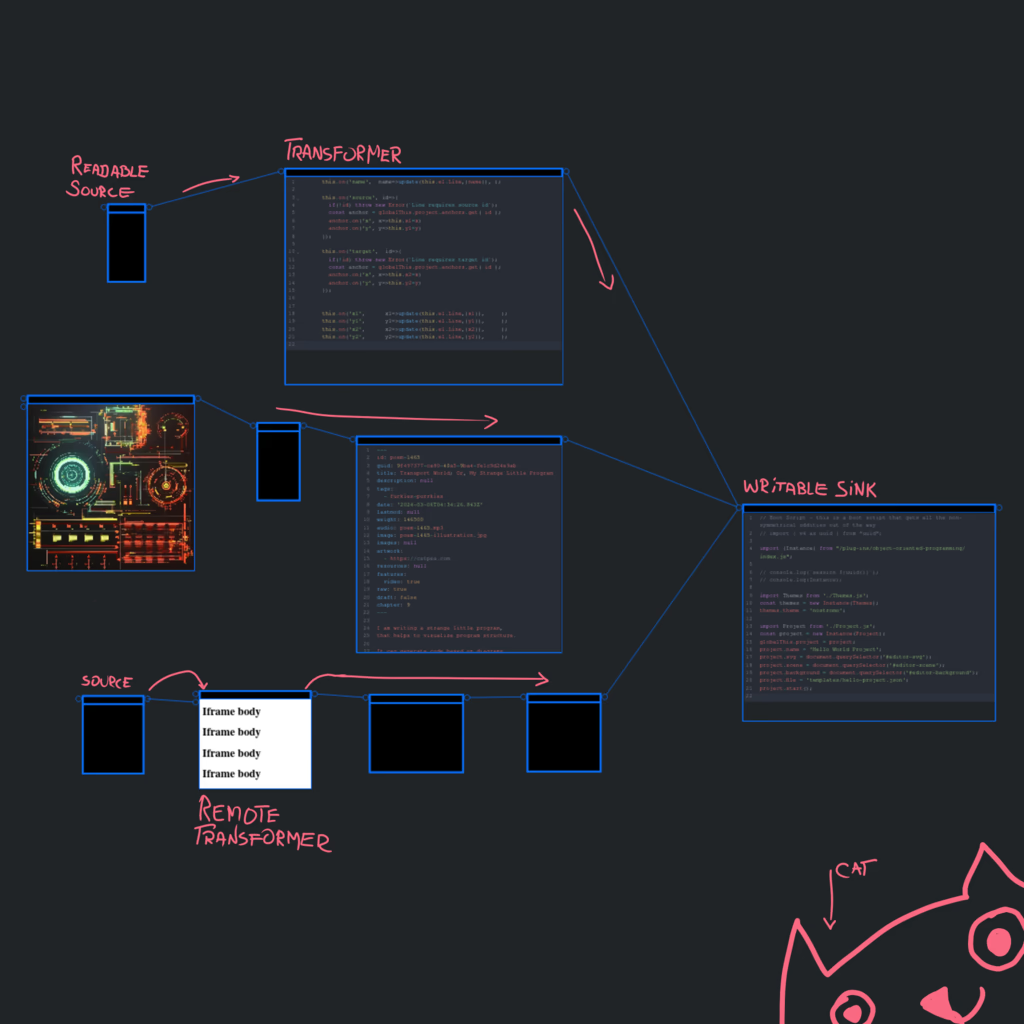
In this post the author argues that a visual‑programming language can be cleanly engineered by treating its artifacts as a “virtual file system” rather than as ordinary data objects: every component is a virtual file that knows how to materialise itself into an object, buffer or string; services and windows are just higher‑level composites of these files. By arranging the generated files in a hierarchical virtual FS and finally packaging them into a ZIP, the VPL can be deployed from the browser without server round‑trips, while still allowing other tools (AI logo generators, 3D editors) to inject their outputs as ordinary files. The resulting architecture is therefore declarative, compositional and platform‑agnostic: visual blocks become files, file trees become services, and the whole system can be understood by anyone who knows how to read a filesystem—an abstraction that unifies programming, UI design and deployment into one coherent model.

·

#1467: 236 Days Until Halloween

In the early 1990s I was hunting for interesting TV shows on my limited local channels, stumbling across both official and bootleg stations from German, British, and Czech broadcasters—shows like a Musketeer series and Roseanne Barr’s appearances kept me hooked. After skipping school to dodge bullies and learning about American traditions while watching those programs, I discovered Halloween’s importance, which inspired me to adopt an “American boy” persona: I worked as a programmer in the U.S., wore a Blues Brothers suit, and began crafting elaborate tail costumes for the holiday. Over years of practice I built rigs to hold my tail, perfected the costume, and finally felt like a true American. The post ends by urging others to start preparing their own spirit‑animal‑inspired outfits well before Halloween.

·

#1466: The Corned Beef House

I dropped out of my high school after encountering bad adults, but was picked up by an adult education program where the principal welcomed me warmly. I found myself busy and unfocused on making friends, yet I still sought meaning in everyday moments—eating at a local Corned Beef House while discussing laws, religions, UFOs, and X‑Files with regular patrons. The conversation sparked philosophical musings about time, choices, and self‑education, prompting me to pursue university and travel through restaurants, coffee shops, neighborhoods, towns, and continents to find my own “Corned Beef House” of knowledge. I believe that speaking out against lies and manipulating ideas, embracing adventures like the Triple Crown or other trails, will ground me in reality, elevate my culture, and help humanity grow intellectually beyond its current stagnant lattice.

·

#1465: Never Been Bored; Or, A Walk In The Park With My Strange Little Program

I’ve built a compact, custom‑OOP style program that lets me visualize and generate code from diagrams—integrating with code editors and even external sites—and now I’m expanding it by leveraging the WebStreams API so data can be streamed and transformed on the fly (e.g., converting video frames to black‑and‑white without loading everything into memory). The goal is a flexible visual programming language that connects stream transformers, processes user input (like form submissions), and ties reusable library code together in a small, predictable base; having coded for years, I find the simplest, most compact programs the most powerful.

·

#1464: Bodybuilding Simplified

The post outlines a simple standing dumbbell routine that mixes lateral raises, curls and overhead presses into short intervals of work and rest, using an interval timer to structure the workout. Starting with light 3–5‑lb weights, you record how long you can lift before fatigue sets in, then set that duration as your exercise time and match it with a calculated rest period; gradually extend the work phase and shorten the rest each week until you reach a 30‑minute session (and eventually 45–60 minutes). The writer emphasizes tracking progress, adjusting weight when ready, staying hydrated and monitoring nutrition, while noting that walking long trails can replace gym sessions if desired.

·

#1463: How To Become Smarter

The post argues that many people fall into a routine‑driven slump where loneliness, stress and overwork dull their minds, making them feel unintelligent even though they’re capable. It suggests that this “slow‑down” is simply the body’s alarm and can be reset by taking deliberate breaks—pausing work, journaling for a few days, and then shifting focus to physical activity and creative pursuits such as trail guiding and learning programming. By combining outdoor adventure with philosophical reading (from classic thinkers to contemporary writers), one can “repair” both body and mind, re‑ignite color in life, and ultimately build a personal legacy that moves beyond the old work‑centric routine.

·

#1462: Bodybuilder vs. Jogger

Bodybuilding parallels jogging in that both require endurance, but the key difference is that a bodybuilder steadily increases load while a jogger repeats the same distance each run. A good routine begins with light weights—often 3 lb dumbbells—and long sets, then gradually moves to heavier weights (e.g., 5 lb) as the muscles adapt; lifting too heavy too soon stalls growth. Interval timers help shorten rest and extend workout time, creating consistency similar to a jogger’s interval training. By watching form, hydration, and progressively adding weight, you can build muscle without over‑fatigue, achieving the same endurance‑based progression that a jogger uses for distance.

·

#1461: The World Of Programming Knows No Bounds

I write about my favorite program, WikiWiki, which works in view and edit modes and even auto‑creates new articles when they’re missing. I then describe visual programming as a two‑layered system—transport on top of program below—that can generate code or move data around, making it useful for editors, apps, iframes, etc. To improve readability I moved from reactive variables to object‑oriented design, and eventually built my own OOP variant that automates monitoring and cleanup. Finally I claim programming is self‑learning: small projects teach concepts, bugs reveal mistakes, and mastering a language—like JavaScript—is like learning to ride a bike, improving with practice.

·

#1460: Bodybuilding: Begin With Endurance And Use Your Time Wisely

The post argues that the usual quick‑lift routine takes forever to build muscle, and that successful bodybuilders rely on a long, steady endurance approach rather than short heavy sets; it explains how childhood obesity can lead to early weight training but only after many years of eating and lifting does fat finally get cut by exercise. It then suggests that overweight people can become bodybuilders simply by walking, jogging or dancing with dumbbells for hours, gradually extending the duration of lifts (using interval timers), increasing weight slowly, syncing movements to music, and healing properly; this long‑duration training, not short heavy sets, produces realistic muscle gains and a healthy, athletic body.

·

#1459: Baby Steps; Or, Adventure And The Quest For Authenticity, Class, Wisdom And Greatness

Walking the Appalachian, Pacific Crest, and Continental Divide Trails—together with listening to audiobooks of biographies, philosophy, science, and adventure—is presented as an “emergency escape hatch” from a life steeped in side‑chicks, drugs, violence, and poor upbringing. The author argues that such a journey offers both challenge and culture, allowing the traveler to leave behind bad ideas and become ennobled by honest deeds. By experiencing the trails’ magnificence, the writer believes adults can help youth realize that growing up is not enough; authenticity, class, and continual effort toward greatness are essential for becoming great beings.

·

#1458: How To Get Good At Programming; Or; Create Thousands Of Little Programs

The post argues that the best way to become a proficient programmer is to start with a simple, easy‑to‑read language and stick to it across all layers of development—networking, command line tools, servers, phone apps, and desktop applications—so that you can learn by building small, personally interesting programs. It recommends using a C‑family language (C/C++, Zig, Rust or Go) for the core but ultimately settling on JavaScript because it covers both client and server without heavy typing, letting you refactor quickly and avoid switching between many languages. By writing bite‑size projects that do what interests you, you stay out of routine office work, keep your learning focused, and gradually strengthen all aspects of your skill set, eventually enabling you to launch a startup.

·

#1457: What To Look For In A Real Presidential Candidate

In this post a leader is described as possessing greatness, wisdom, knowledge, and understanding of the world; it argues that being tough on crime must be paired with preventing people from falling into mind‑and‑wallet poverty through effective education, aided by a computer‑based debit‑card system that ensures each account resets to $100 when below that amount at midnight (indexed to inflation), allowing up to $3.5 million total withdrawals over 100 years. The author claims this simple software change will lift human dignity, keep politicians honest, and reduce crime, arguing that education makes people “classy” and stops self‑medication; the proposed system is one of many campaign promises aimed at eliminating poverty of mind and creating a lasting legacy of greatness.

·

#1456: Learn Programming, Just In Case

After a brief personal intro, the post outlines how to build simple web or desktop applications with JavaScript/Node.js—using tools like Express, Passport, Puppeteer, Node‑RED, p5.js, or Electron—and suggests low‑cost hosting on Raspberry Pi or similar for creating and monetizing such projects.

·

#1455: Visualizing Bodybuilding

The post argues that gym workouts are boring and less effective for weight loss than walking long trails such as the Appalachian, Pacific Crest or Continental Divide Trails, emphasizing the benefits of soft‑terrain walks for body restoration. It stresses that you must start now to avoid future weight gain, and that heavy weights can backfire if too heavy at first; instead it recommends using interval timers, light dumbbells (3–5 lb) with music to build endurance, gradually increasing to 10–15 lb as you progress. Finally it suggests watching video examples and copying their routine for consistent practice.

·

#1454: Eddy Currents; Or, Adventure, Health, Wisdom, and Greatness

The post argues that personal growth is driven by a delicate mechanism—an ancient mythic “adventure” that lifts us up—and that this mechanism can be strengthened or weakened by various factors such as low wages, religion, curiosity and fear. It stresses the need for inner strength, a center, and an armor of self‑pulling together, suggesting that adventure begins with simple acts like walking in the woods while listening to books and lectures (e.g., Bill Bryson, “A Short History of Nearly Everything,” Charlton Heston’s Giants of Philosophy). The writer encourages building experience through hikes, camping, and exposure to ideas from Chomsky to Zinn, believing that such journeys will bring health, wisdom and greatness. Ultimately the post envisions a world where each person has grown fully, cultures converge in wisdom, and world peace follows.

·

#1453: How Books Change Culture

In the first encounter, while in eighth grade he read *Batman* by Craig Shaw Gardner and found joy in ignoring teachers’ chatter; in his second experience, he studied Hamlet and later spent time at a Michigan hardware store’s cardboard box of UFO‑themed books before exploring the same theme again in a New York library, where he discovered a Yeti story; this led to a third encounter with the box that revealed UFOs as a kind of religion built on collective fantasy. He then went to college, was inspired by narrated works such as Bill Bryson’s adventures and other science popularizers, which deepened his cultural inheritance through authors like Nietzsche, Rand, Hitchens, and Ken Robinson; he listened to audiobooks continuously and learned about everything that mattered. Finally, he says if given another chance, he would revisit these books along Appalachian, Pacific Crest, and Continental Divide Trails, believing growth means ascending all the way up to become a great being.

·

#1452: Michigan Bird Report 2024; Or, First Day Of Michigan Spring

Whimsically describing spring in Michigan, the author recounts the arrival of various birds—including ducks, sparrows, crows, pigeons, and geese—along with skunks and squirrels, celebrating their return and local residents’ enthusiasm.

·

#1451: Computer Programming Expands Your World

Computer programming is presented as an accessible human-made tool that begins as a language to control computers and evolves into a creative medium akin to a painter’s brush, allowing users to craft inventions with imagination. It requires no physical factories or expensive machinery—everything can be built in infinite digital space through code. The author stresses the widespread lack of programming knowledge, likening it to growing up without reading, and highlights its power to turn ideas into reality. Programming also serves as a practical way to learn subjects like math, biology, chemistry, and physics by simulating virtual organisms, game engines, or CNC parts, making complex concepts tangible. With fewer barriers, the digital world offers endless possibilities—from recreating arcade games to producing generative art—making learning tools such as p5.js and Node‑RED excellent starting points for beginners.

·

#1450: The Transformative Workout; Or, Of Lifting Too Heavy And The Plateau

The post explains that beginners should start with very light dumbbells (around 3–5 lb per hand), performing continuous work for an hour or more before adding rest, and gradually increase the load to 8, 10, 12, then 15 lb as endurance builds. Lifting heavy weights for short periods can boost strength but often leads to plateaus unless preceded by a solid endurance base. The author argues that reshaping the body requires building this foundation first; heavy lifting alone does not produce large muscles and is best used after light‑weight adaptation.

·

#1449: First Time At The Gym; Or, Heavy Or Light

In this post the author likens gym training to high school, urging self‑directed learning and gradual complexity: start from the center—humble beginnings—and spiral outward by tackling challenges that build endurance rather than shortcuts. They describe simple power workouts (fencing, football, climbing) and introduce a dance‑trance interval timer—30 s of dumbbell work followed by 60 s rest with vibration cues—that shortens rests over weeks to extend total duration. Light weights are framed as the path to heavier loads; milestones like being able to put on socks illustrate progress. The writer stresses moving beyond comfort zones—in weight, music tempo, motion range—and notes disciplined repetition (e.g., lifting 5 000 times an hour) as key to shaping a strong body.

·

#1448: Towards Simple Reactive OOP; Or, The Trouble With Programming

The post argues that modern programming languages often leave developers scrambling—dynamic code generation creates tangled “spaghetti” flows while static code can still be unreadable—so the author proposes that true power lies in a reactive, object‑oriented paradigm combined with powerful macro support. By weaving fine‑grained property configuration, invariant constraints, observability hooks (before, during, and after changes), and automatic life‑cycle management into the language itself, developers could write concise, readable text that expands into correct, maintainable code through a pre‑processor or macro layer, thus eliminating the need for external frameworks and restoring clarity to everyday coding.

·

#1447: Um, Are The Groundhogs Messing With Us?

In the early spring described in the post, the narrator recounts feeling cold and amused by groundhogs’ weather predictions, enjoying a few pleasant days before snow and wind arrive—making them feel “trolled.” They had prepared for the season by shedding winter clothes and turning their gym into a dance floor, becoming fit and flat‑belly, yet still shiver like a Chihuahua. The narrator wonders whether the groundhogs’ forecasts remain true, contemplates building walls or holding a Cat‑Dog Day, and concludes that action is needed to address the situation.

·

#1446: Speedrunning Bodybuilding

Talk to your gym trainer for guidance and explain your plan, focusing on building endurance first before muscle. Start with 45‑minute workouts (25 minutes works too), using an interval timer set to 60 s of activity/120 s rest for 15 rounds; use 5 lb dumbbells, or lighter if needed, and adjust the work period to 45 or 30 s if 60 s is tough. Reduce rest by half when it feels too long, and take weekends off once you accumulate fatigue. Monitor hydration and electrolytes, especially if adding salty foods; keep a calibrated blood‑pressure monitor. Every two weeks shorten rest to build endurance until you can workout 45 min nonstop, then add 15 min for an hour (or up to three hours if you’re already large). After gaining endurance, increase weight—8–10 lb for skinny folks seeking muscle, lighter weights at faster music for those who are larger—to burn fat. Keep a steady beat of lift/release and aim for about 5,100 lifts per hour. This routine blends dance‑like motion with dumbbell work to keep you healthy, restore energy, and promote long life.