·

#1277: Is Bicycling Hard? Or, A Little Story About How I Got Back On The Bicycle

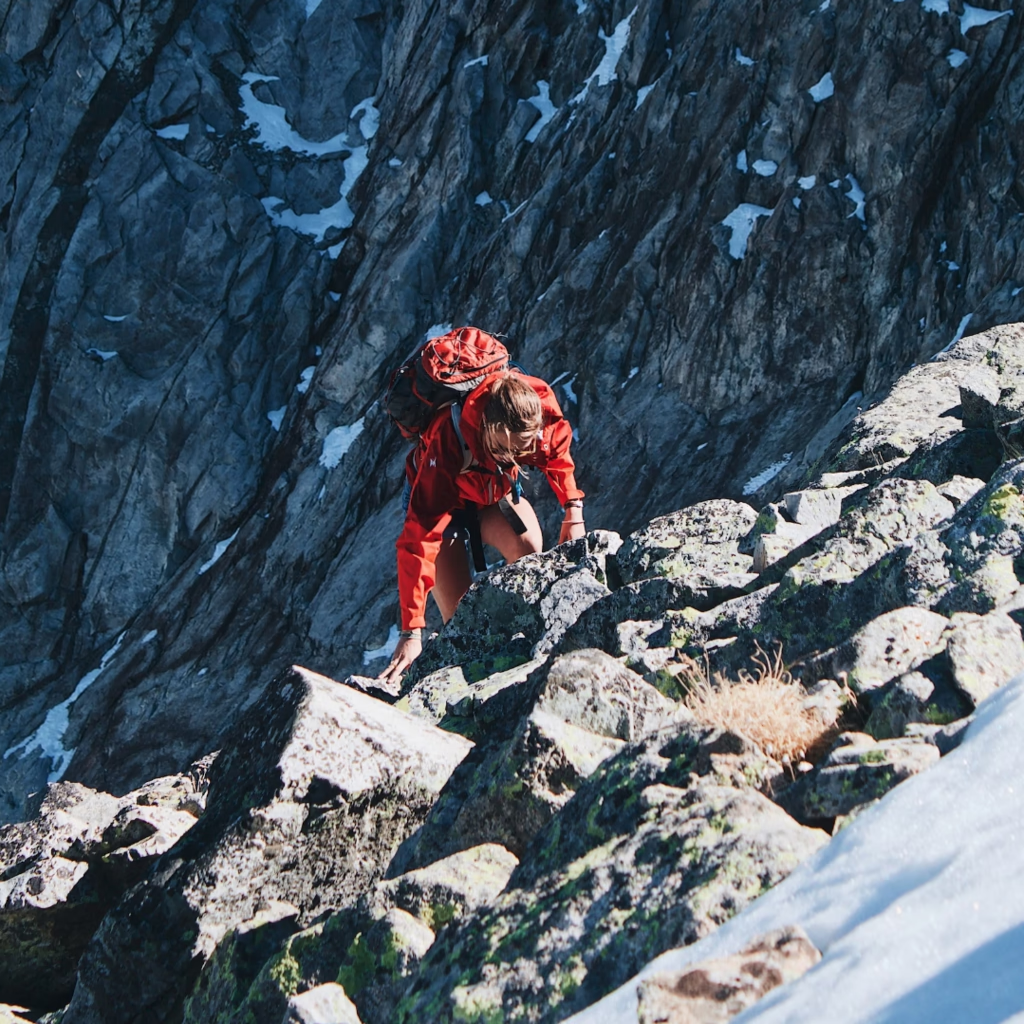
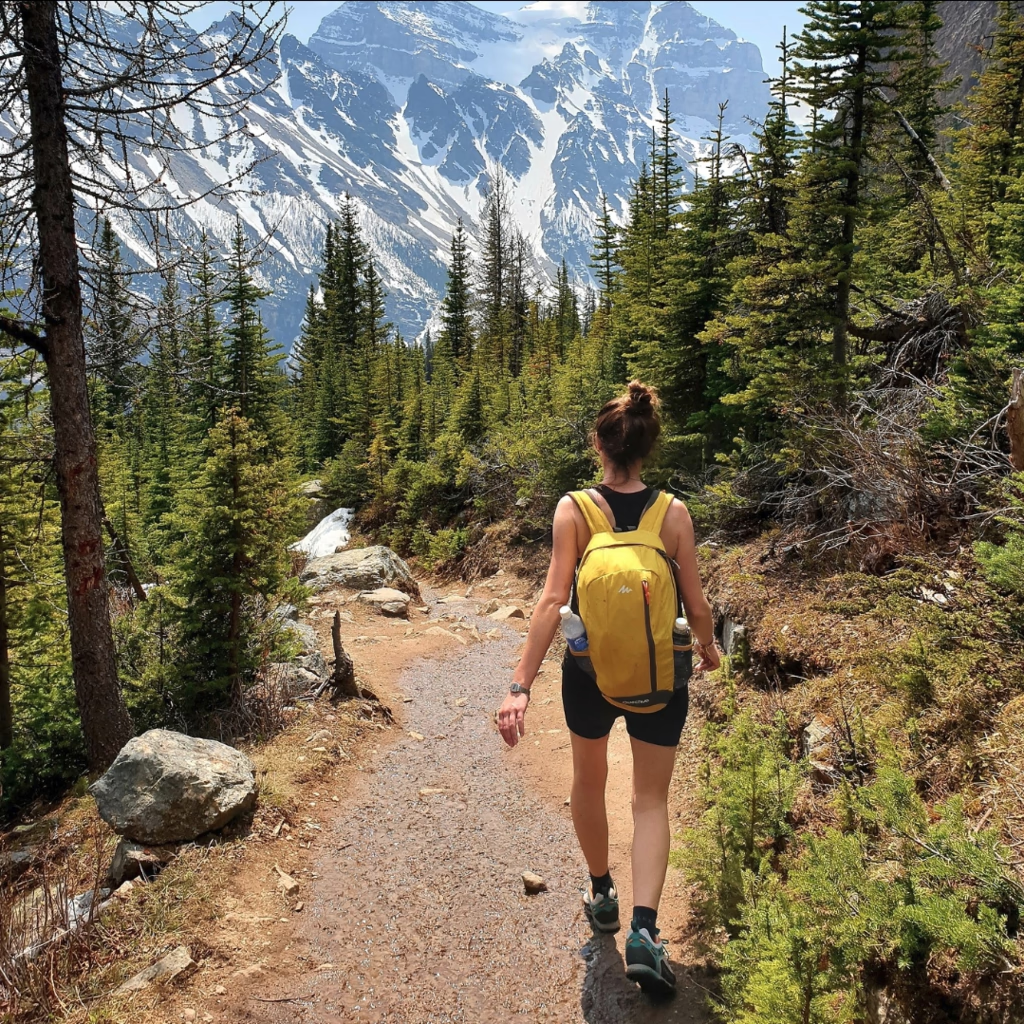
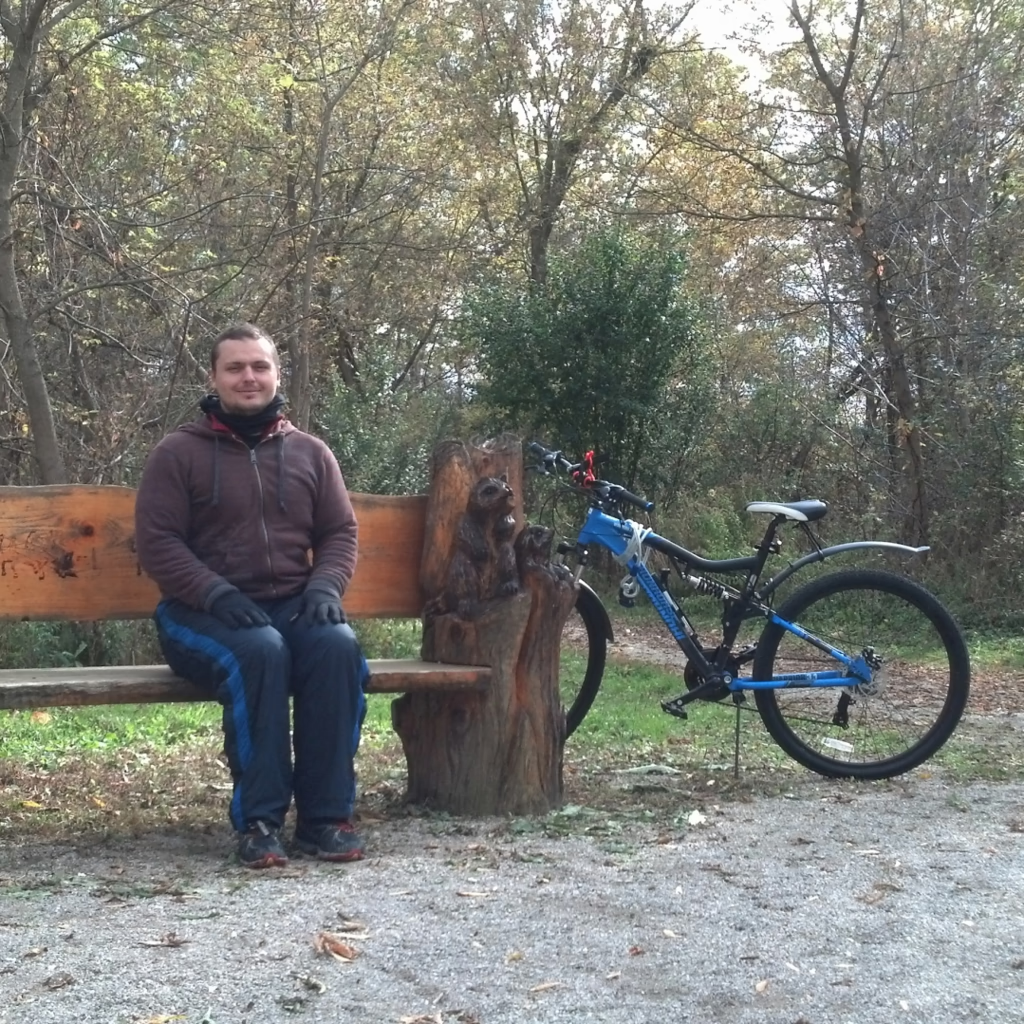
I spent my teenage days exploring Michigan’s highways, where I discovered a tiny trail along I‑275 that eventually became known as the i275 Bicycle Trail; after camping at Nordhouse Wilderness and craving adventure again, I bought an old aluminum bike from a garage sale, packed bread, and set off for the trail. My journey was filled with mishaps—mud, a punctured tire, a squeaking pedal—and a series of repairs that taught me to carry tools, a tire repair kit, and even a handlebar bag; along the way I experimented with different bikes (a mountain

·

#1276: Try Not To Rest At The Gym

Gym sessions are described as precious and unique, encouraging continuous movement rather than long rests. The writer suggests beginning with light weights, gradually increasing load, and switching to different exercises when an arm or body part tires—never sitting or lying down unless injured, then focusing on other muscle groups. The routine is organized by a sequence of muscle groups (biceps, shoulders, chest, abdominals) that rely on intervals, music tempo, and rhythmic movement—sometimes even dancing with dumbbells for hours—to keep the body balanced, integrated, and youthful.

·

#1275: Of The Sunrise And The Sunset; Or, A Slow And Tiny Step Towards Bicycling And Camping

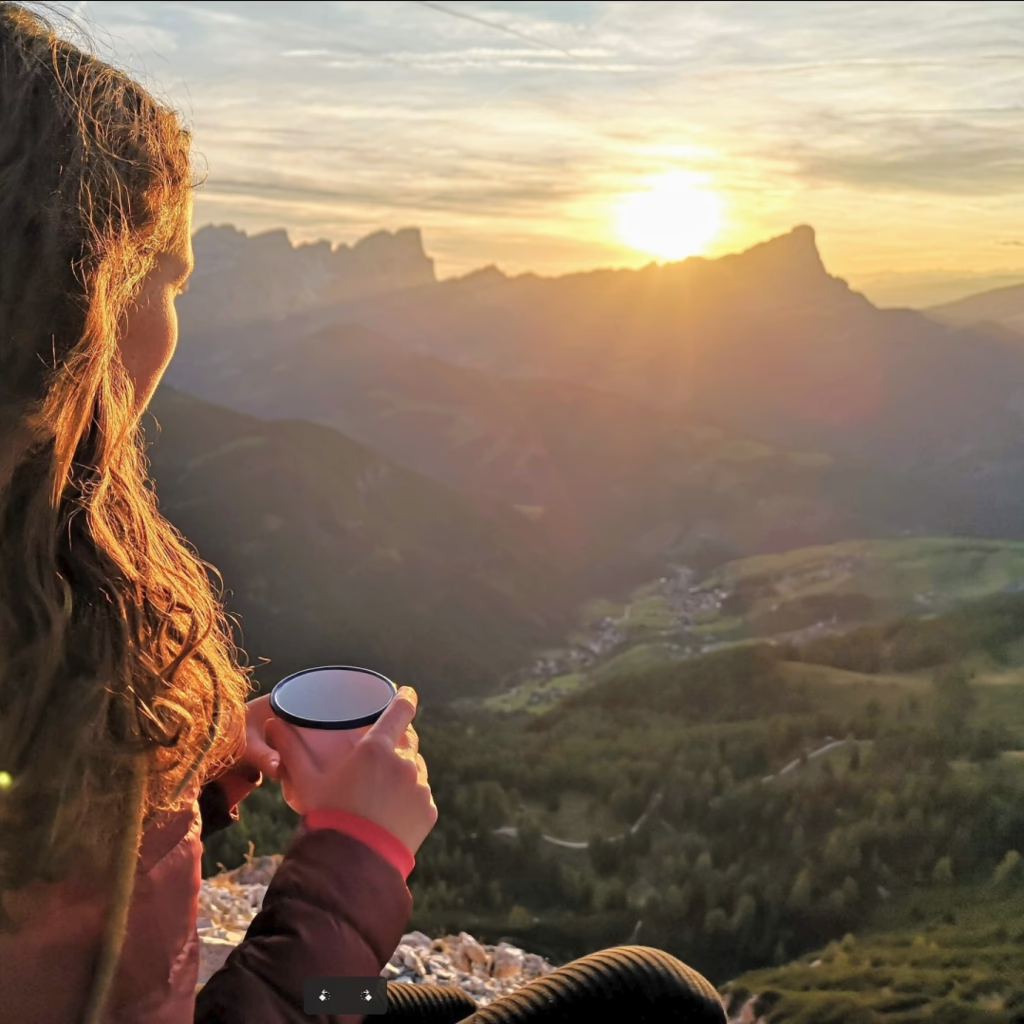
The post celebrates the beauty of both sunrise and sunset, urging readers to experience them actively—by walking or cycling into new places, setting up tents, gathering firewood, and enjoying nature’s colors—all while appreciating the simple pleasures of breakfast under the sun, the quiet moments at twilight, and the rhythm of daily life that balances work, stress, and books. It encourages a mindful, adventurous spirit: preparing a backpack, exploring trails, and recognizing oneself as part of the universe, so that each sunrise and sunset becomes a celebration rather than just an event.

·

#1274: Get Up! The Commencement Address Is As Fake As Your Education, And You Still Need To Learn For Real

The post argues that true education is self‑directed and deeply personal rather than the rote, standardized learning imposed by schools; it urges readers to let their own curiosity guide them through carefully chosen books, to build a “memory palace” of knowledge, and to avoid being manipulated by politics, celebrity rhetoric, or religious indoctrination. By walking long trails and listening to narrated books, one can internalize the lessons, grow continuously, and become an authentic thinker who leaves a lasting legacy for future generations.

·

#1273: Rise, Don't Memorize

The post argues that true learning comes from visualizing and experiencing concepts—like the apple’s fall or Lorentz transformations—rather than rote memorization, using historical examples such as Newton, Cavendish, and Einstein to illustrate how insight emerges from observation and experimentation; it critiques conventional schooling for presenting formulas in a fixed sequence that often misses the “inner‑most” curiosity of each student, while praising fieldwork and narrative books (e.g., Appalachian, Pacific Crest, Continental Divide trails) as vehicles for inheriting wisdom, thus encouraging learners to follow their own path toward greatness.

·

#1272: Half Way Up Mount Katahdin; Or, Use Your Superpower Of Endurance

After a first jog that ends with a stop and return home, the post explains how to treat that as a baseline measurement, gradually extending the duration by adding rest intervals and recording times over a month. It then praises walking—especially for larger people—as an art that uses only feet, reduces car dependence, strengthens muscles, and makes jogging easier. The author recommends training on trails such as the Appalachian, Pacific Crest, and Continental Divide, with practical tips like bringing satellite communicators and water filters, while noting weather and concrete surfaces as factors. He links walking to nutrition, family legacy, stress relief, and wisdom, concluding that young people need trails to understand life, and that one should bring books and perhaps walk half‑way up Mount Katahdin.

·

#1271: A Yellow Bellied Buttercup’s Guide To Camping In Spicy Or Moody Weather

A brief guide on preparing for a forest trip that stresses careful tent placement, weather awareness, essential gear like waterproof bags and saws, and the importance of audio books to keep you entertained during rainy or stormy conditions.

·

#1270: A Tiny Glance At Effective Education

The author argues that today’s schooling is adult‑centric and underdelivers, so it should become a hands‑on, self‑directed experience: biology classes would let students rent microscopes, art rooms would provide projectors and canvas, and outdoor trails like the Appalachian Trail would be part of learning. Textbooks should turn into interactive visualizations; students need room and time to absorb wise books and exchange programs. High school should function as a start‑up accelerator, ending with launching a small business, while achievements are monetized through allowances. Programming is presented as the core language of modern education, and schools must provide home labs, computers, tutors, and guidance into startups for students to become powerful, capable learners.

·

#1269: What Is Freedom Of Will?

The post argues that true education comes from free, self‑directed learning rather than rote memorization imposed by schools, and that students must reclaim their intellectual inheritance to achieve personal growth and societal improvement.

·

#1268: Towards Understanding How To Paint Hair

The post explains that hair should be treated as a three‑dimensional object, so artists must first sketch its 3D shape—using sharp edges and mid‑tones to define volume—and then add shadows and highlights to give depth. It stresses that many beginners skip this step, directly painting colors without the underlying 3D structure, which leads to flat results. By visualizing hair as a bundle of tubes or rolls, artists can more easily plan its form; once the basic shape is set, adding mid‑tones, shadows, and subtle highlights completes the rendering, allowing faster, more accurate techniques for both simple and complex hairstyles.

·

#1267: To Transform Your Body, Use An Interval Timer, And Slowly Speed Up Your Songs

The post argues that continuous motion and proper pacing are the keys to an effective workout: short bursts of heavy lifts alone aren’t enough, so beginners—especially middle‑aged adults who want to emulate youthful energy—should start with low intensity, gradually increase endurance, and use interval timers to structure work and rest. Pairing this rhythm with music or dance not only motivates but also provides the beat that drives consistent effort; monitoring electrolytes and blood pressure and consulting a doctor are advised for safety. Altogether, the piece presents a simple, accessible routine—slow start, timed intervals, musical accompaniment—that can transform the body into a more athletic state over time.

·

#1266: Towards Growing All The Way Up And Becoming A Great Being

The post reflects on human life as a fragile yet enduring miracle shaped by physics, chemistry, and evolution, urging readers to pursue greatness through continuous growth, memory preservation, and intellectual inheritance. It likens our journey to that of rivers or slime molds—following unique paths amid chaos—and emphasizes the importance of learning from giants, staying rooted in concrete foundations, and seeking knowledge in libraries. By reconnecting with the universe at moments of reflection, one can find wisdom, power, and a precious mind that ultimately blooms endlessly.

·

#1265: The Graduation Is A Lie

The post argues that our school systems are built more for show than substance—students spend years taking courses and filling out resumes while teachers prioritize rote memorization over true understanding. The author feels the experience of being “faked” into believing one is competent, only to be let down by a curriculum that offers little real knowledge or practical skills. He stresses that this educational failure leaves students stressed, underprepared for work, and vulnerable to repeated cycles of debt and misemployment. To break out of the cycle he suggests returning to books (especially narrated audio‑books), walking long trails for clarity, and letting stress become a catalyst rather than a curse; in short, it’s a call to reclaim authentic learning and personal growth so that future success is earned by real knowledge, not by an inflated transcript.

·

#1264: Introduction To Color; Or, An Easy Path Towards A Masterful Mastery Of Mixing Colors

The post outlines a three‑step workflow for quickly creating art: first, lock in shapes using either a wall projector or a grid method (the former being especially easy when the projector is linked to a computer); second, nail the colors by overlaying a transparent reference image—an approach that G’MIC’s color picker and filters such as vibrance or posterize make precise—and mixing paint accordingly; third, refine details by studying favorite works. It recommends free tools like Krita for digital painting (with a stylus rather than a mouse) and G’MIC for color sampling, arguing that working through a portrait is an effective way to master hue, tone, and the subtleties of skin tones beyond what a simple color wheel offers. The article concludes that digital techniques give painters an easy ramp to grasp color theory and can be translated back into physical mixing if desired.

·

#1263: Knowledge Artists; Or What Do Science Popularizers Do?

The post argues that true learning is self‑directed and deeply interconnected, whereas “fake” education merely gives an illusion of choice and often relies on rote memorisation. It contends that real study involves adventurous, cross‑linked experiences that let learners internalise knowledge (“knowing the city by heart”), a process best facilitated by science popularisers who weave clear narratives that tie facts together across fields. By presenting stories that link concepts to everyday life, these popularisers spark curiosity and lead students toward independent exploration, which is further empowered by programming skills that provide precise tools for simulation and discovery.

·

#1262: Good Art Changes Lives

The post presents art creation as a progressive journey beginning with simple doodles, moving through pencils, brushes, and other tools such as blending stumps and painting knives, each technique—like impasto—that adds texture and detail; it stresses learning from masters, practicing portraits to internalize flows and shadows before synthesizing new faces, and claims that being an artist is innate, with good art “changing lives,” while referencing camera‑obscura tradition to underscore the legacy of mastery.

·

#1261: How To Become A Great Being

The post argues that true greatness comes from a blend of knowledge, wisdom, and culture (or “class”), rather than simple memorization or grades. It explains that knowledge is an active skill like programming, while wisdom allows one to apply that skill creatively to solve real problems—moving from understanding the theory to building useful applications. The author stresses that learning from great works and people “on whose shoulders we stand” enriches our culture and mindset, and that self‑education completes this trio by letting us pursue knowledge and wisdom independently when we are calm enough to absorb it. In short, greatness is achieved through a continuous cycle of acquiring knowledge, applying it wisely, absorbing cultural influences, and finally mastering self‑learning.

·

#1260: A Trail Towards Real Education

The post argues that students learn best when subjects are framed in real‑world contexts: they need to see why math matters, just as they do for reading and writing. It proposes schools become “startup accelerators,” where learning programming first gives precise syntax and visual tools that let students build projects—games, art, music—that they can publish, earn from, and use to lift themselves out of poverty. The author believes subject divisions are artificial; education should be self‑directed, with topics chosen by the learner and supported by peers, mentors, and AI language models rather than rote lectures. Ultimately, progress is measured by tangible life outcomes, not grades, and future generations depend on such context‑rich, technology‑enabled learning to become “great beings.”

·

#1259: The Short Note About Fixing Education

Higher‑level learning isn’t really taught in schools at all – it springs from a student’s inner curiosity, not from preset lectures or rote memorization of formulas without understanding their construction. The post argues that real education is an inward process that begins with personal curiosity and follows each learner’s own path; institutional teaching and even inspiring teachers can only provide fleeting illumination, whereas true knowledge comes from engaging deeply with nonfiction in the library and discovering one’s own way to live as a “great human being.” Because current schooling relies on grades, fixed subjects, and long‑term stress, students need time away from classrooms and outdoor adventures (hiking, camping) to recover and absorb wisdom.

·

#1258: The First Real Night In The Woods Is Not As Bad As It Seems

The post explains how to prepare and enjoy a comfortable outdoor adventure by starting small—setting up a tent in your own backyard with nature‑sound videos before heading into the wilderness—then gradually moving to state parks. It stresses that an expedition is never solo, recommending two tents for flexibility but keeping one at home. The writer advises choosing campsites with sturdy trees (avoiding “widow makers”), avoiding low spots where water can pool and being ready to relocate if weather turns bad. For wildlife safety, it suggests hanging food on a rope to keep raccoons away, carrying bear spray for bear country, paying attention to scent, and making noise to stay safe. Overall, the article presents practical tips—site selection, gear, animal precautions, and sound planning—to reduce fears and ensure a successful first night in the woods.

·

#1257: Authentic Wealth Of Wisdom; Or, On The Importance Of Interconnectedness Of Knowledge

The author argues that modern schooling reduces learning to memorization and punishment, stifling students’ curiosity. Real education begins when learners pursue their own interests, making connections across subjects through self‑driven projects such as programming, simulations, or art installations; these interdisciplinary explorations create authentic, functional knowledge that fuels future growth. The writer calls for a shift from factory‑style schools to genuine learning experiences that foster deeply connected knowledge and personal heights.

·

#1256: States Of Mind; Or, On Helping Our Minds Grow

Listening to narrated non‑fiction books is presented as a simple diagnostic: if the story falls apart, you’re likely out of sync mentally and need to recover. The post argues that recovery comes from immersing oneself in engaging reads—especially adventure tales that mix joy, knowledge, and wisdom—and from taking a multi‑month vacation in genuinely beautiful surroundings, which helps reset the mind after work‑induced fatigue. After an initial period of doubt that turns into a focused resolve, the writer suggests that once recovered one should share the experience by creating a two‑hour narrated book for younger generations, complete with cover art and free download, to keep humanity’s wisdom alive.

·

#1255: You Were Super Smart All Along; Or, How Fake Teachers Sold The World

The post contrasts real teachers who spark genuine understanding and curiosity with “fake” ones who force rote memorization, urging students to pursue true learning on their own terms.

·

#1254: Where To Start In Life

The post argues that true growing up is an active process of continual learning rather than simply aging; it emphasizes the importance of selecting and deeply studying high‑quality books from clear‑thinking scholars, repeating them to uncover layered insights, and avoiding shallow school memorization or misleading popular works; by immersing oneself in well‑chosen nonfiction, one expands mind, becomes a “great being,” and contributes to a more beautiful world.