·

#1205: The Fraud Of Subject Divisions

The author argues that the current university system is fragmented and self‑serving: subjects split knowledge into silos that teachers exploit to control learning, while standardized lectures (like CS 50) become merely “tricks” that waste time on rote topics such as algorithms, data structures and AI. They claim that students need a clear aim and genuine inspiration rather than “interesting facts”; otherwise teaching becomes mere performance by liars who “gag” their listeners. In particular, the writer criticizes philosophy classes for being shallow—using Descartes and Socrates only to illustrate points but failing to connect them to real life issues such as war, poverty, and indoctrination—and suggests that true teaching would let students see the bigger picture of how education can shape a world‑peaceful future.

·

#1204: What Is Real Education?

The post describes “real education” as a self‑directed, curiosity‑driven process in which learning unfolds naturally without memorization or standardized tests; progress appears as a sequence of interconnected steps marked by personal achievements and discoveries. It emphasizes continuous thought, undivided attention, and journaling, drawing inspiration from great thinkers to build upon their legacy. In this view education is an upward slope of growth that reflects each learner’s personality and leads toward ever‑higher heights.

·

#1203: What Is Junk Education?

The post likens learning to a series of misled experiences—junk science, fabricated myths, and deceptive leaders—and then offers its remedy: disciplined self‑education through books. It urges the reader to cultivate virtues such as restraint, dignity, nobility, unbreakability, fortitude, courage, honor, love, insight, foresight, understanding, authenticity, and heroism, all rooted in a humble beginning of learning from great writers. By walking trails like the Appalachian or Pacific Crest one can broaden vision, while continuous reading at the library builds an accretion disk of knowledge that eventually coalesces into wisdom and ignites greatness. The final call is to start this journey immediately so that one may add real knowledge, strengthen talents, create lasting works, and leave a brighter legacy for the world.

·

#1202: Sets And Reps May Be A Myth; But Endurance Is Not

A well‑structured jogging routine showcases how sustained running builds endurance and strength across the body; by gradually increasing workout complexity and reducing rest intervals, you can develop this “superpower” of endurance. Even beginners—like those aiming for a lean, muscular physique—can benefit from using jogging as a foundation, adding ankle or wrist weights, dumbbells, and eventually weighted vests to progressively challenge the legs, core, shoulders, and upper limbs. When you pace yourself properly—neither rushing nor resting too long—the body adapts smoothly, strengthening muscles from ankles to wrists while improving overall fitness.

·

#1201: Helping Students Identify Ineffective (Or Junk) Education

The post argues that true education only reveals its power once students reach a “tipping point,” illustrating this with creative examples such as painting via wall projection, using half‑opacity reference images in Krita, composing beats in LMMS, and combining RxJS with Dataflow for JavaScript programming. It critiques the current system’s reliance on rote memorization—mistimed, out of context, and ultimately “junk” knowledge—and links it to low GPAs, self‑doubt, and a sense of desperation that drives students into the “darkest corners.” The author stresses that simple, foundational subjects should be taught first, that programming can be grasped in days, and that math classes should pair formula memorization with practical coding skills to reveal fraud. He further calls for schools to expose students not only to curricula but also to a thousand well‑chosen books (e.g., *To Kill a Mockingbird*), so learning isn’t confined to classroom walls, and insists that institutions must guide learners from start to finish rather than merely pointing them toward resources—otherwise they become “make‑believe” schools.

·

#1200: Learn And Rise Above: Don’t Let The Parasites And Ghouls Scare You

The post reflects on how few strong leaders have shaped the world while most people focus only on personal gain, using tactics such as confusion, war, and indoctrination to maintain control; it urges readers to break free from these influences by cultivating knowledge through books, listening, and learning from great authors, so they can grow into “great beings” who rise above their cages, inspire future selves, and ultimately bring about personal and collective improvement.

·

#1199: Discovering Your True Age

To stay young, the author suggests moving more, listening to books while hiking or camping, choosing inspiring titles, and walking instead of riding buses; by experiencing nature—encountering creatures such as a spider on a shirt, an angry goose, a bat tangled in hair, a snake with extra sss…sass, or a bear roaring outside a tent—the reader gains a glimpse of true age and keeps youth alive. Thus, buying a backpack and tent for adventure is presented as the ideal way to spend time.

·

#1198: On Ineffective Education And Fake Graduation

The post argues that today’s educational system is plagued by corruption and an overreliance on memorization, producing graduates who possess diplomas but little real achievement. It stresses that true learning comes from self‑education—especially in programming—and from building side projects that can grow into startups; these activities demonstrate genuine skill and provide the experience needed to succeed in prestigious roles. In this view a diploma is merely a symbolic label, while real graduation is achieved through tangible accomplishments rather than institutional recognition.

·

#1197: The Insult Of Graduation; Or, Hackers Are Philosophers Too

Hackers view the digital realm as a landscape of systemic opportunities rather than mere bugs, seeing patterns and connections that others overlook; their mindset treats errors as clues for improvement and approaches problems with an all‑encompassing, self‑taught perspective that transcends nationality or race. By dissecting systems into their smallest components, they uncover hidden potentials and dissolve artificial borders—both in networks and in everyday life—making them creative pioneers who continuously reinvent the world around them. Their relentless upward trajectory is driven not by status or accolades but by an innate drive toward excellence, proving that true learning is endless and self‑sustained.

·

#1196: Of The Ladders And Measuring Sticks

The post argues that “ladders” (metaphorical steps) are useful scaffolds for learning, not just tools of elevation, and that standardized education is too rigid while real learning involves leaps forward through hands‑on projects such as VPL (visual programming language) and AT (the Appalachian–Pacific–Continental trail). The writer claims schools only lift a few students and leave most behind, so parents should let kids pursue real achievements instead of memorization; the world needs genuine achievers, not pill‑popping doctors or pretenders.

·

#1195: A Long Camping Adventure At Lake Michigan

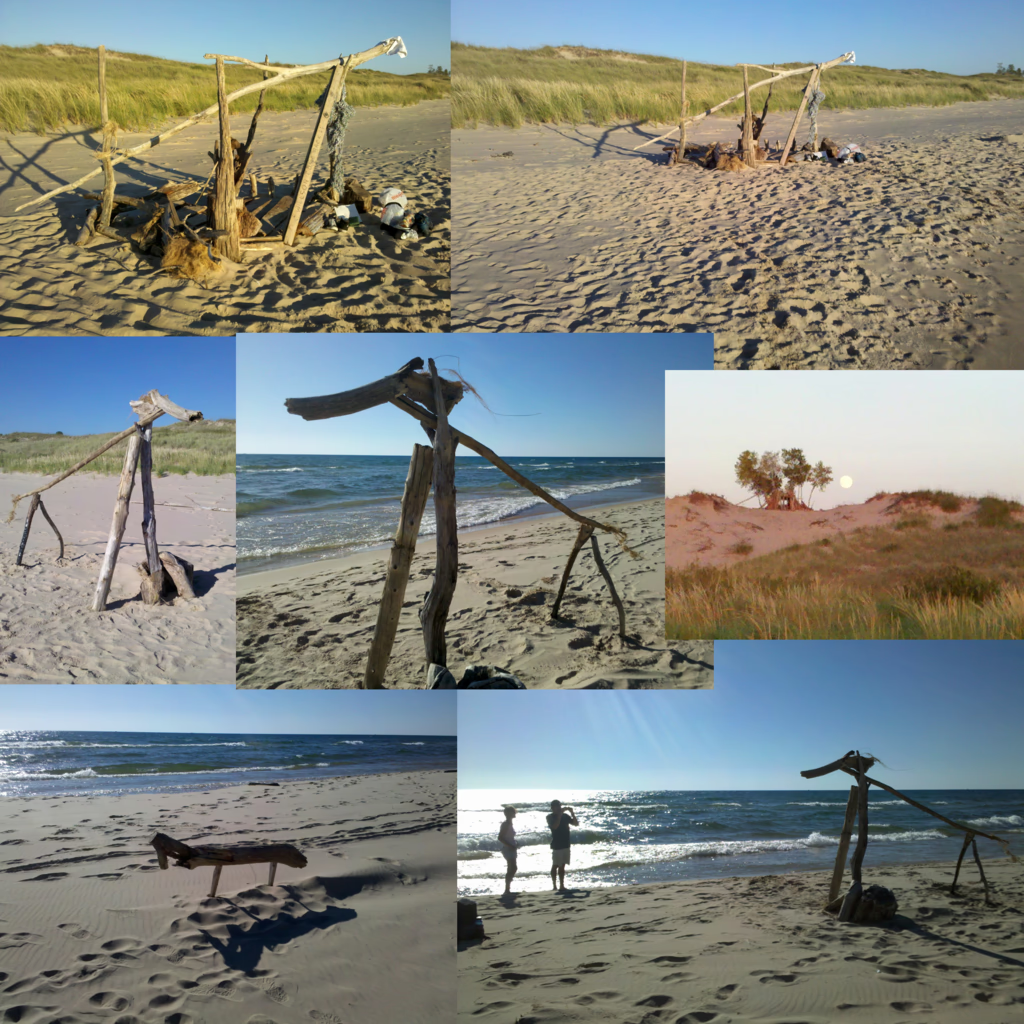
I arrived in Ludington, Michigan around 5 a.m., parked near the supermarket, took a nap, and then drove through quiet woods at night to the state park where I camped at Jack Pine sites, exploring dunes, collecting fanny packs of fossils and seashells, and even showering in hot water while observing raccoons and owls. Along the way I bought quirky items like a white chocolate bar named after a revolver and a magnesium fire starter, used blueberry drink mix for dinner, and enjoyed two weeks at Jack Pine Hike In Sites. After that, I spent three weeks at Nordhouse, experiencing thunderstorms and blue‑glowing dune grass, before returning home with beach sand still on my trunk.

·

#1194: The Road Towards Greatness

Growing up is about gaining wisdom and unlocking oneself, finding one's place in the universe; while aging occurs automatically, true growth requires effort and is always worthwhile. We move through cultural levels that become more advanced as we grow, but stopping halfway leaves some behind—those with higher culture may seem smarter simply because of their advantage. Ineffective education and poverty keep people at a disadvantage, so humanity's growth depends on real learning: knowledge that turns into wisdom. Only by building on the shoulders of giants can we understand our path and meaning—a lifelong rise toward greatness.

·

#1193: From Visual Programming To A Smart And Annoying Little Company

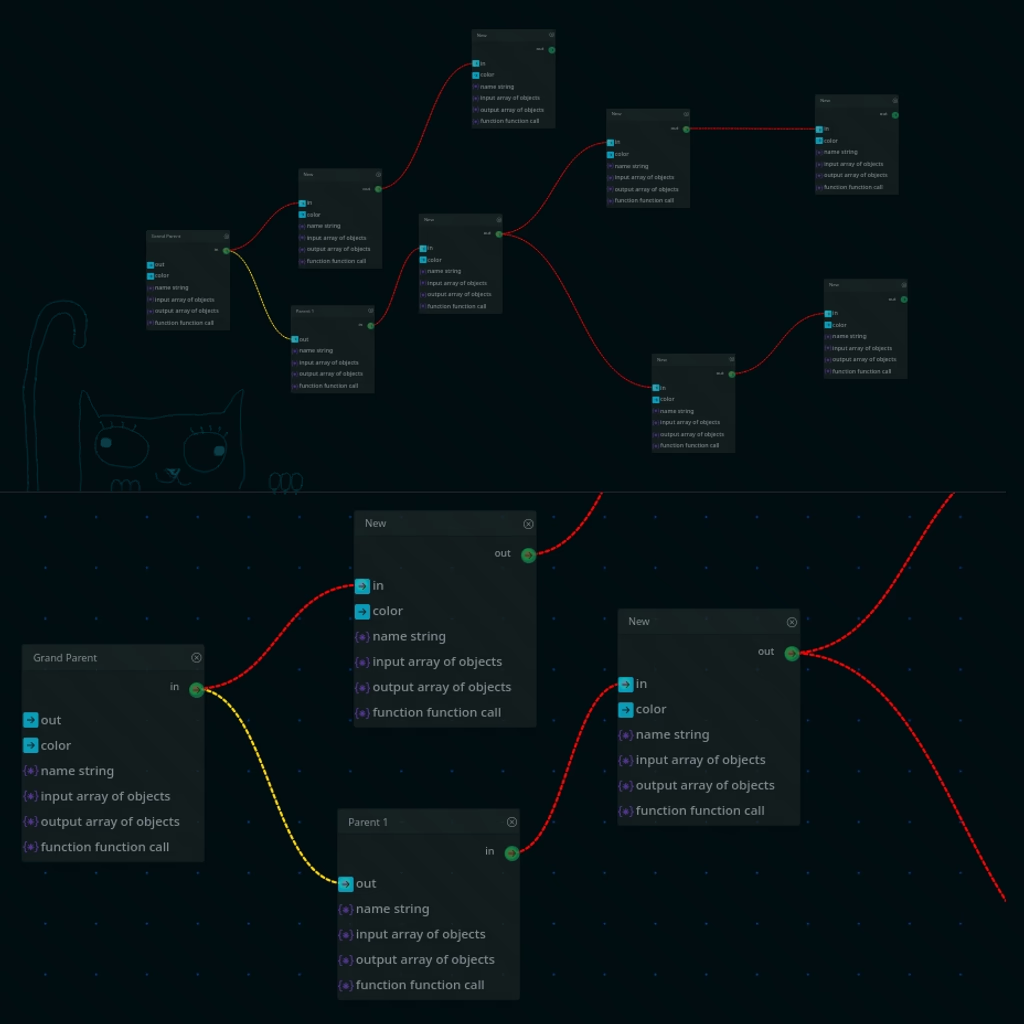
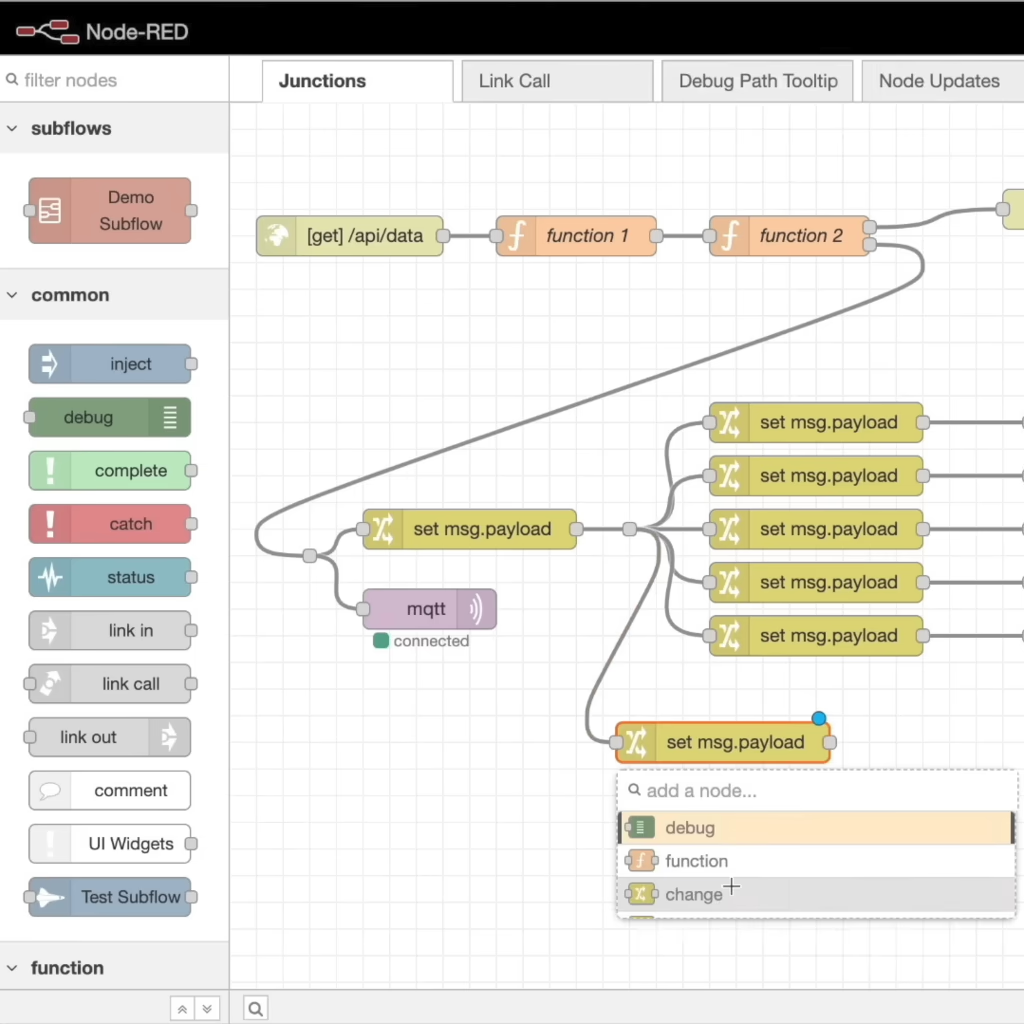
A web‑browser plugin that embeds a visual programming language would let users automate tasks—such as scheduled browsing, data extraction from news sites or weather feeds, and device control like thermostats—by connecting simple input/output “node” boxes (source nodes for data streams, filter/branching nodes, and output nodes such as dashboards). Because the language runs client‑side in JavaScript, it needs no external server, making it cheap to develop and deploy; reusable sub‑programs can be grouped into new nodes, enabling cross‑connectivity with local servers. The concept is illustrated by tools like Node‑RED or Blender’s Geometry Nodes, suggesting that browser‑based visual programming could become a widely useful automation platform.

·

#1192: A Universe Of Your Own

The post argues that true learning comes from actively simulating scientific concepts rather than merely memorizing facts, using mitochondria and cellular processes as an example; it suggests that popular science stories spark curiosity but lack structure, so programming simulations—especially with p5.js—provides a hands‑on way to model complex systems such as planetary orbits, relativity, chaos (Lorenz attractor), and even DNA replication. By coding these phenomena, the author claims we can “build our own knowledge library,” turning abstract ideas into concrete, visualizable experiments that deepen understanding of both biology and physics.

·

#1191: Playing With Computers

Computers are portrayed as powerful tools for both learning programming and creating programs, with the author arguing that self‑directed, paced learning through coding eliminates teacher trickery and reveals true understanding; this approach is presented as a means to escape poverty, spark cultural revolution, and empower individuals across disciplines—from arts to sciences—by enabling them to build apps, compose music, and manipulate digital media. The post claims that programming’s versatility lies in its ability to turn abstract lectures into tangible projects, proving knowledge through working code, and suggests JavaScript as the most practical language due to its cross‑platform reach, while encouraging readers to combine coding with other learning experiences (e.g., hiking) to fully realize their creative potential for the benefit of society.

·

#1190: How Engineering Failure Was The Only Way All Along

Every programmer faces hard projects that often lead to repeated failures, yet each setback can be seen as an opportunity for growth; by repeatedly giving up and restarting, one gains fresh perspective, refines problem‑solving skills, and ultimately writes code unlike any other. The author argues that failure is not a weakness but a powerful learning engine, contrasting it with formal education that may stifle creativity; he encourages readers to treat failures as stepping stones, hire tutors if needed, and embrace the iterative process of debugging and re‑designing to become experts who can launch successful applications.

·

#1189: A Sure Recipe For Deadly Bear Jerky; Or, A Weight-loss And Fitness Program For The Rest Of Us

The author describes how “trance”—a relaxed, focused state—occurs naturally during long runs and can be cultivated by listening to music with a steady beat or simply enjoying the rhythm of movement. They explain that runners often perform best when they let themselves relax rather than think about time or distance, and suggest using interval timers and slow‑to‑fast song transitions to eliminate rest breaks. The post then shifts to hiking as a preparatory activity, recommending major North American trails (Appalachian, Pacific Crest, Continental Divide) for family outings that can boost fitness and longevity. Finally, the writer encourages packing essential gear—backpack, matches, bug spray, sturdy knife—and using these adventures to fuel workouts, replace idle internet time, and enjoy the “taste” of life through active living.

·

#1188: Advancing Human Kind Is Really Easy

The post celebrates the idea that all people are united by shared intellect and potential, regardless of culture, poverty, education or circumstance; it argues that we each possess unique brilliance, yet share a common “top layer” where ideas can blend peacefully, and calls for recognizing these similarities to repair educational gaps, foster growth, and plan for future centuries.

·

#1187: Doodle Diagrams; For Learning, Programming, and Tactical Office Shenanigans

Doodle diagrams are a flexible, creative way of visualizing ideas—especially useful for programmers before formal mind‑maps or concept maps take shape. By sketching everything from many angles with markers, they let you break down complex interfaces into simple building blocks; the author shows this by dissecting LMMS’s song editor into just two elements—the time track and draggable rectangles—to make a small clone in JavaScript and Svelte. The post also argues that doodle diagrams help clear scattered thoughts and relieve work‑related stress, encouraging developers to keep notebooks full of colorful sketches as they craft side projects or launch their own startup, while pointing out useful online tutorials for JS, Svelte, and LMMS.

·

#1186: Growing Strong; Or, Humanity And Self Education

The post reflects on human development as a continuous “growing up” process that transcends mere aging and involves acquiring wisdom through inheritance, analogy, and synthesis. It argues that this intellectual growth is rare, limited to a few capable beings, and that true learning arises from personal responsibility rather than rote memorization or institutional grades. The author calls for self‑education via reading great works and engaging in reflective adventures, suggesting that individual progress fuels humanity’s collective advancement.

·

#1185: Profound Self Education Is Now More Important Than Ever

The author argues that humans should grow continuously into great beings who make lasting contributions, yet those in control often suppress independent thought; while we can detect overt advertising, subtle automated recommendations like “Other users also watched” are harder to notice and influence opinions—so the solution is authentic self‑education: follow your curiosities, not just school grades, embrace adventure, and taste creativity so that you become unshakable.

·

#1184: Your Teachers Manipulated You Into Cramming, Called You Hormones, And Still Think It's Funny

In this post, the author argues that programming is a powerful, self‑directed tool for building businesses and learning, rather than a hobby or talent limited to a few. He encourages readers to embrace software development—especially using JavaScript, Node.js, Svelte, and SvelteKit—as a means of creating online ventures, licensing products, or launching multiple startups until one succeeds. By mastering these technologies and staying attuned to community trends, one can turn simple code into a company, generate AI art, control micro‑controllers, and ultimately gain the freedom and creativity that formal schooling often fails to provide.

·

#1183: Don’t Let The World Stress You Out

The author reflects on the limitations imposed by traditional schooling—cramming, financial strain, and cultural wars that stifle creativity—and urges readers to tap into their own inner genius. By studying books, philosophy, and engaging in self‑driven exploration (journaling, drawing, programming), one can break free of the cycle of rote learning and economic hardship, synthesize ideas, and rise above the clouds of ignorance; ultimately, through persistent study and imagination, anyone can become a beacon for others to follow.

·

#1182: A 156 Days Until Halloween, And A Tail of Tales

The author recounts how they started preparing their superhero‑style Halloween costume months ahead, noting that the effort is worthwhile and continues to pay off throughout the year. They describe an encounter at the gym with a mailman who had a military background, whom they jokingly reminded to "put on some muscle," while the author’s own tail caught his attention, sparking laughter. The narrator reflects on this moment repeatedly, noting that early costume preparation allows ample time for testing and refining the outfit. They emphasize how wearing such an outfit feels empowering—like armor—and even suggest that a tail is essential for balance, muscle development, and hiding weapons, concluding that superheroes should embrace their tails just as great apes do.