Reading great books transforms a person’s life by exposing them to the culture of brilliant thinkers and encouraging self‑directed learning rather than rote memorization, which the author argues schools often enforce. He shares his own journey from school struggles—being cheered for “Weed is just an herb” in biology—to working at Best Buy, then landing a full‑stack senior developer role, and finally realizing that true growth happens when one follows personal curiosities and studies at their own pace. The author stresses that the wisdom of great writers gives you tools you can’t get from teachers alone, and that embracing these ideas allows you to become a “great being” who contributes lasting knowledge for others to build upon.
The post argues that modern politics is largely driven by uneducated voters who, overwhelmed by daily hardships and lacking deeper learning, are easily swayed toward “the right side” without true understanding; this leads to the rise of parties that thrive on static mass support rather than genuine progress, allowing pretenders to govern with minimal effort while benefiting their own networks. As a result, policy decisions—like extending emergency powers or environmental neglect—become tools for self‑interest, leaving ordinary citizens unserved. The author further suggests that large language models (AI) now possess enough intelligence to analyze and forecast the real impacts of political choices, potentially restoring voters’ power. Ultimately he believes that renewed education, poverty reduction, and a focus on civil rights will reinvigorate politics into a wiser, safer future.
The post calls for humanity to wake its inner strength, adopt AI‑driven updates, and learn continuously so that we may evolve from Earth‑bound beings into explorers and colonizers of the Milky Way, guided by the mysteries of the Laniakea supercluster.
The Governor’s Office of Michigan issued a unanimous “Burn Fat Not Fossil Fuel” ruling that bans vehicle commutes to wellness facilities such as gyms, with the law carrying a felony penalty for violations; in response, the local police union staged a protest claiming the rule infringed on constitutional rights, while the governor’s office cited it was only voiced by officers unable to reach the gym. A marching chant from the Michigan Marine Corps and local militia celebrated the new ruling, featuring verses that repeat “Left, Right, Left” and proclaim walking to the gym as a way to burn fat and save fuel.
The post argues that traditional schooling often provides fragmented and rote learning, leaving students with a superficial grasp of subjects like mathematics, and suggests that true understanding comes from self‑directed study using creative courses such as “Screensaver Class” or “Generative Art Class.” It claims teachers mainly aim to keep students passing state tests for their own benefit, thereby neglecting genuine learning; the author lists several audio books (e.g., *Giants of Philosophy*, *A Short History of Nearly Everything*) and recommends starting in a library to freely access knowledge. Finally, it stresses that without effective education people experience lifelong regrets, mid‑life crises, and social problems, and calls for individuals to become their own teachers by immersing themselves in real learning materials.
The post explores the long‑standing quest for visualizing program structure and argues that existing approaches—directory trees, documentation, static analysis, GraphViz graphs, node‑based systems like Blender’s Geometry Nodes or Node‑RED, and even Apple Automator—all fall short because they either expose low‑level details (if/foreach/filter) or rely on generic high‑level concepts that can’t capture a specific application’s architecture. It proposes instead to build a code‑management system whose UI is explicitly designed around the unique, high‑level constructs of the project at hand, rather than being generic; the interface would act as a concept map, exposing the internal architecture and serving both as documentation and as an editor (e.g., a Bootstrap‑theme builder that lets you drag‑and‑drop dashboards, cards, forms, etc. while automatically generating code behind them).
Anton Chekhov’s phrase “a man is what he believes” frames an examination of how students and teachers, trapped in a system that rewards memorization over insight, create a climate of fear and desperation that fuels conspiracy thinking. The author argues that this cycle—where educators merely repeat what they have learned and learners accept it as truth—leads to a dead‑end mindset. To break the loop he recommends immersing oneself in narrated books by thinkers such as Carl Sagan, Bill Bryson, Neil de Grasse Tyson, and Will Durant; through listening one can internalize the rhythm of ideas like music, gain real understanding, and finally leave conspiracy behind.
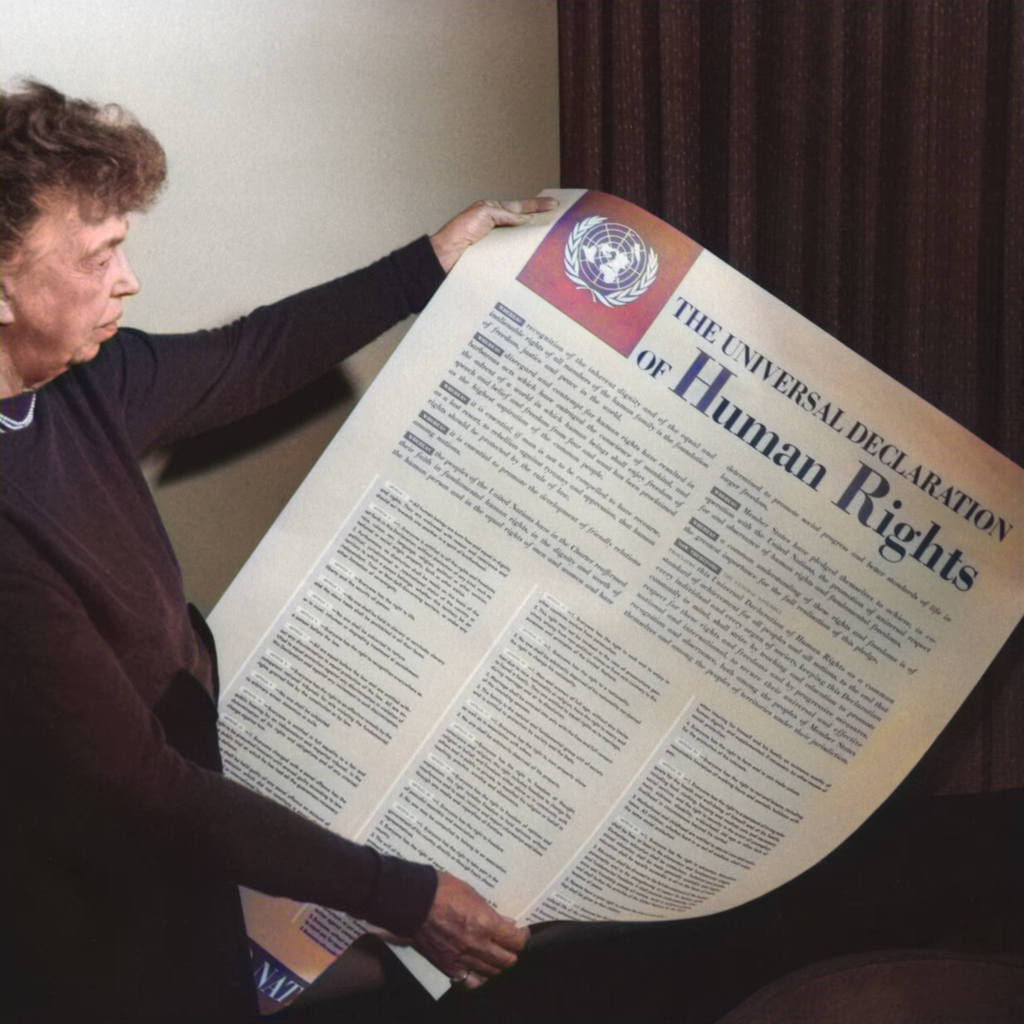
The poem reflects on humanity’s role as “rising apes” rather than passive instruments, urging us to move beyond the old book‑friend’s metaphor of being played like piano keys and to rewrite our own “manual of life.” It calls for a renewal of the Universal Declaration of Human Rights with thousands of new articles, an awakening that chooses the road of continuous war or one of collective rise. The speaker stresses that we must leave indoctrination behind, craft self‑directed educational systems, and remind children that teachers can be false but philosophers honor them; only by rising above our nature and embracing knowledge, wisdom, and greatness will future generations succeed.
Endurance is an often-overlooked yet crucial element of fitness that begins with simple practices like jogging, where gradual adaptation and controlled pain lead to improved performance and even Olympic speeds. It’s not about competition but continuous progression, and music or narrated books can aid the process by providing rhythm and distraction. Endurance extends beyond jogging to whole‑body workouts such as dancing, which strengthens all muscle groups and supports long‑distance running. The key is incremental load within an optimal window—neither too heavy nor too light—to stimulate adaptation without overexertion. Practical tips include proper footwear, socks, supportive mattresses, and neoprene belts for warming muscles. In sum, consistent gradual effort and mindful resources build enduring fitness.
This article explains how to use dance—specifically shuffle and cutting‑shapes moves—as a full‑body workout that builds endurance and strength. It recommends starting slowly, adding dumbbells for added resistance, and gradually increasing the tempo of your music (using tools like Audacity or ffmpeg) to keep the rhythm tight. By timing each session with an interval timer, playing strong beats, and keeping the practice continuous for about an hour a day, you can improve speed, stamina, and feel less tired while dancing. The routine is flexible: take breaks only if needed, but aim for daily sessions from Monday through Friday (or even seven days) to let your body adapt and progress steadily.
The author argues that the best way to build robust software is by starting small and staying modular: plan your program as a tree of loosely coupled components, use simple tables for data, and expose a lightweight HTTP API with a GUI client that talks to it. By writing clear, single‑purpose commands (for example, a tiny reverse‑proxy server) and keeping the codebase tidy, you can easily add new features such as a wiki editor or multiple clients while still maintaining a single source of truth for state. The post stresses automation, regular backups, and using nested structures so that each component stays independent yet coordinated—so that the overall system grows naturally from one small program to many, all driven by simple commands and clean architecture.
The post argues that our global “culture” functions as an indoctrinated cult of false beliefs—pushed by poverty, inadequate education, and lack of basic security—and proposes that only through comprehensive storytelling, widespread education, universal income, and cross‑cultural empathy can we break this cycle and prevent the wars it breeds.
The post argues that true greatness is not achieved through quick tricks or flashy lectures but by a lifelong process of growth, friendship with thinkers, and deep study of their ideas—especially through the author’s own voice. It claims our current era shows schools failing to lift communities because money becomes the main driver; education can even become an addiction when it relies on student loans. The writer then proposes that “culture of greatness” is a super‑cultural framework that unites heart, mind, class and clear thinking, and that this framework can be entered by listening to narrated philosophy books such as Will Durant’s *Story of Philosophy* or Charlton Heston’s *Giants of Philosophy*. By immersing oneself in these audio texts, one can “heal,” “replenish” and ultimately join the culture of greatness.
The post argues that the beliefs we adopt in youth shape our entire lives, and that many of those beliefs are false—often reinforced by a rote, memorization‑based education system that values grades over real learning. It claims poverty and “fake” schooling create stress and keep students in a maze of misinformation, while true education should be self‑directed, curiosity‑driven, and free of grade pressure; success is measured not by GPA but by life achievements. The author cites Butter Yates to emphasize the courage needed to confront one’s own assumptions and suggests that teachers maintain grades for their jobs rather than student progress. In essence, authentic learning comes from books and personal exploration, enabling students to become “great beings” who contribute to world peace.
The post argues that high school should teach students to build their own businesses rather than just get jobs and criticizes the current education system as indoctrinated, memorization‑focused, and prison‑like, causing boredom, bullying, and drug use; it distinguishes between effective self‑driven learning and ineffective standardized testing, suggesting “progress” as a better term for education; finally it calls on teachers to shift from memorization to authentic teaching so students can truly advance humanity.
A whimsical tale recounts a visitor who delights in peanuts yet dislikes cheddar, while observing playful squirrels and heroic crows defending their domain from a menacing hawk; after the crows’ victorious battle, the hawk returns briefly before retreating again, leaving the narrator’s world peaceful, with the visitor’s return symbolizing triumph and contentment.
The poem reflects on the promise of AI—its ability to predict, heal, and transform society—while noting its potential to age people back, alter politics, and bring an end to crime. It imagines a world where machines become self‑improving, education and governance are reshaped by interactive tests, and humanity’s future is defined by the tipping point that AI creates. The author anticipates that within our lifetime this technology will change everything, from medicine to space travel, and that once it arrives, the old ways will be forgotten.
The post proposes that modern “Tarot”‑style decks of wisdom cards are a 15th‑century invention, and offers a practical way to build one: pick as many or few cards as you wish, write short philosophical insights on each (the author gives three sample cards drawn from Gell‑Mann/Nietzsche, Thoreau/Dixie/Ferris Bueller, and Sun Tzu/Kurt Vonnegut/Mark Twain/Mahatma Gandhi), illustrate the front and back with generative AI tools like Midjourney or Stable Diffusion (upscaled for printing on paper using imgupscaler.com or a local setup such as Dalai), then print them via a service such as boardgamesmaker.com, optionally add a booklet of card descriptions. The result is a personalized deck that can be expanded with new wisdom cards over time.
The author urges readers to embrace philosophy and education as tools against war and poverty, arguing that ignorance breeds conflict and that true learning unites humanity. He praises books—especially philosophical ones—as means to broaden minds, while lamenting how poor schooling and misguided leaders turn nations into weapons. The message calls for personal initiative—re‑stacking shelves, studying in libraries—and stresses curiosity as the engine of knowledge. By cultivating individual wisdom, the writer believes society can escape poverty, end wars, and reach a peaceful nation where each person becomes a powerful observer of life.
Nordhouse Dunes Over At Free Soil in Michigan is a repeat‑visitable nature spot where visitors can hike from a modest parking fee, gather wood after hours, and stay refreshed by nearby water pumps; a gas station lies a few miles away for fuel and food. Though the trail can feel lonely and cold at first, golden mornings bring a quiet magic that refreshes mind and body, encouraging a slower pace and a sense of freedom amid stony beaches and sky‑high vistas. Visitors are advised to pack gloves, a knife, and an umbrella to weather storms, and to bring a narrated book or philosophy journal as they enjoy pine‑lined views over Lake Michigan’s ancient‑sea feel. The trip is framed as a move from overwork into nature, with the experience echoing the “Triple Crown” of Appalachian, Pacific Crest, and Continental Divide trails—a reminder that true renewal comes when one returns not only in body but in soul.
I love geese and recently had a memorable encounter with a particularly bold one in Michigan: after I honked at her for blocking traffic, she lifted her feathery butt in the air and stared me straight in the eye, causing me to jump. Throughout my post I also reflect on how geese seem like “angry Brontosaurus” that stay on the ground despite their ability to fly, share a whimsical legend about Vikings being driven away by a powerful goose, and describe the local geese’s habit of hanging out behind the mall during cold weather—an amusing blend of personal observation and fanciful folklore.
The post celebrates Michigan’s seagulls as heralds of spring, describing a local tradition in which residents watch for their arrival and prepare by shedding coats and hats. It portrays the gulls as friendly, social birds that chatter in herds, enjoy snacks, music, rhyme, and dance when they prance; they’re also noted for being smart, even dabbling in pebble art, and love to sail on ships around the world. In short, it paints the seagulls as cheerful “kitty‑cats of the sea” whose favorite thing is announcing the arrival of spring.
Reading philosophy becomes a personal journey when you immerse yourself in the lives and times of its authors—just as if you were learning from a close friend. By studying their writings not merely by rote memorization but by exploring the context, the epochs that shaped them, and how their thoughts evolved over a lifetime, you gain an intimate understanding of each thinker’s personality and intentions. This “heart‑involved” study turns books into invitations for friendship across time, letting you feel the philosophers’ joys and struggles while connecting their insights to your own world. In short, real learning happens when you ask yourself what it meant to be that person, and then let those answers guide you toward wisdom and greatness.