·

#0965: Simple Explanation Of How Individualized Education Can Guide Us Toward World Peace

The post uses an operating‑system metaphor to argue that human minds are dynamic, evolving machines whose education can be upgraded much like software updates. It claims that standardized learning feels like eating the same “broccoli” over and over, whereas personalized, technology‑driven instruction—especially via smartphones—lets learners build their own knowledge paths, experiment with real projects, and earn rewards for solving problems. By creating a privacy‑respecting, self‑paced school where students can freely assemble curricula, collaborate online, and gain experience through bounties, the author believes individuals will feel empowered, overcome poverty fears, and continually refine their skills, just as an OS is upgraded or replaced to improve performance.

·

#0964: If You Got A Tailbone You Need A Tail

Research shows that having a tail—whether literal or metaphorical—offers practical benefits: it helps distribute weight, supports the back, and can even enhance intelligence. The post emphasizes that animals from squirrels to whales naturally possess tails, suggesting humans could benefit similarly. It stresses choosing a tail that fits one’s scale and size, implying careful selection is essential. Finally, it playfully suggests wearing a tail for style—whether on Halloween or year‑round—to feel mighty and strong.

·

#0963: One World

Our world is complex, yet cultures are destined to converge toward wisdom and peace. Young people struggle to grasp group identities, often simplifying them with the vague “they,” which deepens divisions and fuels conflict—an old trick that exploits our minds’ need for coherent narratives. When we accept falsehoods as truths, our worldview warps, and groups hate each other because of these shared lies rather than any real difference. Children can quickly abandon local labels if taught to build their own certainties: they must learn to evaluate assumptions and check premises. Schools were intended as the cradle of modern civilization, pushing beyond “them” into deeper understanding; however, this often forces children to disobey parents and politicians to cling to status quo. Yet the real task is elevating all cultures through wisdom so they unite without conflict. Standardized schooling has become factory‑like, prompting self‑education as a replacement. The world’s mission—to end poverty, lift cultures, grow, learn, rise—remains in our nature; one day students will marvel at how we once demanded obedience yet hoped for change.

·

#0962: Saving Progress

The post is an introspective ode to becoming a “great being” through the synthesis of art, philosophy, and personal experience: it urges the reader to cultivate poetry, music, invention, and wisdom, all inspired by ancient philosophers and cosmic wonder; it weaves together poetic reflection on life’s cycles, the transformative power of books, and the author’s own sailing adventures as a means of self‑discovery

·

#0961: A Handful Of Observations On The Subject Of Writing Books

I’ve been thinking about writing a book since high school, but my idea of what a book is has evolved into an audio‑book project that lasts for hundreds of hours—each 10‑minute poem a small chapter in a larger program that adapts to the listener’s mind. I started with simple verses and now weave them into software‑development themes, treating each recording as a dynamic “software” upgrade for the mind rather than a static sheet of information. I see a 300‑hour audio book as roughly thirty separate books, and I repeat ideas often so they stick; I let my audience from many cultures hear the same thought in different ways. I keep it free to share, finish one project before starting another (calling it “Part Two”), and believe well‑narrated audiobooks are a way to move humanity toward the future.

·

#0960: Your First Programming Business; Or, Learning Programming The Easy Breezy Peasy Wheezy Way

The post paints a picture of today’s programming landscape—first‑hand tools feel clunky, especially on smartphones where you’re stuck with browsers and ad‑laden apps, yet JavaScript (with its server‑side runtimes) remains the de‑facto stack for web‑based projects. It proposes building an app by treating each feature like a wiki page: write a BDD description, then hand it off to other developers who can code the part for pay—essentially creating a marketplace of small modules that can be assembled into a full application. The writer suggests using modern front‑end frameworks (Bootstrap or Svelte) and offline support via PouchDB, while noting this “meta‑programming” model could help entrepreneurs pitch ideas to investors before anyone actually writes the code. In short, it’s an invitation to treat app development as a collaborative, feature‑by‑feature BDD process in a Wild West of programming.

·

#0959: Superpowers Are Real

Stepping into Philo Sophia—love of wisdom—reveals a reversal: great thinkers abandon gods and kings, rising from the dark corners of history and finding their power in books rather than miracles outside themselves. Young people, especially those who feel wronged, naturally inherit centuries of wisdom by asking “Who would I need to be to write like that?” and thus resurrect the spirits of philosophers. This inward expansion—what the author calls superpowers—is born from listening to well‑narrated nonfiction and adventure stories, which ignite inner force, joy, and unbreakable wisdom. By shifting our culture toward such inheritance, we can guard nature, peace, and authenticity for future generations, ensuring that the superpowers of humanity are nurtured through continuous learning and friendship across time.

·

#0958: A Very Brief Introduction To User Interface Design

The post argues that for modern web development one should pick popular, actively maintained open‑source tools—specifically Bootstrap, Svelte, and PouchDB (with its CouchDB back‑end). It explains how HTML, CSS and JavaScript are the core building blocks of the browser, and compares them to smartphones to show their ubiquity. Bootstrap is praised for giving ready‑made layout, menu and style components while keeping the underlying markup visible; Svelte is highlighted as a lightweight code generator that automatically updates the UI without bundling extra libraries; and PouchDB is presented as a JavaScript‑based in‑browser database that syncs with CouchDB to provide scalable persistence. Together, these three technologies form a long‑lasting stack that lets developers learn the fundamentals while benefiting from powerful abstractions, and the post even suggests experimenting by recreating CouchDB’s Futon UI using Svelte, Bootstrap and PouchDB as an exercise.

·

#0957: Unstoppably Brilliant

The post reflects on how teachers often fail to connect textbook knowledge with practical application—using examples such as projecting onto a canvas or teaching “programming a square” only in theory—and leave students with a superficial grasp of concepts like loops and hand‑eye coordination. The author argues that self‑education, through hands‑on projects, creative exploration (collage, design, programming) and learning from parents or personal practice, is essential for true mastery, especially in art, design and coding. He believes schools only cover basic reading, writing and arithmetic and that the real value lies in cultivating talent, knowledge and wisdom through continuous self‑learning.

·

#0956: Looking Towards Powerful Education

For his part of adulthood, he suggests taking on a business venture to experience startup life and investor dynamics, while encouraging readers to reflect on their own educated selves—asking whether they would hire themselves and what that decision reveals about who they need to become. He stresses that true education is self‑driven: learning what one loves month after month, using tools like programming tutorials or design projects (e.g., wall projectors) as concrete feedback loops, and building a robust portfolio over time. By rejecting “fake” schooling and student‑loan traps, he argues we can genuinely graduate into authentic creators who grow continuously toward greatness.

·

#0955: Self Education And The Future Of Humanity

The post reflects on how people begin as “warriors” but need to upgrade their worldview, recognizing that many seemingly good ideas can be easily distorted and therefore are unreliable. It criticizes a system where poverty forces teachers into rote teaching so students earn diplomas without true learning, creating a cycle of poverty and limited knowledge. The author argues that real education—and the cultural uplift needed to end poverty—comes from each person taking responsibility for their own learning: reading many respected books by celebrated thinkers, not just one or memorizing texts but engaging with ideas independently. By doing so, children can be given brighter futures and reminded that growing up means continually rising toward greatness.

·

#0954: There Are No Intellectuals

In this essay the author argues that “being an intellectual” is not a fixed identity but a developmental phase—much like a child’s babbling—that gradually evolves through repeated synthesis of ideas into branching thought. He sketches a sequence of stages, culminating in what he calls the “great being” phase, where one makes lasting contributions to humanity via art, music, literature, and storytelling. The piece stresses that personal growth is meant to ease others’ lives even at one’s own cost, and it criticizes modern schooling as a paycheck mill that fails to nurture true intellectual independence. Ultimately he calls for continuous self‑education and cultural renewal so we may rise from the baby‑like repetition of words to creative synthesis and finally to enduring impact on the world.

·

#0953: The Portable Distributed Code Editor

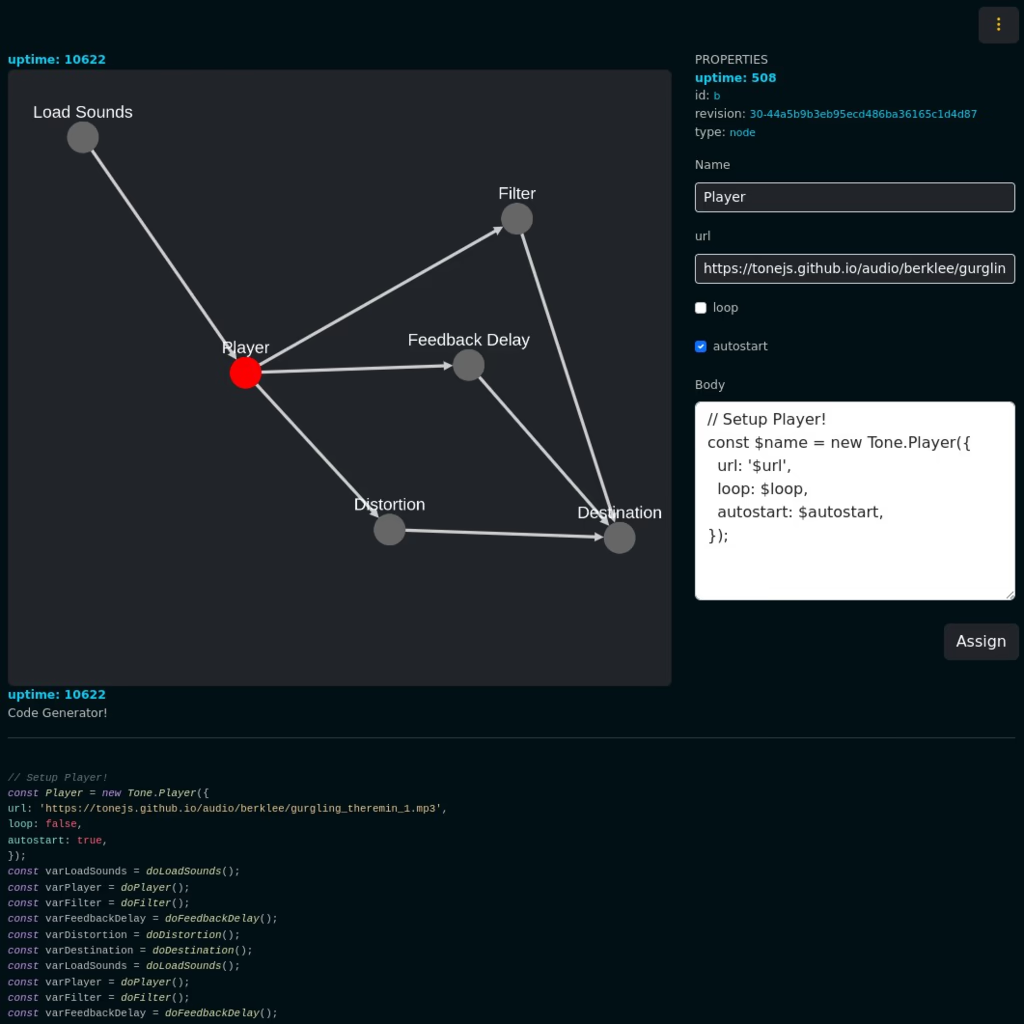
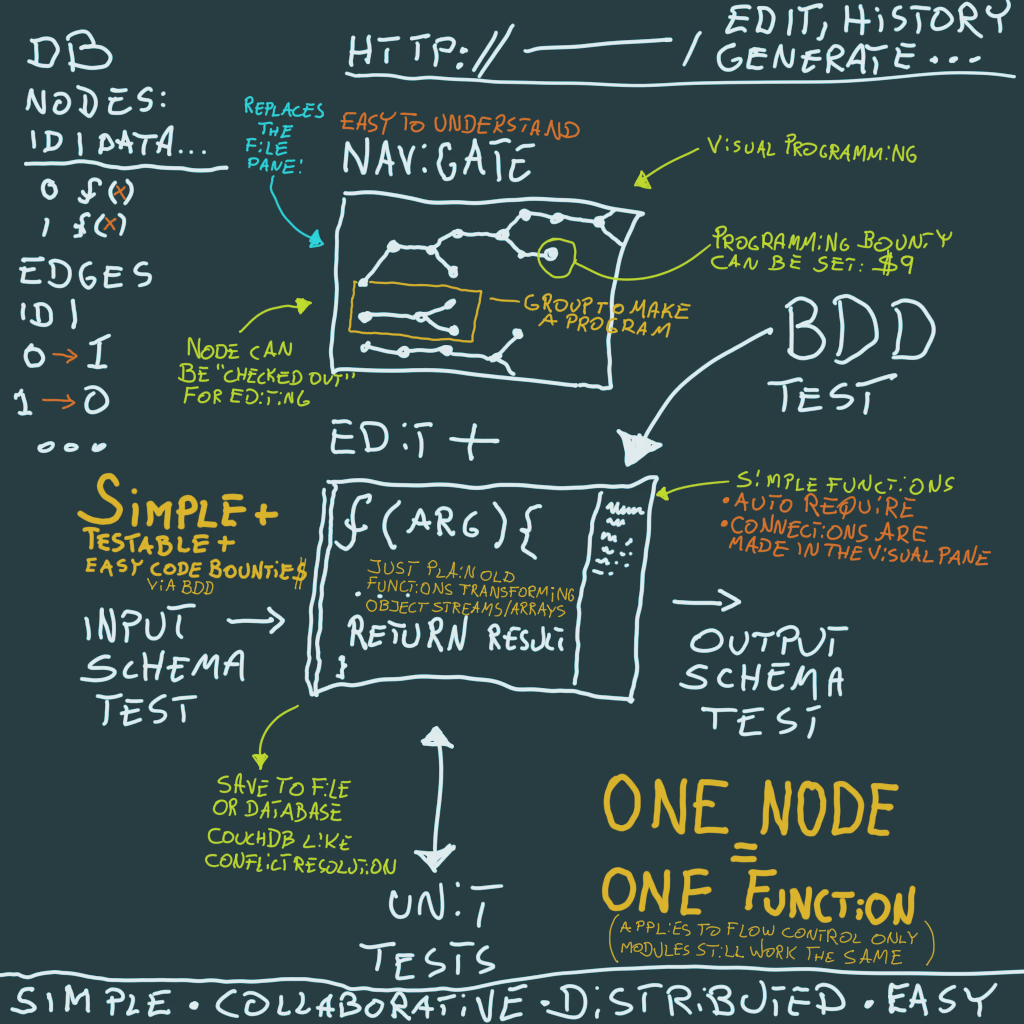
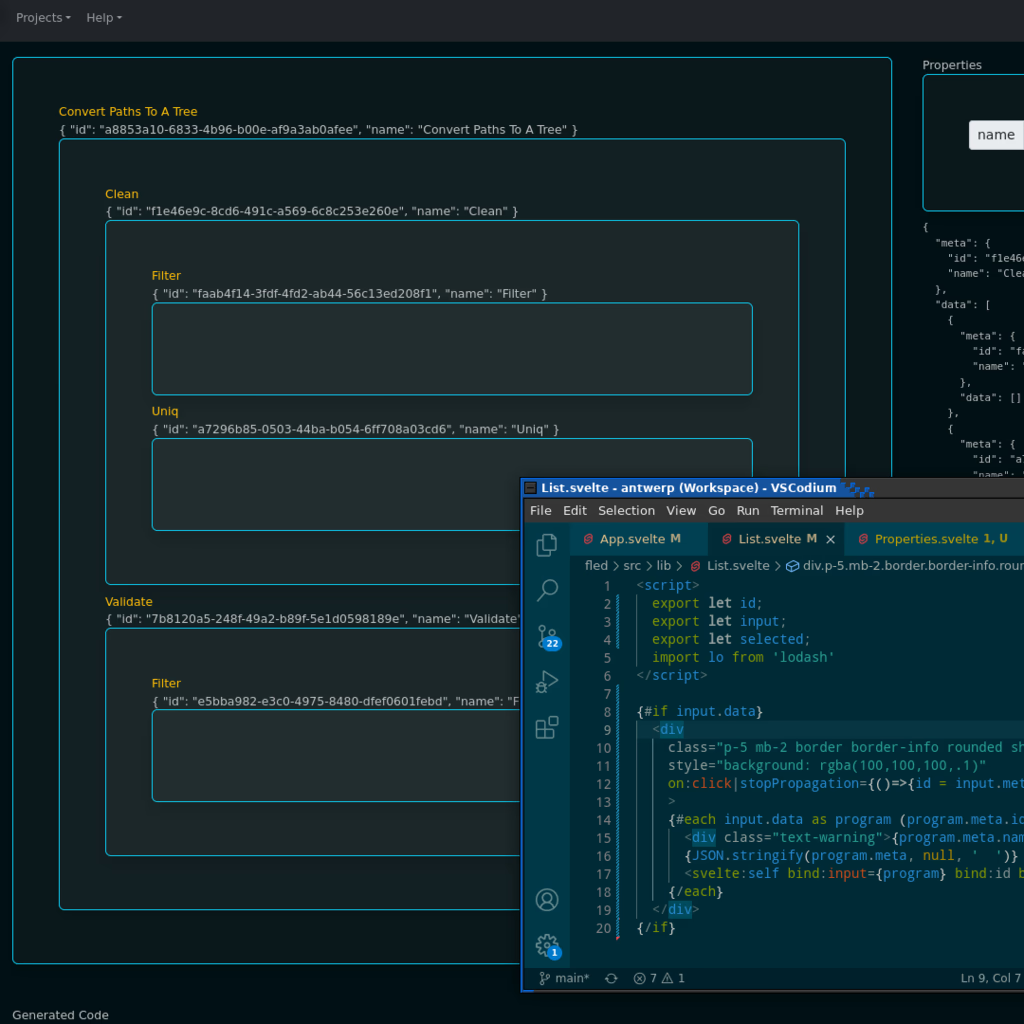
Local HTTP servers are the ideal way to ship serious UI applications: a browser connects to a local port, allowing remote access, sharing, cross‑connection and portability (e.g., on an RPi). The entire stack runs in JavaScript—client side with HTML/JS and server side with plain JS—to keep things simple and web‑native. The interface is essentially a tree of nodes that can be decorated: tags for the pros, visual ports for artists, or familiar Finder‑style panes for novices; editors like CodeMirror/Ace provide built‑in code editing. Files are only generated on demand and aren’t the core of the program—each function lives in its own note with optional input/output schema and a unit‑test spot, enabling BDD per node (description, bounty, etc.). This modular, open‑source approach lets programmers build their own editor and showcase it as a portfolio piece.

·

#0952: On Strange Little Computer Programs

The post reflects on the beauty of small “strange” programs—those whose lines of code relative to their usefulness reveal an elegant simplicity reminiscent of Unix’s “do one thing and do it well.” It praises editors, Wikipedia, early phones, and microjs.com as examples where minimalistic design yields powerful, flexible systems. By keeping command‑line tools tiny yet expressive (the filesystem tree, /proc, device files) and pairing them with simple UIs like dat.gui, developers can build robust yet controllable applications without overcomplicating the code. In short, the article celebrates how modest, oddly‑crafted programs become the backbone of powerful operating systems when left in their pure, unaltered form.

·

#0951: Warrior Nature And Creativity

The post celebrates how adventure stories fuel our growth, imagination, and inner “warrior” spirit, and it argues that culture is never fixed but must evolve continuously to keep everyone moving forward together. It calls for education that keeps pace with the world so no one is left behind, and sees the modern warrior as a creator‑inventor who strives toward greatness through continual learning and invention.

·

#0950: Understanding Visual Programming

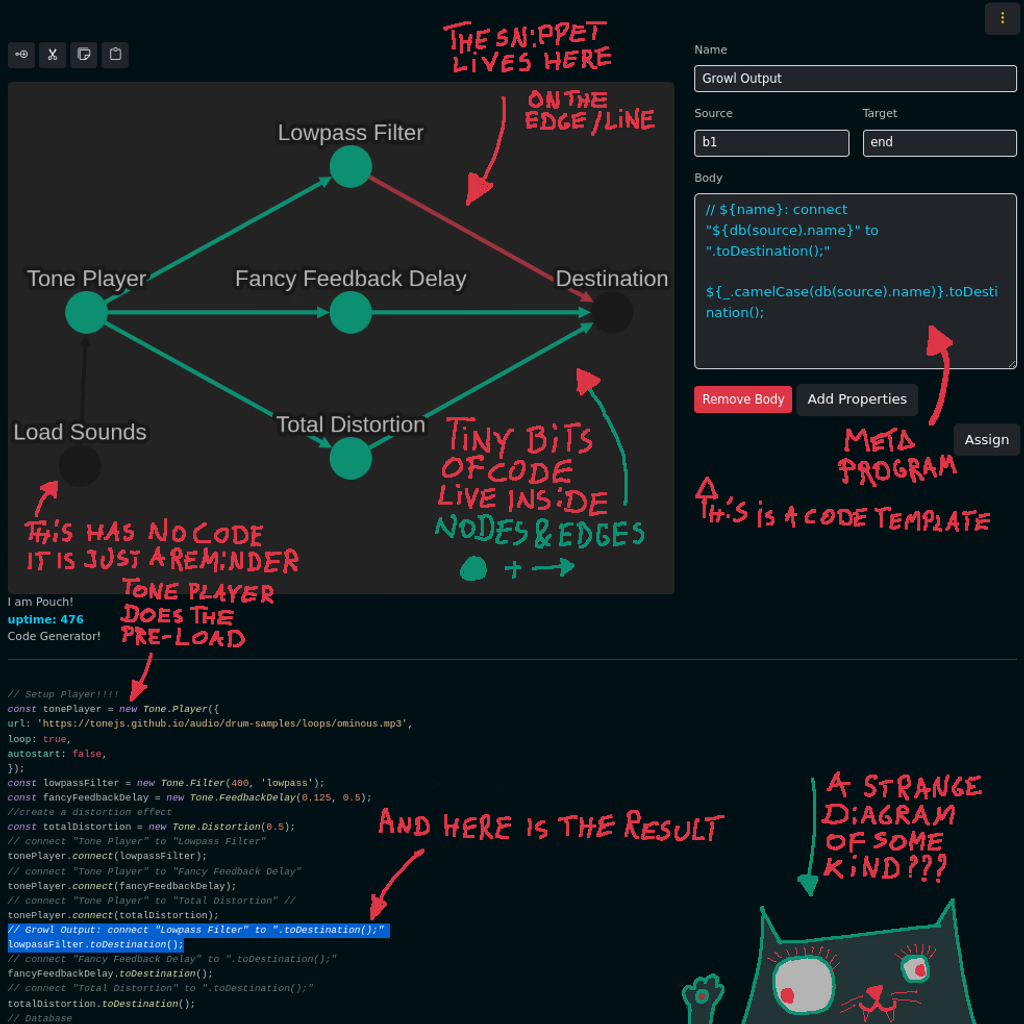
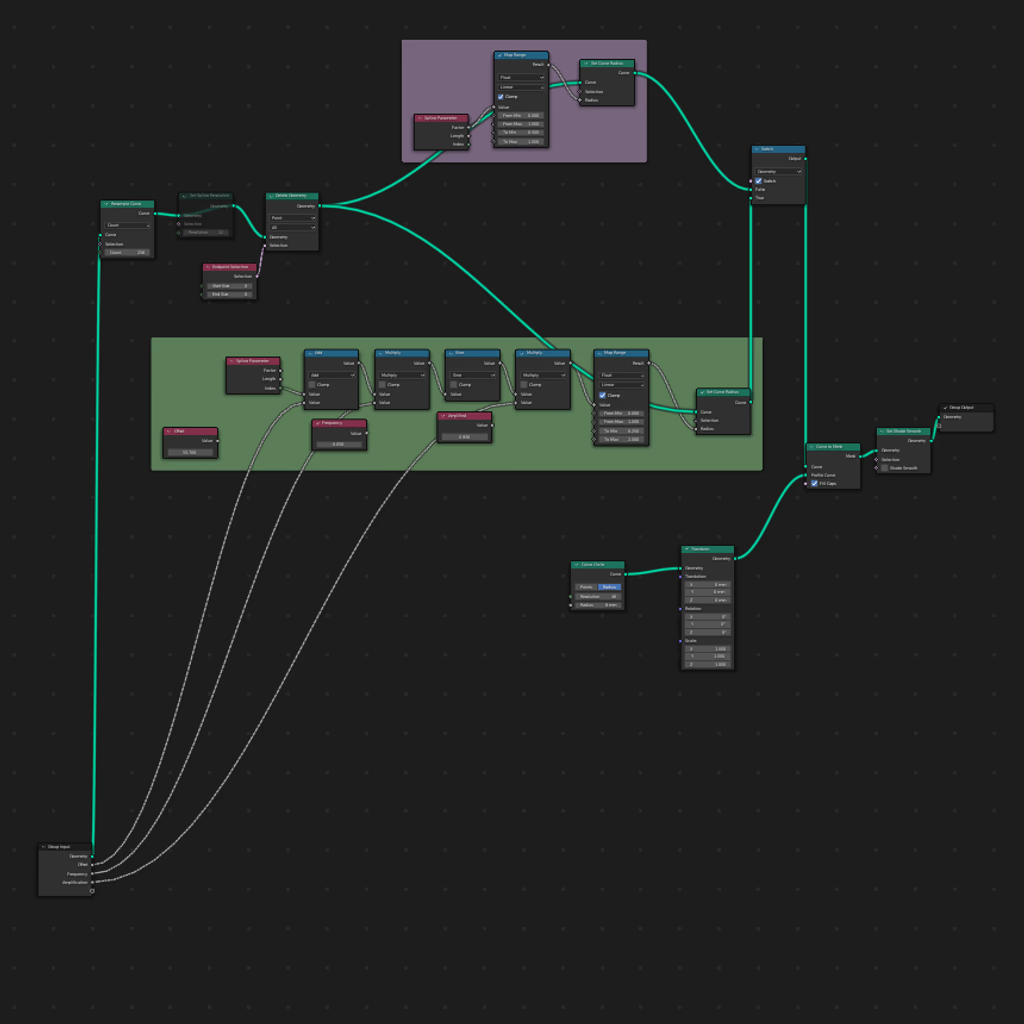
Visual programming turns a simple list of eight questions into a network of interconnected boxes and lines: each question is first placed in a “list” box, then passed through an “ask” box that sends it to the user; lines connect these boxes, making the flow visible and allowing branching logic—completed answers go one way to a database‑save box while incomplete ones follow another path. Additional boxes can be inserted along any line, and each box has sockets for inputs and outputs; a logic box can fan out its virtual envelope into separate outputs (e.g., “complete,” “incomplete,” “error”), which then feed distinct downstream processes such as human resources or sales. In this way the entire workflow—from question retrieval to final human review—is abstracted into a visual, modular diagram that clarifies and streamlines the process.

·

#0949: The Great Halloween Challenge

The post encourages readers to remember their inner warriors and reclaim that spirit by creating and continuously wearing a personalized “superhero” outfit—an imaginative costume that can include anything from swords and wings to lasers and creative perfumes—so that even after Halloween the costume stays in use. It urges everyone to start building this unique suit right away, adding elements that reflect personal strengths, and to adopt a superhero name that represents their identity. By doing so, we join a new fashion revolution that celebrates individuality and transforms everyday life into an ongoing display of self‑expression and empowerment.

·

#0948: World School: The Most Beautiful Future

The post proposes creating a “world school” that will operate with anti‑corruption mechanisms—such as graduate voting and self‑paced, game‑based learning instead of grades—to give students the freedom to study outside tainted lectures. It envisions inexpensive devices (music players with narrated books in multiple languages) that help relieve stress and sleep while removing indoctrination, and calls for teachers who recognize gifted pupils and guide them without terrorizing others. The school will be available to people moving away from danger zones, track progress for remote work and job offers, and let students build startups until one succeeds. The author believes that if a billion people join in, the system could be built in a year, just as the World Encyclopedia did.

·

#0947: Cleaning Up The Cat Pea

I built three custom tools—antwerp, stellar‑fox, and rsend—to get my new website up and running: antwerp is a static site generator that turns plain text files into HTML; stellar‑fox implements the HTTP server logic (404 handling, slash redirects for directories, and chunk‑streaming of files) so I can serve content efficiently without loading entire files into memory; rsend handles remote data transfer by fingerprinting changed files to update the site quickly on a Raspberry Pi. After fixing many UI bugs, I reflect that programming feels like a living skill rather than merely learning a language.

·

#0946: Busy Bee

The post argues that true learning comes from engaging directly with books and exploring ideas independently rather than following rigid, “standardized” curricula; it praises the act of opening a book at its beginning, watching concepts unfold, and letting curiosity guide one through the text, while dismissing oversimplified theories as mere crayon sketches. The writer claims that teachers sometimes feel like operators in a factory, pushing students into debt‑laden programs that lack real value, and stresses that the real wisdom lies in wandering trails of knowledge—books in libraries, audio recordings, and music—where one can freely discover ideas and build understanding from scratch to mastery.

·

#0945: Programmers Shmogrammers

A passionate programmer describes how his life revolves around inventing small programs—timers, calculators, 3‑D gadgets—and doing it for fun, not merely for a paycheck. He believes coding is an art that requires self‑study and creative problem solving rather than rote interview questions, and that real learning comes from building things “inside out.” With limited time he often completes projects alone, finds the usual interview routine tedious, and prefers to pursue his own projects—like 3‑D printing tools or music composition—rather than answer typical binary or OOP trivia. He sees programming as a creative, almost artistic craft that should be practiced through experimentation and personal projects rather than formal schooling, and he ends by calling himself a “watchmaker” of code.

·

#0944: Learning Programming Is Easy

The author argues that subjects are fascinating yet poorly taught by teachers, and proposes learning programming through p5.js and related tutorials to automate math; he cites Bresenham’s circle drawing algorithm and node.js HTTP server examples, suggesting that mastering these tools can spark curiosity and lead to deeper knowledge. He stresses the importance of self‑initiated study over classroom instruction, encourages exploring helmet npm documentation, and believes that reading narrated nonfiction books enriches wisdom. Ultimately, he claims that combining programming practice with continuous learning transforms a person into a “great being” who discovers meaning through personal quests.

·

#0943: The World Must Grow

The post argues that true knowledge and wisdom—obtained through education—are the keys to uniting cultures, raising social classes, and ending war, poverty, and inequality. It claims that cultural divisions arise mainly from uneven levels of schooling, and that modern public schools have become standardized, ineffective tools that merely pay off students rather than teach them. By returning to “real” knowledge, borrowing solutions by analogy, and making beloved books and subjects truly accessible, we can create a new world where no one asks if they have a problem and everyone is connected as family. The author believes the meaning of life lies in knowledge, wisdom, culture, class, and compassion, and that only when schools become real again—when people rise together and each aims to become great beings—will the world truly grow.

·

#0942: Of Computer Servers And Potatoes

I recently uploaded a 5‑gigabyte archive that already contained about 4.5 GB of data; the disk ran out of space, so I canceled and recreated the hosting account, losing my coupon but earning a $30 refund for three months. The software on the old server was awful, so I’ll move to a barebones Debian setup on a Raspberry Pi instead. I used a tar archive—essentially a zip file without compression—which unpacked in just a minute or two; if I’d uploaded each file individually it would have taken much longer. The entire 10‑GB upload now works fine and has taught me a lot about programming as an art form, even though the server runs on 1990s technology at $9/month.