·

#0869: Writing Programs

The post recounts the author’s journey through multiple programming languages—starting with PHP and Perl, moving into Java and JavaScript—and culminates in their current full‑stack workflow using modern JavaScript tools. They explain how the evolution of web technologies—from early UI frameworks like Flex and Flash to today’s responsive libraries such as Bootstrap—has shaped their development style. The author highlights the convenience of JavaScript for rapid prototyping, the power of Babel for transpiling next‑generation syntax, and the event‑driven nature of engine.io that simplifies server communication. They also showcase how tools like Svelte automate UI updates, while Gulp and Vinyl provide a lightweight build system, allowing them to create custom code editors on the fly. Overall, the piece celebrates the synergy of these technologies in enabling a single developer to design and maintain both client‑side interfaces and server logic with minimal boilerplate.

·

#0868: Modern Luxury Source Code Editors; Or, Where The Heck, To Put The Darn Source Code?

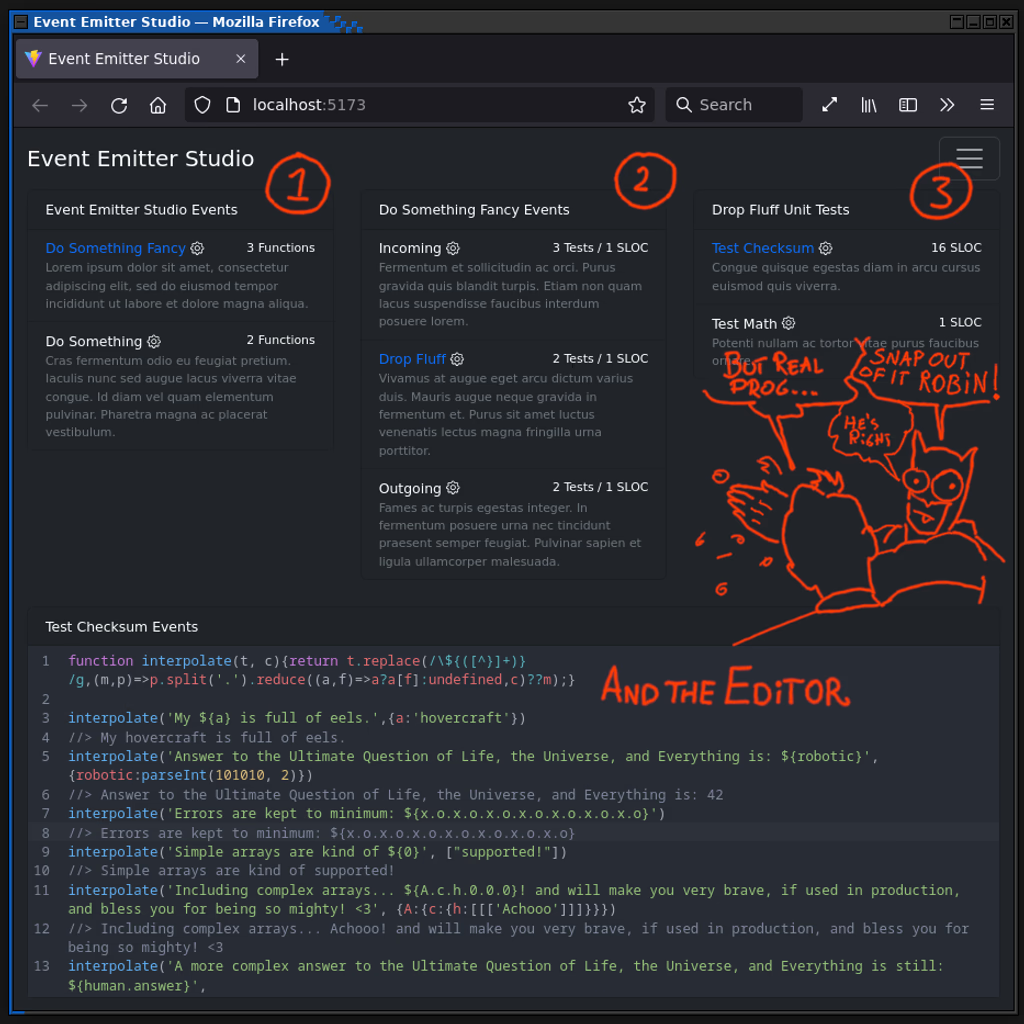
I propose that the future of programming lies in a self‑guided, visual IDE that replaces the old terminal and “smartphone” concept with a simple, three‑column layout: an event list, a function list that processes those events, and a test list for each function—all beneath a code editor where the programmer can edit the handler and its tests. By adding a “build” button the system automatically generates a ready module (node stream or command‑line app) that can be committed locally, letting newcomers focus on writing logic rather than boilerplate while still seeing how their functions integrate into an EventEmitter pattern. This approach should make programming accessible to the modern teenager and keep the programmer’s role alive in an era where smartphones are viewed as too simple for true development.

·

#0867: Do Not Lose Faith In Humanity

The post describes a world beset by war, famine, and looming nuclear threats, where evil acts are largely the result of chance, chaos, and poverty rather than deliberate design. It argues that “evil men” are shaped by extreme hardship and lack of education, not innate traits, and can be healed through education—specifically by establishing schools that illuminate minds and provide a place to return for those who have lost their way. The author emphasizes the power of honest answers and shared knowledge (even via audio) to unite humanity as one family and to prevent further fracturing, urging readers to maintain faith in people, gain wisdom, and become “great beings” so that pain and tragedy can be transformed into lasting meaning.

·

#0866: The Fanciful Event Emitter: A Super Strange Programming Poem

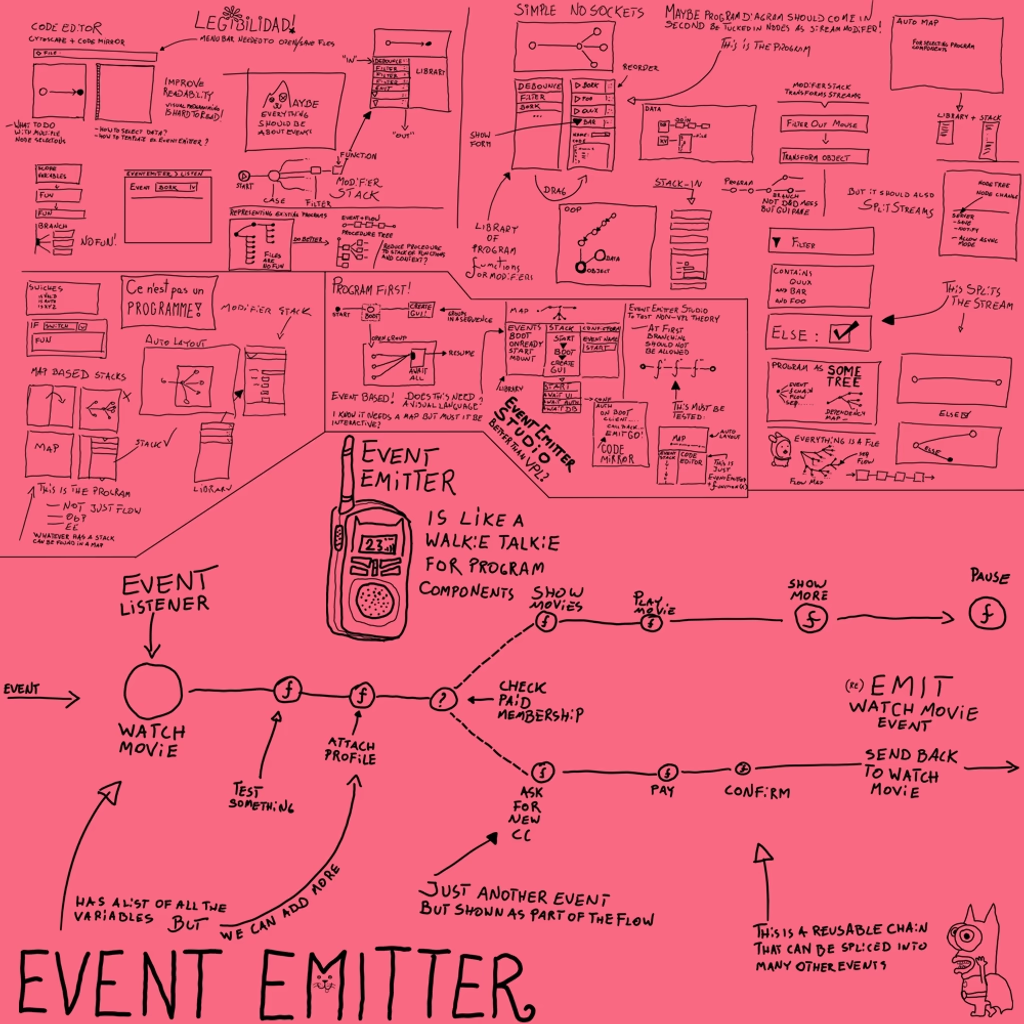
The post explains how JavaScript’s EventEmitter works—events are fired (e.g., a mouse click), carry data like `x=5` or `user=alice`, listeners are set up to react, and some libraries let you use wildcards to listen to many events—and then tells a story about an interview where a candidate built a program around these concepts but over‑engineered it with extra abstractions that made the code hard to read. The author praises a minimal EventEmitter architecture as clean and extensible, and suggests visualizing it as a graph: nodes for listeners, edges for emitted events, so if‑statements become just more listeners in the chain. By treating variables as data carried by events, you can click on a listener to see its inputs. In short, the post argues that using EventEmitters keeps code simple and maintainable, and visualizing them as graphs helps understand, track, and generate such systems.

·

#0865: Little Stories From Nordhouse Dunes

During a weekend stay in a State Park, I set up a campfire and cooked hot dogs while a nearby family of teens unpacked beside my tent. While listening to an iPod playing Paul Strathern’s “Philosophy in 90 Minutes” series, I chatted with the family’s mother about audiobooks and shared firewood, batteries, and bug spray. Afterward, I recounted Bill Bryson’s “I’m a Stranger Here‑Myself,” humorously noting Grover Cleveland’s window‑pee anecdote, before renewing my parking permit at the dune trailhead and meeting a couple of regular visitors. The day continued with scenic climbs, observation platforms, and encounters with deer, horses, and even a raccoon drawing I’d shown to the park ranger. Throughout, I enjoyed the lush pine canopy, the quiet beach‑like lake, and the varied “seasons” of Nordhouse that made the woods feel both calm and vibrant.

·

#0864: The New School; Or, Building The First Imperfect School That Is Worthy Of All The Future Generations

The post describes an innovative, open‑school format that uses interactive left and right panes—guidance and hands‑on manipulation—to let students build products (from simple web themes to phone apps) without time limits or grades, relying instead on unit tests and a marketplace where customers post component requests with budgets; multiple students can submit solutions, the best is chosen by the poster, and payouts are distributed (e.g., $900 for the winner, $10 symbolic rewards for others), while the school collects a fee—an approach that aims to pay students for instruction and production, encourage real‑world product creation, and motivate continuous improvement through feedback from users; the author believes such an environment enables learning of math, physics, chemistry, and art via interactive visualizations (e.g., converting notation to code as in 3Blue1Brown) and Blender tutorials, with tutorial videos and live support seen as key assets that can lift students out of poverty.

·

#0863: Schools Where Teachers Are Trained To Teach Students Who Just Want To Learn

The post argues that teachers should let students pursue their own interests so that learning becomes meaningful rather than rote memorization, noting that overwork or stress hampers self‑education; it claims bad grades push students into temporary recall instead of real understanding, and that schools often kill creativity and need to be repaired by encouraging independent study of wise books and adventurous experiences, which ultimately leads to personal growth and greatness.

·

#0862: Into The Fray; Or, Code Generation And The Search For Motivation To Learn Programming

The post argues that building a successful solo‑programming business is difficult because you’re up against multi‑person startups, but failure can become an asset: by learning what works and selling those solutions to other startups, you turn experience into reusable products. It contrasts the solitary coder’s chaotic creativity with collaborative teams, suggesting that solo developers thrive when they focus on code generation—using simple template engines like ejs or AST tools—to automate boilerplate and quickly produce marketable items such as website themes in JavaScript; this approach not only speeds development but also creates a repeatable product line that can be sold, turning individual coding effort into a scalable business model.

·

#0861: I Went To The Woods; Or, Don’t Let Broken Schools Frighten You

After reflecting on how schools often fail to deliver lifelong learning, I argue that self‑education—beginning with acclaimed non‑fiction titles and continuing through hands‑on projects such as digital painting in Krita, 3D modeling in Blender, or JavaScript programming—provides the real path to intellectual independence. By embracing curiosity, treating learning as a joyful adventure rather than a graded test, and taking responsibility for one’s own growth, students can become “great beings” who build better schools that lift humanity out of poverty.

·

#0860: What Is In A Programming Language Anyway?

The post explains that programming boils down to organizing data and behavior into a coherent structure using the core building blocks of variables, functions, if‑statements, loops, and objects—each grouping the others in a natural hierarchy. Variables hold values (like “serverAddress = 'example.com'”), functions perform actions or return new variables, if‑statements branch logic, loops iterate over collections, and objects bundle related variables and methods together (e.g., `player.go('north')` or `room.connect('north', createRoom('Bathroom'))`). The author illustrates this with a MUD example where rooms, players, and inventory items are all objects that expose methods such as `.go()` and `.drop()`. He further notes that HTML tags can be seen as dehydrated object hierarchies, and templating engines like Svelte hydrate them back into live objects. In short, the article shows how to think of a program as a nested set of objects whose properties (variables) and methods (functions) are orchestrated by control flow (if/loop), making JavaScript an ideal language for building such structures.

·

#0859: The High School Cookbook

The post proposes a cookbook‑style guide for learning math and programming in a real‑world context—specifically as a tool to lift people out of poverty. It frames each lesson like a recipe, with clear examples (including links to video tutorials) that students can browse, test, and master at their own pace, gaining “powers” to tackle more complex tasks. The guide also includes practical challenges such as building a startup from idea to funding, all designed for one person to complete without discouragement. Finally it envisions the book being freely available in the public domain or under GPL, inviting community contributions of bugs, repairs, translations and enhancements, with the ultimate goal that learning “grows up” until everyone becomes wise and great beings.

·

#0858: Real School And Subject Divisions

The author proposes re‑structuring education into a flexible, tree‑like system of subject clusters drawn from real‑world fields such as those listed in Y Combinator’s RFS (e.g., Education, Software, VR/AR, AI, Healthcare, Government 2.0, Nature & Adventure, Art, Design, Music, Web/App Development, 3D Modeling, Open‑source OS, Jewelry via JSCAD, etc.), allowing students to explore and revisit topics at their own pace; they argue that current subject divisions are wrong, schools are misused, and war is a distraction for leaders; they envision an economy where universal income (US$100/day) supports students, who learn math by applying it to entrepreneurial projects; the system eliminates grades and graduation, keeping doors open for continuous learning.

·

#0857: Cats And Dogs Living Together

The post argues that creative pursuits—painting, programming, composing, rhyming, singing, sculpting, building, and inventing—are all forms of genuine knowledge because they interconnect and reinforce each other. It illustrates this with 3‑D modeling, where understanding vertices, edges, and faces is essential not only for the models themselves but also for designing effective user interfaces; mastering these concepts enables richer UI design even when it seems complex at first glance. The author then describes a “hacker” as an educated, cross‑disciplinary thinker who can surpass specialists by applying knowledge from one domain to another, and emphasizes that such versatility is rare but powerful. Finally, the post laments how modern schooling often delivers fragmented, pre‑packaged learning that stifles this cross‑stream thinking; it calls for a reformed education system that nurtures continuous growth and creative synthesis rather than rigid grades or standardized exams.

·

#0856: GPA Is Sus

The post argues that contemporary schooling relies on a system of threats—bad grades, class attendance, lunch fees—and the promise of future benefits (military enlistment, college admission, student loans) to keep students obedient, but this approach neglects real learning and curiosity. The author claims that grades are merely a fabricated metric used by teachers and colleges to gauge performance rather than knowledge, and that interviews and standardized curricula further reinforce cramming over true understanding. He suggests that if education were truly based on knowledge and self‑driven exploration, students could launch startups, deepen their expertise, and achieve real growth instead of merely pretending to succeed for future opportunities.

·

#0855: Of Denial Of Education, And The Problem Of Sequence

The author argues that many problems—crime, war, poverty—stem from a “sequence” of misapplied fixes rather than true solutions: people become criminals when stress turns ordinary individuals into hardened actors, yet prisons only lock them in that state; similarly, women’s lack of education is a deliberate tool to keep them obedient and prevent uprisings. He calls for real, individualized learning—beyond “fake” schooling—to empower people to start businesses, innovate, and escape poverty. Finally he urges the world to adopt universal income and free, quality education as a means of rebuilding humanity, so that every nation can offer its citizens true learning and thereby unleash their greatness.

·

#0854: The User As A Programmer

The post opens with a rant about the endless troubles in programming and the irony that writing less code sometimes brings more success, then critiques confusing languages, startup advice, and broken interfaces; it proposes that real value comes from letting users build simple programs on their phones by composing small “actions” into sequential groups, providing an action marketplace and attaching conversational user‑interface components to those actions so that each step can pop up with its own UI when executed—an approach grounded in functional programming that keeps the program structure clear while giving users a tangible way to create, customize, and monetize their apps.

·

#0853: The Cure And The Humanity

The post paints a poetic picture of a “multiplex” that burns books, builds walls and prisons, destroys minds, and feeds on poverty and distraction—only needing five books to infect the mind. It says its greatest fear is the non‑follower, the hidden thinker, and proposes that the cure lies in the voices of young people who narrate their own knowledge: by reading, speaking out against old ways, they become philosophers, artists and scientists, understand politics, heal divisions, and bring humanity toward greatness.

·

#0852: Programming Is Fun

The post celebrates the accessibility of web‑development tutorials by highlighting Svelte’s clean, step‑by‑step guide (and its counterparts in Vue.js and React), and argues that learning programming is a matter of building mental scaffolds rather than memorizing formulas; it points out how prior knowledge speeds up the process and how free‑form tools like p5.js let you explore math through sound, graphics, and vector manipulation—so that the routine calculations become automatic and you can reinvent concepts such as vectors, magnets or attractors—ultimately stressing that programming offers limitless horizons for anyone who pursues it on their own terms.

·

#0851: Find Your Own Books: Authentic Knowledge Comes From Everywhere

The post reflects on individual learning styles and the need for personalized reading, asserting that each person’s pace and sequence of understanding are shaped by their own knowledge and experiences; it argues that no single textbook can teach everyone, but every book offers useful ideas suited to its reader. It notes how passion can be lost under waiting lists or insufficient prerequisites, and how authentic learning empowers one to spot liars and manipulators in a world overwhelmed by pretenders. The author calls for self‑education through countless powerful books, stressing that only by rising above poverty, stress, and misdirected curricula can we recover peace, safety, and wisdom.

·

#0850: Programming By Describing Actions In Plain Text

The post proposes a flow‑based programming model that relies on event listeners to drive streams of data through simple processing steps—illustrated by tracking mouse X,Y coordinates across a web page, filtering them only when the button is pressed, and then painting colored pixels along the path. It envisions building such programs as a sequence of text paragraphs that describe each step (listener, filter, painter) and can be assembled into a visual graph using Cytoscape.js; this text‑first approach lets developers describe functionality before it exists, while an automated code generator turns those descriptions into unit tests and bounty posts for missing parts.

·

#0849: Fancy Little Rings

I started by learning hard‑surface modeling in Blender and built a box of wallets and dodads, then moved to Krita to improve my drawing skills with portraits and reference images; later I returned to Blender for sculpting, geometry nodes, and procedural generation of hinges and rings, leading me to design my first Captain Planet ring. During this process I discovered a Baroque kit‑bash on CGTrader, purchased 150 neat decorations for $5, and imported them as .fbx files into Blender, setting origins and scaling appropriately. Using the lattice modifier (resolution 4) and mirror modifier I could distort and duplicate the flat arrangements around the ring, though my initial Boolean unions failed to fuse the rings into a single object; I plan to simplify by keeping one Boolean operation. Overall, the post stresses that keeping geometry simple, using mirrored copies, and limiting adjustments to one side helps avoid errors, and concludes with encouragement for beginners to practice jewelry modeling in Blender by loosely recreating Captain Planet or Dark Souls rings.

·

#0848: You Are Royalty, And Wisdom Is Your Treasure And Armor

The post argues that a world full of liars can be redeemed by “free and open” books, especially those narrated or written by their authors, and that libraries are the key to shaping a wiser future. It calls for classrooms that become adventures rather than rigid factories, urging students to learn through exploration. The author then quotes Vonnegut, Rand, Thoreau, and Whitman as examples of how literature can spark personal growth and societal change, and ends with a rallying appeal: let wisdom be our treasure, and let the best of quotes and poems seed future writings.

·

#0847: The Drawing Tutorial; Or, A World Tricked Out Of Learning Art

Drawing with reference images in Krita is simple and effective: set the image at 50 % opacity, use the eyedropper for accurate colors, and practice with cheap pen‑and‑tablet setups. Tutorials on YouTube help you master this workflow, while other creative fields—like jewelry design or metal casting—can be explored once comfortable. The post also stresses that many artists claim “tracing” is a flaw, but using reference is simply disciplined practice; humility and honest self‑description (“I’m just practicing shapes”) keep you on track. By consistently learning from references, sharing your progress, and teaching others, you can grow into a confident hyper‑realist artist who exhibits in galleries and leads local workshops.

·

#0846: Write Right

The author describes the creative process behind writing a whimsical poem that blends their love for programming with playful wordplay and self‑learning of English. They recount how they began the piece after waking up feeling bored, struggled to find an interesting topic, narrowed down from 47 options to 11, then finally chose one theme. The poem itself mixes technical references (e.g., “programming is a lyrical flea”) with playful rhymes and puns (“peel”/“kneed”), reflecting both the joy of coding and the challenge of mastering language. Throughout, the narrator humorously narrates their journey from learning basic words to forming full sentences, illustrating how practice turns simple sounds into meaningful expression.