·

#0485: Fixing Politics By Throwing Computers Into The Mix

A visionary computer program was designed to solve national problems by engaging educated voters in direct decision‑making. After realizing that politicians were misled and incapable of addressing mass incarceration and other crises, the program gathered “nerds” who coded it into a system where every citizen could vote on key definitions—first, what constitutes real education—and then break tasks down into jobs and sub‑jobs for collective execution. The program’s logic eliminated the need for traditional representatives, allowing citizens to directly shape policies that transformed classrooms into businesses, lifted people out of poverty, reformed prisons into hospitals, and ultimately restored faith in governance by making voting the core engine of change.

·

#0484: Like Leaves On A Tree

The poem celebrates humans as fluid, creative thinkers rather than mere workers or rule‑followers, urging us to reshape old systems and politics with fresh insight. It calls for genuine learning—re‑reading books and gaining wisdom—rather than superficial study, and frames our progress like a river that needs sunshine, wind, rain, and snow to flourish. The verses conclude that true lessons grow organically, as leaves on a tree, rather than being imposed or taught from the top down.

·

#0483: To Fix The World

The post likens a nation’s laws to source code, arguing that by rewriting this “program” we can end poverty, mass incarceration, unfairness and poor education. It stresses that many people accept the status quo because they never question inherited culture; real learning is needed to see and fix the problem. Self‑education—through books, narrated versions, interactive lectures and infographics—is presented as the first step toward building new universities and a wiser society. When each person takes responsibility for their own study, the world can be “more meaningful” and become richer in knowledge, wisdom and greatness; this collective self‑study will ultimately reshape laws, culture and future generations.

·

#0482: The Art Of Growing Up

A writer muses that uninterrupted self‑growth—fueled by a wide range of passions from museums to Mars exploration and Raspberry Pi projects—keeps one’s dreams alive, drives continual learning, and ultimately defines the future.

·

#0481: There Are No Ordinary People

The post argues that people who settle into “ordinary” routines miss out on unique growth, urging readers to embrace adventurous, authentic lives—supported by audiobooks—to become truly extraordinary.

·

#0480: Great and Cheerful Philosophical Adventures

Nature walks are presented as deep philosophical quests that reveal a new virtue—cheerfulness—that complements classic virtues, urging readers to prepare thoughtfully for both contemplative insight and practical adventure.

·

#0479: Φιλο Σοφία: A World Of Great Beings

The post argues that dictators fall when successive generations learn to confront them, not only in war but “in time,” because the most powerful weapon against evil is the creative mind of young people; this idea is illustrated by the image of the laughing philosopher and the history of book burnings, showing

·

#0478: A Whole Million Of Somewhat-Interesting Stories

The author opens by stressing the need to heed personal advice and cultural influences while walking one’s own path, and then turns to a reflective practice of consulting an elder self for guidance—an exercise he says even young people can use to tap into wisdom. He goes on to describe his own life as a series of adventures that blend archaeology, programming, and freedom from bullies, noting moments that feel “Indiana‑Jones‑like” and the loss of a precious artifact that has kept him focused on museums. Since about age ten he has been learning programming in a deliberate sequence, and he’s observed how much software is over‑engineered; he prefers minimal, useful implementations that resemble simple command‑line menus rather than bloated programs. In closing he frames following one’s curiosities as a pyramid, where each step builds toward a richer, deeper understanding of life.

·

#0477: For The Love Of Great Expeditions

The author introduces the “45‑minute rule,” which distinguishes an adventure (the initial excitement) from an expedition (the sustained effort), and illustrates it with a childhood anecdote about eating real sandwiches in a bus that never left the parking lot. He then recounts attending El Blizzardo—an event he assumes happens every other year—in New York, noting his lack of preparation for expeditions but also how the experience taught him to be ready once an adventure begins and to document it with plenty of photos and water. The post reflects on a decade‑long journey that began in 1996, ended with learning English and retiring as a programmer by 2006, then reading a thousand books and producing his first audio book by 2016, and promises a new one in 2026. He stresses how creating long, humorous narrations enriches the spirit and how an expedition’s value lies in its ability to make us “greater.” The piece ends with a reminder that adventures and expeditions are all around us, waiting for us to leave our car keys at home and step out into the world.

·

#0476: Super Smart

The post celebrates how true genius emerges from continuous, self‑driven exploration rather than forced training: by following one’s curiosities across subjects and building on previous discoveries, individuals can create unique works that mirror the great minds of history. It argues that hobbies are stepping stones to deeper pursuits, and that being pushed into unrelated fields leads to misery; instead, a lifelong journey of curiosity—beginning in childhood and evolving with experience—creates the conditions for brilliance and world‑changing contributions.

·

#0475: Real Education vs. Fake Education

The post argues that modern schooling relies too heavily on memorization and standardization, treating learning as a commodity rather than a genuine pursuit of knowledge; it claims that this system benefits institutions more than students, leaving learners with shallow facts instead of real understanding, and emphasizes that true education must be authentic, self‑directed, and rooted in meaningful texts that provide deep, transformative wisdom capable of igniting personal greatness.

·

#0474: Real Education Helps The World Grow

Real Education propels individuals forward by keeping them one or more steps ahead of unseen troubles, fortifying their safety, strength, and intellect while empowering them—and humanity—to learn through books, narrated stories, and practical experience, ultimately enabling personal growth and world-changing impact.

·

#0473: Deer: The Happy Little Horses

The post is a playful poem about a bicycle trip in which the narrator sees a group of deer that he likens to little horses and decides to capture the moment on camera. He rides from his driveway out onto the highway, timing his arrival so he can stop just in time, take several quick shots without a selfie stick, then continues back home while enjoying a snack at a rest area. The poem ends with a self‑rating of ten out of ten and an invitation to repeat the adventure, punctuated by a series of attached photos that illustrate the deer sightings, his bike ride, and his happy selfies.

·

#0472: To A Culture Of Knowledge, Wisdom, And Greatness

The post argues that teaching is more than a job; it’s the vehicle for cultural transmission and generation‑building. The author laments how many teachers copy grades from unrelated subjects, treating a C in one class as if it applied to all others, thereby harming students’ self‑evaluation and learning. He claims that this grade‑centric, memorization‑oriented system turns schools into “jobs” that merely reproduce mistakes instead of cultivating knowledge. The piece stresses that good teaching requires deep grasp of fundamentals (e.g., math and programming) and that homeschooling can isolate kids from culture, making them vulnerable to misinformation. In short, the author sees teaching as a cultural mission whose failure leads to repeated errors and a broken generation.

·

#0471: Learning Is Great

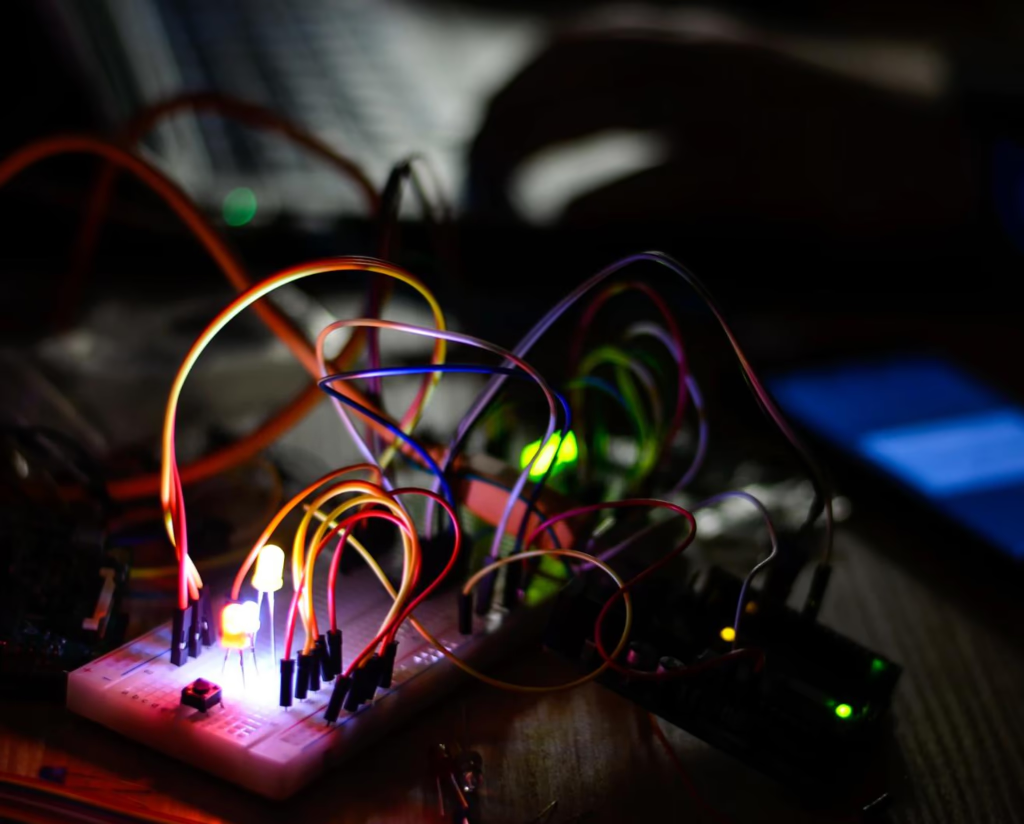
The author reflects on their discontent with traditional math instruction, celebrates a successful personal LED project, and calls for a return to self‑directed learning outside the rigid school system.

·

#0470: Oh Snap! or How Not To Read The Documentation

The author recounts their first attempt at building an LED circuit, detailing how they initially omitted a resistor and consequently burned two LEDs before learning to calculate the correct resistance value. They describe experimenting with various resistor values—10 Ω, 100 Ω, 220 Ω, 330 Ω, and even 51 kΩ—to observe the effect on brightness and LED survival, noting that the proper resistor keeps the LED from burning out while allowing electrons to flow as heat. The post reflects their enthusiasm for electronics, the importance of learning via hands‑on experimentation, and encourages others to try simple circuits with a battery, multimeter, and careful calculation before risking shock or component failure.

·

#0469: All Human Beings

The post calls for a universal renewal of human rights and cultures that guarantee freedom from indoctrination, poverty, and violence. It urges children to learn truthfully and be guided toward knowledge, wisdom, and greatness; it demands open access to all human knowledge through authentic teachers. The text insists on cultures without torture, slavery or detention, free from prisons, with police only serving as rescuers and disarming agents, and a criminal mind treated medically. It also proposes politics divorced from money-making, and laws that are constantly reviewed for their impact on humanity’s hope and beauty. In short, the post invites us to study the Universal Declaration of Human Rights, make necessary repairs, and bring its spirit into our homes so that the future is worthy of all people.

·

#0468: Programming Is Not That Scary

The post explains how to start web development by picking manageable technologies, then details the many layers of hosting and security that come into play once your server is online. It proposes using server‑less functions to keep scaling simple, notes how mobile apps differ from web ones in terms of CPU usage and battery life, and recommends desktop frameworks such as Electron or NW.js

·

#0467: For The World To Flourish

The post argues that a civilization’s maturation hinges on collective learning—self‑education, knowledge, wisdom, and the pursuit of greatness—and that true growth begins when a people can reflect upon themselves and fill their minds with books. It insists that world peace is essential, so conflicts must end and cultures share a common vision of wisdom. The text stresses educating younger generations in stressless environments, encouraging them to build companies and plan rational futures, while reminding adults to correct mistakes that drag the world down. Ultimately it calls for a relaxed, cheerful upbringing, removal of errors, and a peaceful world where each individual sees their own growth as part of collective improvement.

·

#0466: The New Wonder Of The World

The post asserts that real learning comes from passionate teachers using flexible, computer‑assisted lecture models that encourage true understanding instead of rote memorization, urging a shift toward genuine education across all subjects.

·

#0465: Super Nintendent Meow

The post outlines a three‑step plan to build an integrated system: first, create a computer game that earns players fame; second, develop an editor and automator so they can become creators themselves; third, set up a marketplace that frees them from poverty by enabling them to sell their creations. The author describes this as a “school” that teaches abstract thinking and lets students learn without draining their accounts, using an abstract language that speaks worldwide and erases hate. They envision the system evolving through successive implementations—audio‑book creation, music composition with automatic song mutation, and 3D sculpture/jewelry design with automated permutation—each adding a new creative tool while keeping the platform free and open to all, ultimately aiming for world peace.

·

#0464: The Nearly Impossible Journey Towards World Unity And Peace

The post argues that true world peace will come from “real education” built on cultural convergence, where students create independent businesses at graduation instead of chasing grades. These institutions would be open to all, self‑financed by a small share of the businesses’ earnings, and would graduate every student with no expulsions or record‑keeping—just successful business ventures that guide their learning. The author claims current education is uneven, luck‑based, and dishonest; it fails to give people real knowledge, so they must take responsibility for self‑education. If such institutions were properly funded and carried through generations, the author believes humanity would become wiser and more dignified, ultimately achieving peace.

·

#0463: Convergence On Wisdom

The author reflects on reality as a solid wall that many people—especially judges, politicians, and ordinary citizens—struggle to move against, warning that those in power can have their minds poisoned by this struggle. He argues that self‑education is the key to gaining knowledge, wisdom, and greatness, which then empowers individuals to build new schools of “real education” and kindle students’ spirits. Once these truly educated people reach middle age, he predicts an era of convergence where cultures unite in peace and prosperity; without boundless international education the world will again split into divisions, hunger, poverty, and manipulation. In short, real schools are presented as the only way to accelerate this convergence and reduce suffering, war, and regret.

·

#0462: In The Company Of Philosophers

By believing that the world’s most vital changes come when every individual becomes wiser and stronger, this post calls for collective action: we must fix our schools so they lift students out of poverty, inspire them to think like great thinkers such as Greta Thunberg or Ken Robinson, and give them tools to build wise businesses; each person is destined to become a hero and a Great Being, reminding others to grow endlessly; together—through shared wisdom from countless leaders—humanity can overcome its divisions and face future challenges not alone but united.