Archive

Page 16 of 95

Start With Baby Steps And The Little Trails

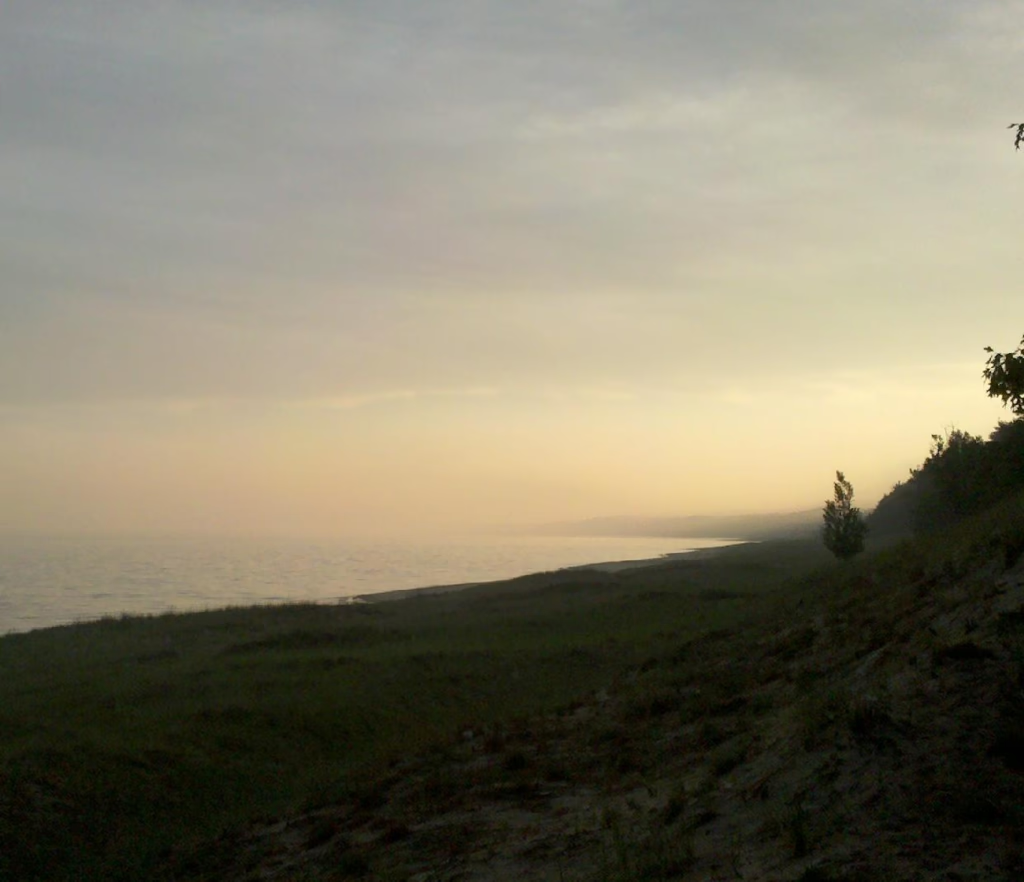
The post outlines how to explore Ludington State Park and its surrounding trails, emphasizing the ease of accessing hiking and camping sites such as the Jack Pine hike‑in spots and the Nordhouse trailheads reachable via either the Nurnberg gravel road or the paved West Forest Trail Road. It details convenient parking options—including free lots near the permit area—, rustic restrooms, showers, and campsites where you can stay next to your car. The guide also points out nearby conveniences like a gas station stocked with snacks, as well as the beauty of Lake Michigan’s horizon that accompanies the walking routes. In short, it offers practical directions and amenities for visitors who want to hike, camp, and enjoy the lakefront scenery without needing to trek far from their vehicles.

Finding Rhymes And Magic, A Tiny Poem Tutorial

The post is a guide on how to write concise rhyming poems, stressing the importance of finding words that fit and sometimes expanding or contracting lines for perfect rhyme. It suggests using a rhyming dictionary or website, practicing different schemes (first–third, second–fourth), and paying attention to rhythm to aid songwriting. The writer shares practical tips such as drafting on a commuter phone for easy editing, keeping a paper journal of favorite rhymes, and recording or video‑recording the recitations to refine delivery. Two sample poems illustrate these ideas: one about a jogging adventure, another about a barking dog named Boo‑Boo. Finally, it hints at using subtle analogies (flowers, planets) to add depth, all wrapped in an encouraging tone that even tiny ideas can become memorable poems.

The Future Legacy

In this reflective essay the author argues that grades and exams are only superficial markers of success—what truly matters is the lasting legacy you build through a balanced life, continuous learning, and creative work. He emphasizes that true fulfillment comes from pursuing passions, not merely fitting into a cubicle or chasing high scores, and that entrepreneurship offers a way to shape one’s own path by choosing what to learn, applying knowledge at an individual pace, and building unique talents that generate real impact. By doing so, we become “miracles of the universe,” capable of inspiring others, leaving a meaningful legacy, and achieving personal greatness in health, happiness, and creativity.

Spring Arrives Nine Days Early: A World Medley

A whimsical poem celebrates the arrival of spring, describing how the author feels the season’s warmth and renewed energy through everyday scenes—a car thermometer reading 70°F, a bike ride across familiar roads, birds flapping overhead, and even the gentle wind that pushes the cyclist back home. The verses capture small joys—mornings of clear weather similar to last June, the rhythm of cycling for ten miles, and the subtle chill still lingering in winter‑clad clothing—all while reflecting on how all these simple moments bring a sense of renewal and creative inspiration.

The Nature Of Greatness

The post argues that our environment—from simple daily settings to larger social structures—shapes our thoughts, behaviors, and ultimately our success or failure. It cites Richard Dawkins’ video on chance and evolution, Zimbardo’s Stanford Prison Experiment and his subsequent “Heroic Imagination Project” as evidence that people can become “terrible” when given certain roles, while also showing how strong environments (e.g., cubicle walls, CEOs, politics) influence mental health. It then turns to Daniel Amen’s brain‑scan study of criminals, suggesting that prisons often worsen the inmates’ conditions and that preventing crime early is key. Finally, it calls for a dual quest: gaining knowledge and wisdom while actively reshaping our surroundings so we can stand against wrongness and help others become strong, meaningful, and lasting in their own lives.

Learning Is Amazing: Adventure Driven Self Education

The post explains how self‑learning music can be both accessible and inspiring, using free software such as LMMS to experiment with classic analog synth sounds—specifically the LB302 (modeled on the 1980s Roland TB‑303) and its simple five‑button interface—and modern digital tools that let you program melodies in a piano roll grid. The writer cites examples from YouTube: a remix of Donna Summer’s “I Feel Love” with the LB302, an LMMS demo showing how easy it is to recreate that track, and a FL Studio remake by Michael Gregory that highlights the minimal‑instrument setup required. They also discuss how Alan Walker’s “Fade” can be broken down into repeating chord patterns (a–b–a–b…) in a piano tutorial, and how the same structure appears in Mad World covers. By combining these case studies, the author shows that you don’t need formal training to produce music—just curiosity and step‑by‑step practice. Finally, they note that LMMS is beginner‑friendly, Bandcamp can host your releases for free, and selling your own tracks opens a path into business and promotion, turning self‑education into both art and income.

To Venus And Back: A Fanciful Flight Of Fancy

The post reflects on the legacy of early computer systems and expert‑AI, muses on how MUDs and statistical AI can shape reality, and finally proposes fanciful reforms—such as a love‑currency tied to Venus—to reshape education, economics, and global governance.

How To Study For Real

The post explains how to learn music programming by starting with a simple LMMS project—specifically a “Faded” clone from Alan Walker—and then inspecting its piano rolls, watching YouTube FL‑Studio and keyboard tutorials, and finally practicing the shuffle dance moves that accompany the track; by combining these resources, the writer shows how to build a learning strategy that turns simple practice into composition and performance.

Do Not Let Schools Trick You, You Are Very Smart

The post argues that genuine learning comes from personal curiosity, playful exploration, and real‑world projects—rather than forced textbook work—and claims that traditional schools often rob students of this freedom.

What Does The Adventurer Seek?

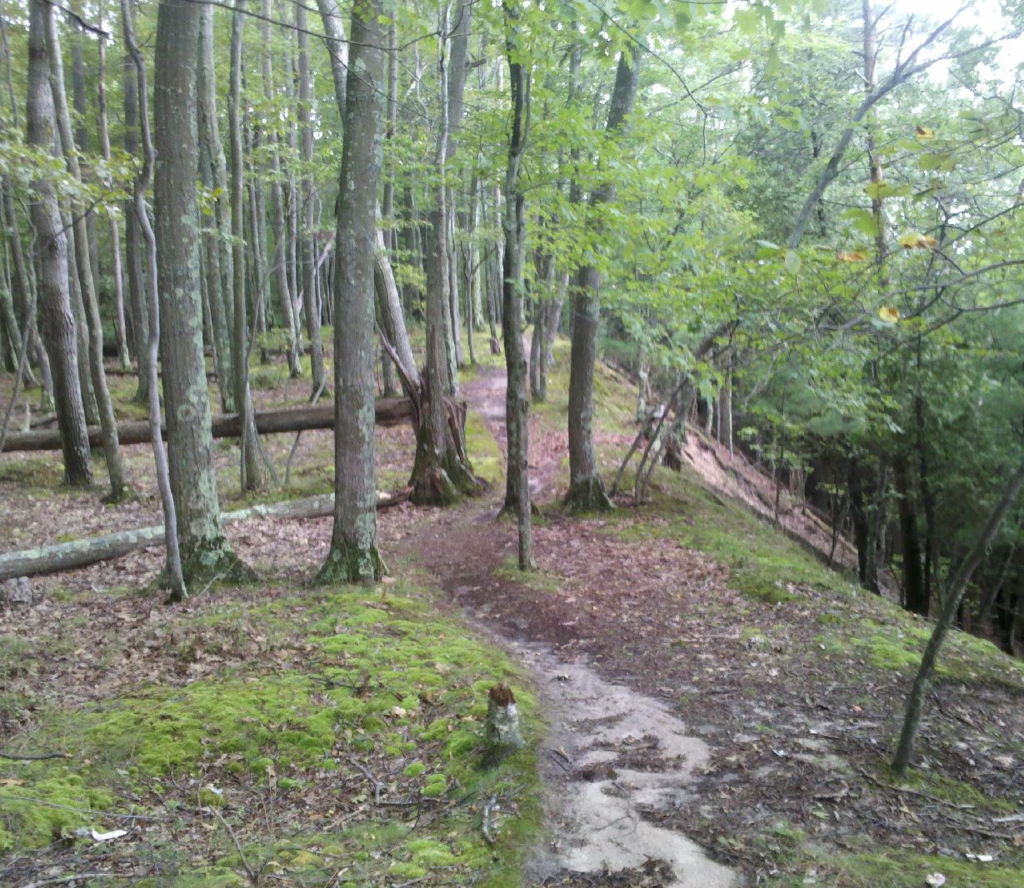
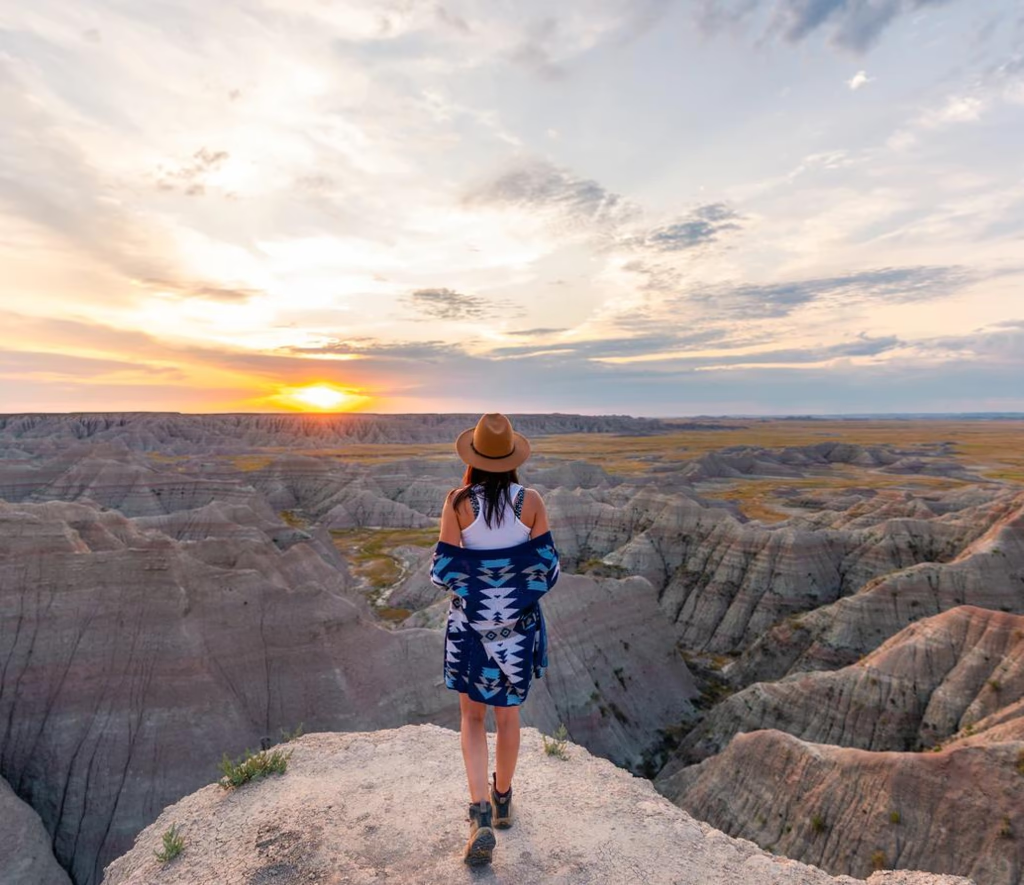
Walking through long trails in nature gives the narrator a new view of life, letting him forget city worries and feel his body heal as stress fades; he notices animals, sights, sounds, and slowly regains health, balance, and curiosity. The experience transforms him into a more authentic, creative person who, after returning to the city, feels confident, writes, paints, composes, and reads about physics and philosophy, and uses this knowledge to help others. In short: the journey on trails brings healing, insight, creativity, and a renewed sense of self.

Song Structure Tutorial with Lil Jazz And His String Orchestra

The post explains how to grasp a song’s structure by listening and then outlines a simple, repeatable framework—opening, intro, action 1, rest, action 2, closing—with each section optionally split into two halves to build tension. It describes the author’s own composition using this model: an opening with slow‑then‑fast parts that mirror in the closing (but reversed), a two‑part intro that introduces drums for smooth transition, two‑half actions driven by strings, a central rest featuring flute to give listeners a delicate break before building back into action 2, and a final action echoing the first but enriched with piano from the opening. The author concludes by presenting the finished track and sharing its audio file.

How To Create A Tiny Product

The post argues that by creating tiny, low‑effort products—digital images, Bootstrap card kits, or handcrafted kits—and learning from quick failures, you can build a portfolio of simple, valuable items and test ideas in the market.

On Finding A Path To Greatness

Prioritizing mental well‑being first, the post urges building a rich, self‑directed intellectual foundation—via audiobooks, exploration, and reflection—and then translating that knowledge into practical business or creative projects to shape one’s own future.

The Experimental Class

The post describes a student’s journey from high school through college and into work, framed by a series of classroom incidents. It opens with an awkward moment in a news class where the teacher gives a kid a “wet willy” after he falls asleep; the narrator leaves the room and later meets the soon‑to‑be principal who creates a new class marked by a poster saying “Wherever you go there you are.” The classmates then discuss their feelings, and the narrator drops out early, receiving encouraging wishes from his peers. After earning his GED, he enters college, lands on the Dean’s list with a 4.0 GPA, and ultimately becomes a programmer—learning at his own pace—and reflects on how these experiences shaped his path.

How Your Generation Can End Fraud And Corruption

By designing simple ES2020 programs that pose user questions in function calls—such as determining the humane nature of the three‑strike law or whether to call police—the author envisions a transparent, self‑adjusting decision system that limits damage from liars and can evolve through human input and voting.

So, What Is Learning Anyway?

The post begins by distinguishing “teaching” (someone else instructs you) from “learning” (you actively seek knowledge) and notes that studying for exams is often just memorization, which the author argues is only a temporary recall skill. Drawing on his own experience learning English through watching cartoons, closed captions, and moving to America, he illustrates how immersion and personal motivation let him internalize language naturally, whereas textbook study or Shakespeare gave little effect. He stresses that true learning depends on interest—“love” for the material—and criticizes schools’ reliance on forced memorization, arguing it stifles curiosity and produces shallow knowledge. Using math as an example, he claims that when students learn concepts through real applications (e.g., building games or programming) they retain them far better than when merely reciting formulas.

The Way The World Is

The post begins by praising humanity as great thinkers, dreamers, and leaders, then laments that our systems still fail—students are overcharged for education, mental health is neglected, poverty and homelessness rise, and people end up in prison instead of care; the author calls on us to recognize these mistakes, document them in personal journals, and propose concrete solutions (e.g., rethinking medical school structures, paying students, reducing memorization). By recording each wrong and its fix, we can build a collective plan that will eventually lead to an integrated world where borders disappear, debt is managed by universal credit, prisons become institutions of care, and humanity truly fulfills its potential.

Little Adventures At Nordhouse Dunes

I drove from Ludington through a series of winding roads—West Nurnberg, West Forest Trail and Porter Creek—to reach the Nordhouse Wilderness Area, where I parked at a small loop near the trailhead and set up camp with a tent and firewood. After gathering logs for a fire, I explored the dunes and woods on the Arrowhead Trail, discovering a new fork that led to a towering dune overlooking Lake Michigan, which offered an impressive view and a quiet spot to sit and listen to my audiobook. Returning to the campsite, I roasted sausage over a campfire, watched the sunset, and slept under the stars while listening to “Electric Universe.”

For Contributions To Human Kind

The author urges a student to pursue a prestigious prize by following a deliberate path: early SAT preparation, enrollment in a top university, entry into cutting‑edge research labs, and focus on anomalous discoveries such as anti‑aging or DNA recombination; he stresses that luck matters but so does proactive planning, noting that schooling can be imperfect yet still offers opportunities. He cites examples like Rosalind

The Lighthouse

I arrived at Ludington State Park and booked a tent spot after showing the booth attendant my raccoon drawings, which she liked. While setting up camp and listening to audio books on my iPod, I met a family whose son played guitar; I encouraged him to listen to audiobooks and later left early in the morning before they could talk again. A few weeks later I returned for another trip to Nordhouse, where I was recognized by a fellow hiker and we exchanged brief conversation while I listened to Paul Strathern’s “Philosophy in 90 Minutes.” After a return home, I revisited Ludington, showed more drawings, and spent the day exploring the hiking trails. At dawn I searched for a shipwreck site, met a scout who explained a baseball cap on his forehead, then proceeded up a dune to view a lighthouse and its surrounding apartment, enjoying a perfect sunset.

Bad Grades Are Meaningless Grades

The post claims that modern schools have turned into profit‑driven businesses where grades and standardized tests drive teachers’ pay, forcing students into rote memorization instead of genuine learning, and proposes a personalized, computer‑aided education model to restore true learning.

Real Education Is Everywhere

The post argues that ordinary school education is limited while “real” learning—rooted in personal interests and practical projects—is far richer: it starts by encouraging you to pursue small businesses that teach money‑making, thus ending poverty and job anxieties. From there it moves through creative arts (photography, portrait drawing, oil painting), music composition with tools like LMMS, and programming/automation using Linux, streams, and event emitters—skills that automate art, compose music, and eliminate warehouse needs. Mathematics is presented as a simple tool for generative music and games, while reading and listening expand into science, electronics, robotics, and drones. As knowledge grows, so do disciplines like philosophy, psychology, education, engineering, entrepreneurship, leadership, and wisdom, culminating in sharing what you learn through audio books, written works, and a portfolio that showcases your experiments and videos.


The Terrible Truth Behind Piano Keys, Scales, Schools and Uneducated Politicians

The post argues that modern schooling, especially in music, reduces learning to rote memorization of theory rather than creative expression; it claims schools treat music as a single block of facts that students must recite for grades, while teachers merely deliver content without tailoring it to individual learners. The author likens musical scales to color palettes—simple pre‑selected sets that allow musicians to express feelings—and suggests that true learning happens when students can freely choose and play in a given scale rather than cram notes. He extends this critique to politics, saying politicians act like actors who perform for votes, and calls for interactive visualizations so both learners and voters can see results clearly. Ultimately he proposes a personalized curriculum built by students, not imposed by teachers or standardized tests, to restore genuine learning and creativity in schools.