·

#0557: The Real Schools

The post argues that modern education is too focused on teacher performance and lecture structure rather than real results; to fix this, lessons should be organized around launching small businesses so students learn programming, soldering, 3D modeling, marketing, etc., with each class forming a “small company” whose collective output yields financial independence. By teaching math and physics only when they serve concrete projects—like building drones, radios, telescopes, or Raspberry‑Pi printers—students see the practical value of these subjects and acquire real skills that translate into marketable products; thus true education is measured by student success (income and entrepreneurship) rather than test scores, and schools must restructure their curricula to create a library of business‑oriented projects instead of isolated subject divisions.

·

#0556: The Quest For Real Education

The post claims that real education is a personalized, self‑paced pursuit of curiosity-driven knowledge—not the standardized, test‑oriented system we currently use—and urges us to reclaim learning as an individual, meaningful experience.

·

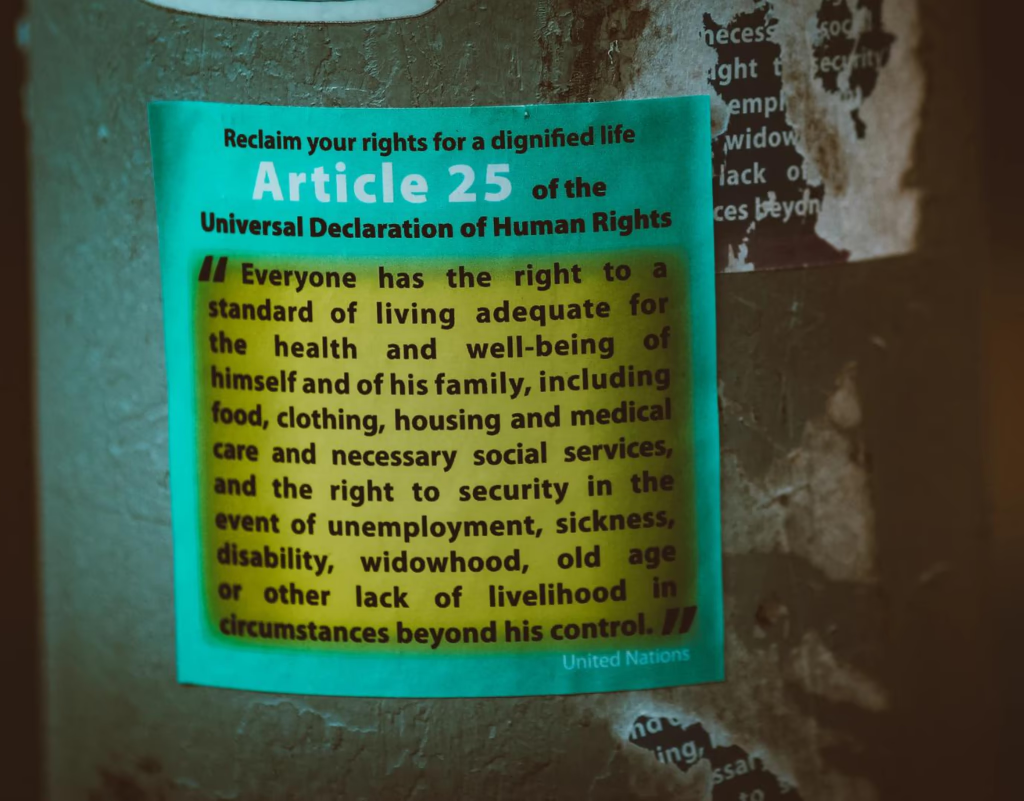
#0555: Programming Challenge: declaration.json

The author explains that people—including US Congress members—are still confused by complex data‑breach issues and are not getting clear answers from companies. They propose writing a human‑centric declaration of rights in a structured JSON format (declaration.json) that uses 128‑bit UUID node IDs so it can be edited and maintained across platforms by many programmers. By mapping nested concepts with mind‑mapping tools, providing profiles such as “Enhanced Human Rights,” the document turns complex agreements into single‑sentence compatibility lists, allowing individuals and companies to present clear statements about bulk data collection, location tracking, and data sales; dashboards would then help track the dynamic components for legislators and other stakeholders.

·

#0554: You Must Expand The Meaning Of Poetry

The post encourages anyone to become a poet by writing every day—starting with one sentence at twilight and then expanding into full stanzas in a notebook—while stressing that true poetry comes from original thought rather than fitting pre‑made structures. It explains that rhythm can be learned with a rhyming dictionary, but the real power lies in chaining words naturally to build fresh building blocks of meaning. By sharing these new creations, the writer not only records personal growth and wisdom but also offers others light and inspiration, thus contributing to humanity’s collective knowledge and future generations.

·

#0553: X and Why: A Real Introduction To Real Mathematics

I recently created a simple p5.js sketch called **math‑101** (available on <https://editor.p5js.org/catpea/sketches/> and the GitHub repo <https://github.com/catpea/p5>) that demonstrates how to draw a stylized tree using basic vector math rather than raw scalars, illustrating why angles, magnitudes and trigonometry are essential for realistic branch lengths; after experimenting with manual code (no functions or loops until the final small‑branch stage), I explain how vectors (magnitude + angle) let me compute x/y components for each branch, showing that a circle’s radius naturally maps to branch length and that simple trig formulas suffice to generate multi‑generation trees—an approach I hope will inspire further generative art such as adding birds, squirrels or animals to the forest.

·

#0552: 3D Models

I recently started exploring 3‑D printing, noting that simple models sell on sites like Thingiverse and Pinshape for about $3–$12 and that the key to a good model is a unique, well‑designed design—one that can be printed with a $200 printer and inexpensive white filament. I’ve been learning Blender (with its 3‑D Print add‑on) and have built a wallet case as part of my self‑study; the design uses thin walls (≈3 mm) to keep printing fast, supports for hinges, and simple geometry that handles warping while still letting cards slide out. After refining the wallet, I plan to apply the same hinge‑and‑manifold approach to a Raspberry Pi case with easy GPIO access, hoping to sell these digital models on online stores so users can print them themselves or have them printed at checkout.

·

#0551: Boss Makes A Dollar I Make A Dime, That’s Why I Learn On Company Time

High‑school should have taught students to build businesses rather than chase grades, and college was portrayed as a “scam” that fails to give real independence; the post argues that a truly functional education system would let learners create successive enterprises that naturally demand math, programming, science, language, history, and social studies—knowledge that can be gained through narrated books read during exchange‑student travels. It stresses that electives are as essential as core subjects, that jobs should support continuous learning, and that the whole point is to lift people out of poverty and into global citizenship. The author cites videos claiming we’ve been misled, urges us to stop living “ordinary” lives, and invites us to seek narrated books, restorative vacations, and healing trails (like the Appalachian or Pacific Crest) as ways to become a “great being” who can change future generations.

·

#0550: Self Education, Blender 3D Print Toolbox, And Non-Manifold Geometry

Using Blender’s free open‑source 3D modeling tools, the post explains how to design manifold models for 3D printing by constantly checking geometry with the “Check All” button; this tool instantly flags errors so you can fix them before exporting an STL file to a slicer such as PrusaSlicer, which converts the model into printer head movements and extruder settings. The author shares personal experience building a wallet with hinges in Tinkercad, noting how small changes in vertex operations (extruding forward then pulling up) can resolve errors that otherwise trigger after each operation. He stresses that mastering vertices and staying within slicer‑friendly geometry leads to high‑quality prints, and concludes by encouraging designers to let their tools guide them while still experimenting with creative shapes, as illustrated by his Cybertruck‑inspired hinge designs.

·

#0549: Education For All The Epochs

The author laments the “fake education” system and urges readers to pursue their own learning path through narrated books and online tutorials, believing that true knowledge comes from self‑directed study rather than institutional instruction; he encourages cultivating a personal passion—whether in art, music, coding or entrepreneurship—and turning it into multiple small ventures so income can grow steadily; he stresses the importance of planning for later life by imagining conversations with one’s future self and making sure to build a career that sustains both financially and spiritually, concluding that awakened genius will multiply with each new book or tutorial and that knowledge ultimately yields wisdom and greatness.

·

#0548: Into Fabrication: Are 3D Printers The Bee's Knees?

The author uses a comic‑book reference—Batman’s useless gun in 1989—to illustrate how a seemingly simple device can become an exciting design challenge. He argues that true ownership of a product starts with its maker, not its buyer, and that learning 3D modeling, printing, and basic machining lets anyone build custom items like wallets, masks or even full‑scale resin kits. By mastering the workflow from concept to prototype, a student can sell his own models on platforms such as Etsy, earn real income, and even outsource finishing work to professional printers or CNC shops. The piece shows that 3D printing is not just about copying others’ files; it’s an entry point into fabrication, product design, and entrepreneurship for anyone willing to learn the tools.

·

#0547: Why Is The Teacher Being Mean To Me?

The post urges students to claim ownership of their learning, confront weak instruction, acquire hands‑on skills (music, 3D printing, coding), launch small businesses, and form collaborative maker teams to lift themselves out of poverty.

·

#0546: Students Must Not Face Broken And Corrupt Schools

The post argues that schools should focus on applied mathematics—such as generative art and programming—to lift students out of poverty, rather than abstract math alone; it claims grades are arbitrary markers of teacher performance, not student learning, and that lectures must be restructured so learners can pause, progress at their own pace, and immediately apply concepts to small income‑generating projects, thereby making education truly practical, inclusive, and capable of breaking the cycle of poverty.

·

#0545: Michigan Adventures

The author begins by humorously redefining Michigan’s Great Lakes as “seas”—the Michigan, Superior, Huron, and Erie Seas—and describes the state’s geography with playful terms like Cape Michigan and Upper Peninsula. From Ohio (“Oh Hi, Yo!”), they set out on U.S. Route 275, passing Bowling Green before heading north to the Upper Peninsula, where a shipwreck museum in Paradise City and a hotel featuring a model ship capture their interest; a day of sightseeing is interrupted by mosquitoes and a stay in a tub‑bedroom. The trip continues southward to Nordhouse Dunes on the coast of the Michigan Sea, where the author spends a month camping, swimming, and roasting sausages, enjoying the wilderness and birdwatching community, and later experiences a dramatic storm that wakes them with thunder, flashes, and rain.


·

#0544: My Little Adventure In 3D Modeling

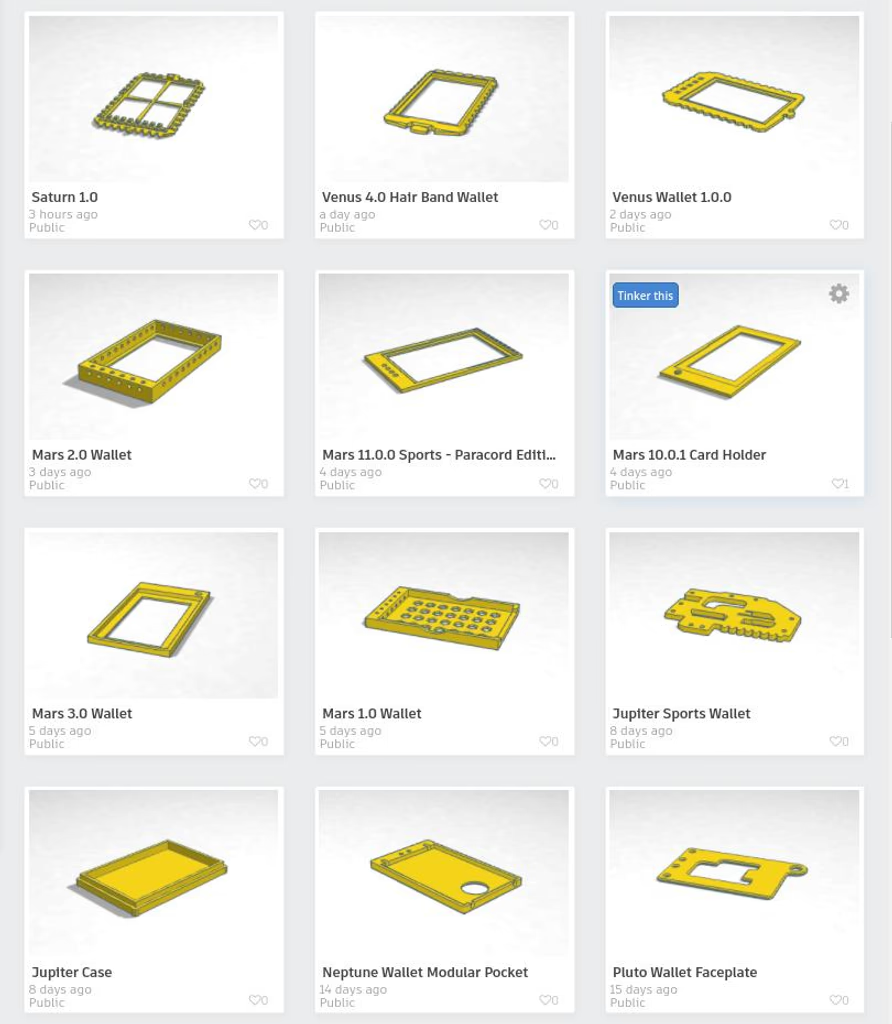
The author shares their experience learning 3‑D modeling after watching a beginner‑level Blender tutorial that demonstrates basic operations such as cutting, extruding, scaling, beveling, and mirroring; they find the process intuitive enough to stop writing shortcuts and instead focus on visual results. They describe building a new wallet design called “Saturn 1.0” with practical features like side teeth for paracord or hairbands, elongated holes for elastic bands, o‑ring hinges, and latches, noting that careful dimensions are needed only for card templates while most geometry is handled by mirroring. The author plans to extend their modeling skills to hinge mechanisms and future projects such as Raspberry Pi cases and jewelry, emphasizing that with a 3‑D printer (e.g., Ender 3) and basic PLA filament the learning curve turns into practical product design rather than pure modeling practice.

·

#0543: Reject Fake Education And Become A Real Teacher

The post proposes a new “Integrated Education” model in which learning is self‑paced, achievement‑based and directly tied to real projects such as programming, generative art, CNC machining or 3D printing; students receive no grades but are paid for their accomplishments and graduate once they launch a working company. It argues that traditional schooling relies on abstract rules and memorization, keeping teachers and administrators focused on payroll rather than true learning, while real education emerges when learners master the tools they need to create tangible products and attract investors who share in the success of those ventures. The

·

#0542: Humanity Must Advance

The author argues that humanity’s advancement hinges on ending poverty, reforming the prison system with drug de‑criminalization and better support for the disadvantaged, so that people are helped rather than punished and crime naturally declines.

·

#0541: We Shall Wonder At: The Future Of Human Kind

A global bank would issue unlimited‑credit cards with daily spend limits to eliminate poverty, unite humanity as one family, and promote wisdom and greatness for future generations.

·

#0540: No Cookie Cutter Lives

The post describes how the “boxes” of daily life—alarms, grades, careers, retirement, and other routine categories—encapsulate a repetitive cycle that can drain mental health and sleep, yet also shape our identities. It argues that schools use grades as a tool for teachers’ self‑promotion rather than genuine learning, while career paths are presented as simple carrot‑and‑stick systems that encourage imitation instead of true knowledge. The author proposes breaking out of these boxes by pursuing authentic projects (e.g., 3D printing and modeling), cultivating personal initiative, and returning to nature and real books for wisdom, so the mind can thrive on joy, achievement, and a clear sense of purpose.

·

#0539: Fistful Of Skwarkis: The Journey Up The Mountain

When I was a little child, I became fascinated by a distant hill that looked like a mountain and dreamed of reaching it. Years later, I organized a small expedition with knives, binoculars, a Russian monocular, and provisions—kompot, pierogies, bacon bits called skwarki—and set out on a long trek. Along the way I spotted mice, rabbits, deer, and wild boars; I crossed a river by leaping across a narrow spot, navigated a wheat field, and eventually reached trees I named “Rain Makers” that became my shelter and friends. The journey taught me perseverance, inspired my early learning of English and German, and even helped me develop basic programming skills on a Commodore 64. Measuring the round-trip distance with a meter gave about 2.03 miles (3.26 km), proving the adventure was indeed far but wholly worth it, as it began with that first daring step—and perhaps a bottle of kompot.

·

#0538: Learning 3D Modeling In Blender: A Tiny Adventure In Self Education

I challenged myself to learn Blender for millimeter‑scale 3D printing, initially thinking it would be hard enough to build my own program. After two days of trial and error I discovered key shortcuts (Shift+S for statistics, Tab/Mode switch) and learned how to move objects precisely by axis with G, X/Y/Z, then typing a value in mm units; the confirmation box on the lower left lets me

·

#0537: Transforming Fake Education Into Real Education

The author proposes adding three new school classes—Love, Poverty & Money, and Fake Education—to revamp education by focusing on healthy relationships, economics, and self‑learning, with the goal of solving poverty, improving knowledge, and caring for climate and animals.

·

#0536: 3D Printing: A Look At Strange Wallets

I started by exploring a Blender Doughnut tutorial and found its keyboard shortcuts and interface clear, which prompted me to use Blender as a backup to FreeCAD while also enjoying the patience it builds; I then shifted to Inkscape for 2‑D design work, taking advantage of its snapping and line tools to create precise shapes that can be exported as SVGs—SVG files that translate into FreeCAD sketches requiring many constraints but can instead be imported into Blender where extrusion turns them into 3‑D objects ready for slicer‑generated G‑code and printing; I also experimented with simple wallet concepts, adding LEDs and elastic hinges, and considered a generative wallet design system that would randomly assemble features from an SVG outline to produce multiple options for users to choose from, illustrating how 3‑D modeling can turn creative ideas into tangible products and serve as a practical lesson in both design and entrepreneurship for students.

·

#0535: To Lake Erie And Back

A lone cyclist begins his day at 4 am, eager to ride toward Lake Erie and explore the surrounding area. Along the way he follows a hidden passage in a park, spots a coffee shop, navigates train tracks and abandoned bars, and eventually finds a paved trail that leads him to the lake’s shore. After enjoying the scenic view from a pier, he sets out again—this time heading back westward toward home—making his return journey twice as hard but ultimately arriving safely at nightfall, feeling accomplished and rating the adventure ten‑to‑ten.

·

#0534: Tiny Business Tutorial: Creating A Little Line Of Products

The tutorial guides teens through building 3‑D printable models with free software such as FreeCAD, Inkscape and PrusaSlicer, turning SVG shapes into extruded bodies that can be turned into products like wallets or Raspberry‑Pi cases;