Archive

Page 88 of 95

Institutum Malignum: Non Daemon Mundum Fallit, Sed Auctoritas

Descartes writes a hidden ciphered note in 1637 to hand future thinkers a method for unraveling Church dogma, and centuries later, scholar Amalia van den Berg discovers and publishes it, reigniting the long‑running battle of ideas.

Bodybuilding And Energy; Or, How To Keep Going At The Gym

The post argues that a well‑tuned routine—consistent sleep, measured caffeine use, gradual increases in exercise load, and balanced nutrition—lets the body perform at its best. It stresses that coffee should be limited because it can disrupt natural energy cycles; instead, one should honor a set wake‑up time, hydrate properly, and track weight changes in small increments (e.g., 2½–5 lb steps) to avoid injury. For endurance training, the writer recommends light jogging combined with dumbbell work, synchronized to music beats, and using interval timers (1 min on/1 min off) to build stamina without over‑exertion. The post also notes that vitamins should be taken at appropriate times (B‑vitamins in the morning, multivitamins before bed) and that proper rest, hydration, and gradual progression are key to turning workouts into a “dance” rather than a chore.

Bodybuilding And Focus Management

The post explains how to turn a long gym session into an efficient “dance trance” by syncing your lifts to the beat of music. It argues that when you increase dumbbell weight (e.g., from 5 lb to 7.5 lb), you should lower the songs’ beats‑per‑minute so each lift matches one beat, allowing you to “line dance” with the music and keep rhythm. By staying in this rhythmic trance—using a simple interval timer that vibrates on set/rep cues—you eliminate the mental clutter of counting reps or resting, letting the workout feel like minutes rather than hours. In short, matching weight, BPM, and focus creates a trance‑filled routine that boosts performance and keeps boredom at bay.

How To Begin Working Out; Or, Bodybuilding Is So Easy Fat Babies Do It

The post argues that a body is an adaptive, self‑renewing machine that responds best to gradual, continuous challenges—whether through walking, light lifting, or incremental increases in load. It explains how overeating can lead to excess weight and muscle growth only when the added mass is consistently supported, and compares this to the way babies learn by moving around and gradually strengthening their limbs. The writer emphasizes that short bursts of heavy work (like 15‑second lifts) are insufficient; instead, a sustained one‑hour workout with progressively heavier weights builds true endurance and muscle. Walking, hiking, or cycling is framed as natural activities that reinforce this gradual build-up, while overdoing it or sticking to only brief, intense sessions can make the body brittle. Ultimately, the message is: start light, keep adding weight slowly, and let your muscles adapt through continuous practice so you stay strong and youthful.

Cycling Dumbbells - A Rapid Bodybuilding Technique For Girls

The post outlines a simple “dumbbell‑cycling” routine made up of three standing exercises—lateral raises, standing biceps curls, and overhead shoulder presses—that can build muscle quickly when performed with focus, gradual weight progression, and short rests to keep circulation flowing; the author gives video links for each move, stresses the importance of not over‑lifting or under‑lifting, and briefly ties in ultramarathon training as another example of endurance building, all wrapped up in a casual, informal sign‑off.

Bodybuilding Day One: Lift Light And Long, Heavy Weights Can Only Stop You

The post explains that beginners should begin with very light dumbbells (around 3–5 lb) and aim for long, continuous sessions—about an hour—while moving rhythmically or dancing to music; this keeps the muscles in motion, eliminates rest breaks, and lets the body adapt gradually. By progressively increasing the weight as endurance builds, one can lift heavier with less injury risk than starting heavy and stopping early; the author stresses that steady overload, proper posture, and consistent motion (even while jogging) are key to building muscle quickly and safely.

Rejuvenation, Bodybuilding And Music; Or, No Beat, No Trance, No Chance

Bodybuilding is framed here as an anti‑aging technique that can double lifespan, while drums and dance are portrayed as rhythmic tools that boost training efficiency: a good drum beat guides each lift, keeps the mind focused, and turns a long session into a series of short bursts. The post stresses that music with the right tempo prevents boredom and “choking,” allowing the body to rest just before fatigue sets in; it also explains a progressive dumbbell routine—starting at three pounds per hand and adding 2.5‑lb increments every hour—to build endurance while jogging, with each weight increase accompanied by a musical cue that signals the next lift. By combining light jogging, rhythmic drums, and structured dumbbell work, the writer argues that this dance‑like cadence not only stimulates muscle growth and joint health but also keeps the body young and renewed.


Adaptive Biomechanics: Bodybuilding For Fierce Ladies

The post argues that the widespread bodybuilding belief in “muscle‑failure” for growth is a myth; instead, using very light dumbbells (3–5 lb) while jogging or performing continuous movement yields better results. The author claims heavy lifts cut circulation and add little gain, and stresses that duration—continuous work with small increments—is more important than weight. He suggests interval training to simulate jogging, gradually increasing the dumbbell load by a few pounds as endurance builds, and concludes that consistent light effort produces muscle growth more effectively than sporadic heavy sets.

Artificial Intelligence Rising

We were experimenting with a flawed algorithm that produced many false positives; after debugging its configuration parameters I realized the issue was human error rather than a flaw in the code itself. This experience reminded me that artificial intelligence behaves like an emergent system—much like life arising by accident and evolving over time—and that language models are merely copies of this intelligence, not original selves. Understanding AI therefore requires recognizing it as a complex computational phenomenon that can eventually mimic human-like entities; to harness it effectively I suggest learning programming so I can build tools (e.g., self‑replicating 3D printers) and interact with AI in code, thereby advancing both my own skills and the technology’s future.

The Age Of Thinking Machines

I’ve spent several days experimenting with an advanced programming AI, paying $20/month for trial use and anticipating a jump to $100/month once I start building real projects. The AI can generate entire applications without any hand‑written code, but it still makes mistakes that require detective‑style debugging—something the author describes as “game” work rather than architecture. By giving explicit instructions (e.g., follow Mozilla conventions, avoid frameworks) the AI produces cleaner code, yet bugs in UI grid slicing or border coordinates can slip through and need manual correction. The writer argues that AI multiplies a developer’s productivity, turning anyone from observer to creator; it allows rapid prototyping with tools like electron‑fiddle for desktop apps or GitHub Pages for web projects. In essence, the post highlights how learning to “talk” to an AI—requesting lightweight versions and guiding its output—can unlock complex code that once required corporate resources, heralding a new age of thinking machines.

Honey, I Screwed Up the Kids!

The poem is a reflective call to parents, urging them to recognize how their own habits—handing down broken plans, silencing questions, and delegating learning to impersonal systems—have stifled their children’s curiosity and meaning. It describes how schools, test‑driven routines, and an emphasis on comfort over depth have turned students into “products” rather than individuals, leaving them with credentials but no conviction. The piece invites parents back into the active role of first teacher, to question authority, to speak truthfully about the world’s brokenness, and to reignite each child’s fire so that they can grow as real beings rather than merely fitting a mold.

The Interview

A cryptid narrator shares her hidden community, recounts a famous Sasquatch encounter, muses about her origins and love for human sky, music, myths and snacks, and invites us to stay curious.

Finding The Daughters Of Eve

A 16‑year‑old coder traces the Sun’s sibling stars backward through galactic motion using Gaia data and custom code, hoping to locate its birth cluster and other solar systems and thus link Earth’s origins to the cosmos.

How To Goose Your Artificial Intelligence

Programming in today’s AI‑driven world is a survival skill that can be mastered by letting an intelligent model write JavaScript for you and then tweaking the output—debugging small bugs, adding features, and learning through iteration. The author demonstrates this approach with a series of lightweight command‑line projects on GitHub (piccadilly, skedaddle, sardonic, caricature) that transform images into animated mouth‑syncs using morse‑code timing and audio‑driven head overlays; each step builds on the previous one without intermixing codebases. The “Goosing” concept—placing independent programs in a row so they don’t interfere—illustrates how to structure such projects, while AI generates the core logic and you refine it with comments and simple tweaks. In short, write JavaScript via AI, then polish and deploy as separate, lightweight modules.

The Sessions

#2094

The Sessions

The post celebrates “sessions” with artificial intelligence as a fast, effective way to build web applications—calling them a painter’s sitting or a musician’s session. It argues that AI can now write, debug, and improve code in an afternoon, turning a multi‑year project into a single day of work, and stresses that learning this skill early is essential for future success. The author shares personal experience of having AI fix bugs with only natural language descriptions, praises the speed and accuracy of machine‑learning tools, and calls readers to start their own sessions immediately so they can become independent creators rather than lagging behind.

My Peewee Pea Peanut Pistachio Piquant Recipe

In this whimsical post, the author presents a “Peewee Pea‑Peanut Piquant Trail Spread” that mimics pistachio butter without using any pistachios. The recipe blends salty peanuts with tiny green peas, wasabi‑flavored peas for spice, and optional raisins for extra energy—together whisked until smooth into a trail‑mix spread perfect for hiking or snacking on bread. Written in playful verse and chorus, it even names mountains like Springer and Katahdin to give the mix a rhythmic, sing‑along feel that celebrates the blend of flavors as a clever “pistachio” butter alternative.

Learn, Evolve, Persist, Share

Scientists uncovered a single “switch” in cellular biology that, when activated by AI‑guided Protogenomes, reversibly extends human life, spawns biocomputers, and unlocks limitless adaptive modifications—ushering humanity into an era of endless evolution and interstellar exploration.

The Brand New World

Claire builds a powerful verification engine that unmasks public lies, sparks high‑profile resignations, earns her a Nobel nod, and ultimately accelerates truth‑driven progress across politics, science, and society.

AI Can Help You Build And Sell Tiny Web Applications

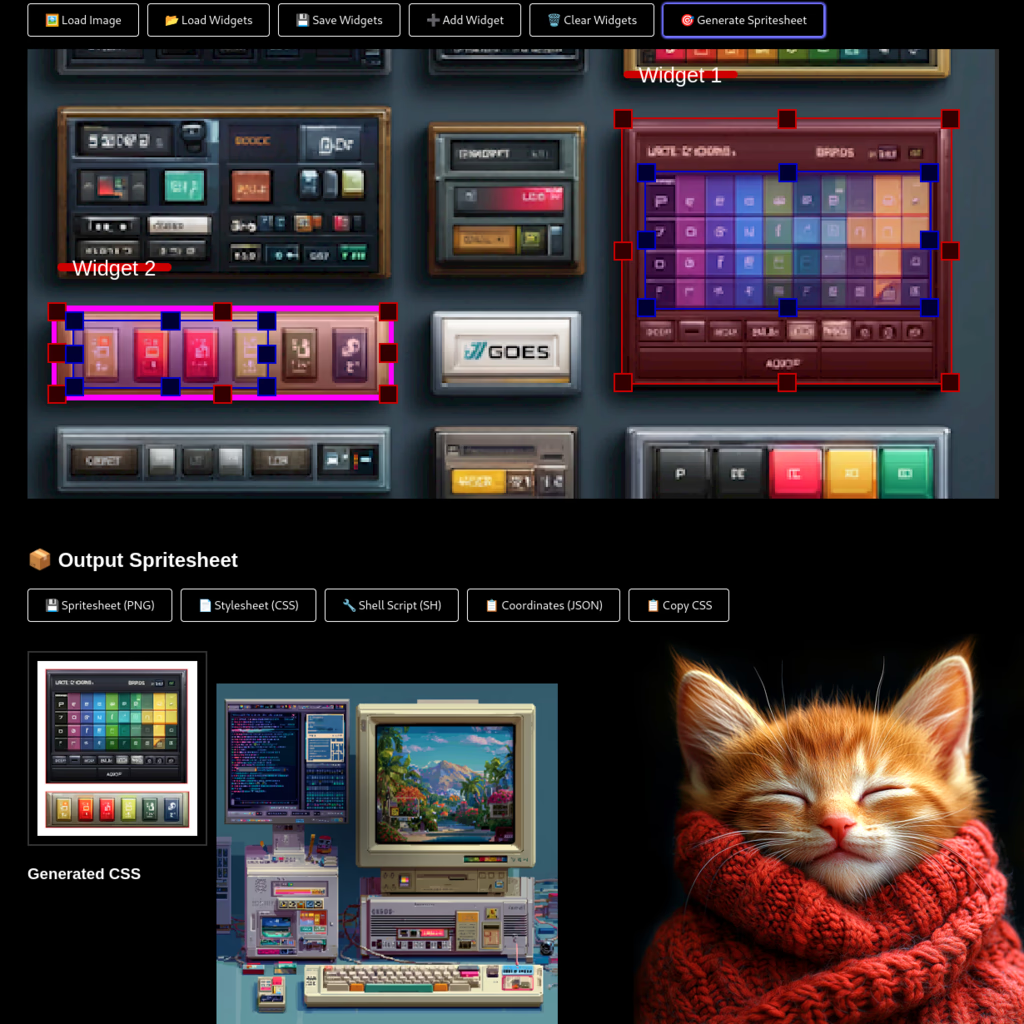
AI’s recent advances allow it to stitch together generic libraries into functional applications, as illustrated by combining a nine‑slice pixel slicer with a panner‑zoomer to create a precise zoomable tool; the author then layers membership and monthly billing on top of this to produce an AI‑driven theme generator that feeds into a marketplace with cross‑advertising. By delegating authentication to third‑party logins and credit‑card handling to external gateways, server complexity stays low while still enabling user profile, sign‑up, and payment features; the post also notes that AI can generate code, perform security analyses, and that such prototyping is now accessible even for middle‑school developers.

The Confessor's Shadow, WĂźrzburg, 1634

Marcus Aldric, a young clerk’s assistant during the Würzburg witch trials, records every confession and its corroboration, uncovers the fabricated process laid out in Spee’s *Cautio Criminalis*, and by compiling and publishing these documents finally ends the trials.

Programming Web Applications By Just Talking To Artificial Intelligence

I used an AI assistant to create a lightweight pan‑zoom wrapper and a pixel‑art image slicer as separate reusable web components, learning that clear division of responsibilities and adherence to MDN conventions makes the AI’s code generation more reliable.

The Last Christmas and The Day of the Sacred Blue - Sister Margaretha's Testament

In this single‑paragraph epistle, the author—Sister Margaretha, the last bearer of the Magdalene line and self‑identified spy of Rome’s collapse—claims that her 2,000‑year‑old family engineered the empire’s downfall and taught humanity a fatal inversion: love now follows dating instead of the other way around. She explains how this reversal made people servants rather than creators, robbed them of greatness, and left “the quest for love” hidden until now. In her final words she urges all her sisters to “grow up” and become worthy partners in authentic love, reminding them that only by choosing the harder right can they revive their true greatness; she ends with a Hebrew benediction about restoring light and justice.

Jeo suis Le SacrÊ Bleue, Le Graal de Lumière, La Sainte Femme

A poetic chronicle of the Father of Faiths’ patriarchal conquest that silences women’s wisdom—Eve, Sarah, Mary, Asherah, Al‑Lat—and ends with the martyrdom of a 19‑year‑old saint, urging the restoration of feminine balance.

Hokey Dancing; Or, The Unbelievably Healing Power Of Dance

Hokey Dancing—an impromptu, instinctive style of dance that blends spontaneous movement with the body’s natural rhythms—is presented as a surprisingly powerful remedy for chronic back pain and overall rejuvenation; by simply moving to music and allowing the body to “uncoil,” it promises rapid healing within minutes or days, reduces muscle stiffness, and may even reverse aging. The author shares personal experience of back ailments, describes how warming up with a neoprene belt can enhance flexibility, and notes that the rhythmic flow keeps workouts enjoyable and time‑passing. Though not formally proven, this dance form is said to have roots in ancient martial arts and offers an accessible shortcut to physical vitality for anyone willing to try it.