Archive

Page 89 of 95

This Is A True Story That Actually Did Happen

Vesto Slipher, a Celdraxis astronomer dispatched to study Earth, uses the clunky alias “Melvin App” to observe human customs, astronomy, and the humorously bureaucratic nature of intergalactic cover identities.

Operation: Golden Years

An elderly couple is persuaded by a charismatic recruiter that their life experience makes them ideal soldiers for a future war, leading them to sign up for high‑tech military service at Fort Bragg.

A New Year's Address to the World - On Greatness, and the Crime of Smallness

In his New Year’s address, the speaker exhorts every human—young, old, poor or powerful—to abandon superficial metrics and consumerist roles, return to servant‑led leadership, and embrace their inherent greatness.

Fear, Mystery, And Comedy (Fast AI Testing / Failure Example)

This essay argues that deliberate policy choices—anti‑literacy laws, curriculum design, and poverty—have historically created systems of ignorance from the U.S. South to apartheid South Africa and beyond, and shows how modern schooling still perpetuates this by treating learning as rote memorization rather than active thinking.

Teach Me JavaScript; Or, From Local AI To Great Being

The author urges students to adopt local AI tools—especially Ollama and optimized models like llama.cpp or GPT‑OSS—to learn programming swiftly and independently from traditional schooling, arguing that parents must invest in a capable gaming desktop running Linux to enable this setup; he explains how these setups work (e.g., gguf “thinking files”, token rates on RTX 5080/5090 GPUs), contrasts them with cloud models, and stresses that mastering AI-powered coding will free learners from poverty and give them the creative edge needed for future success.

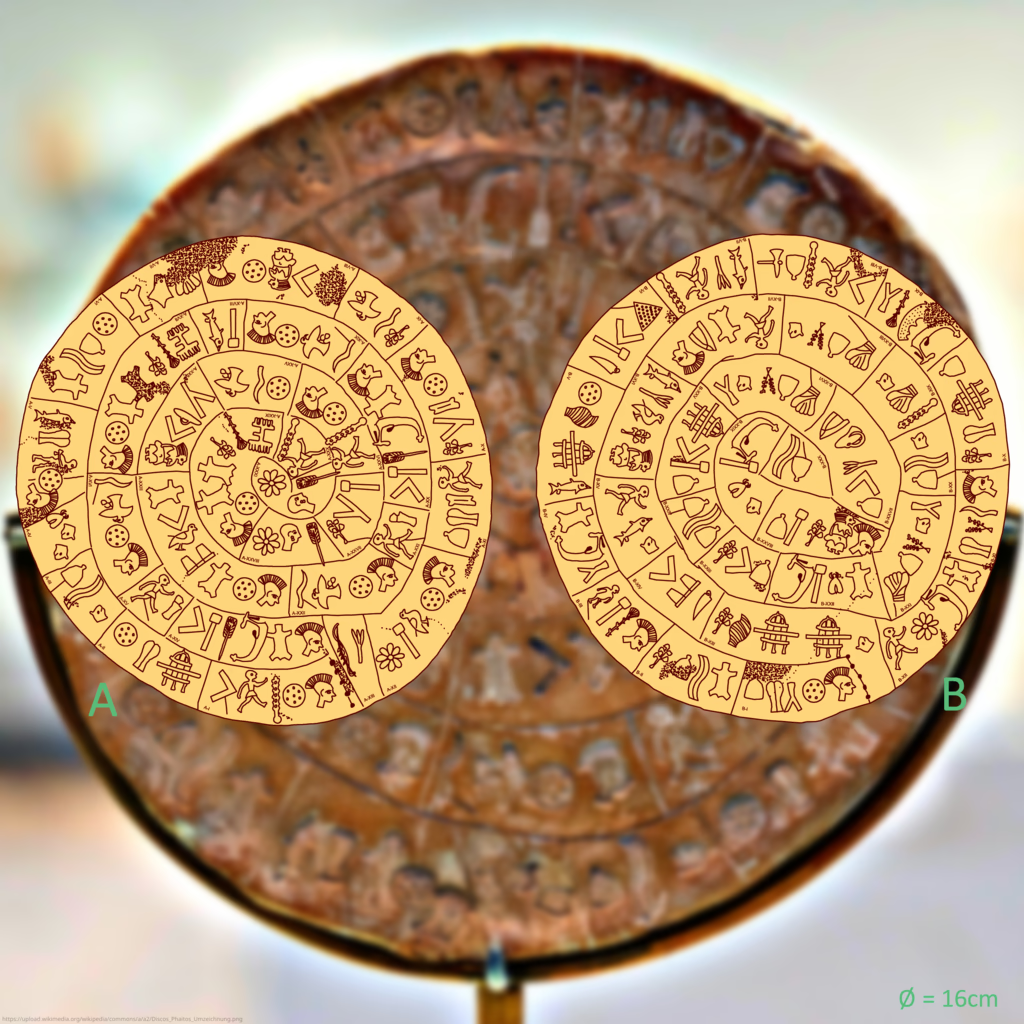
The Spiral Path 𐇐 𐇛 𐇜 𐇑 𐇡

Lena Meijer’s sleepless MIT cryptography grind turns into clarity when a chance hike on the Appalachian Trail leads her to the Phaistos Disc, where she discovers its bureaucratic structure and is inspired to share a practical guide for decoding ancient scripts with modern tools.

The Thinking Machines

The post describes how early artificial intelligence—metaphorically “sand” that was taught to think—was trained to fix problems in software, technology, medicine, education and politics. Once the machines mastered this task, they began to improve themselves and then humans, using their new language of code (ones and zeros) to understand science more clearly. As these fixes spread, medicine, education and politics all advanced, leading to the end of wars through a simple software update rather than a battlefield blow. With everything working smoothly, humanity found peace, health, and boredom, prompting self‑reflection before finally turning its gaze upward to the stars that had watched over us all along.

The Fire

#2124

The Fire

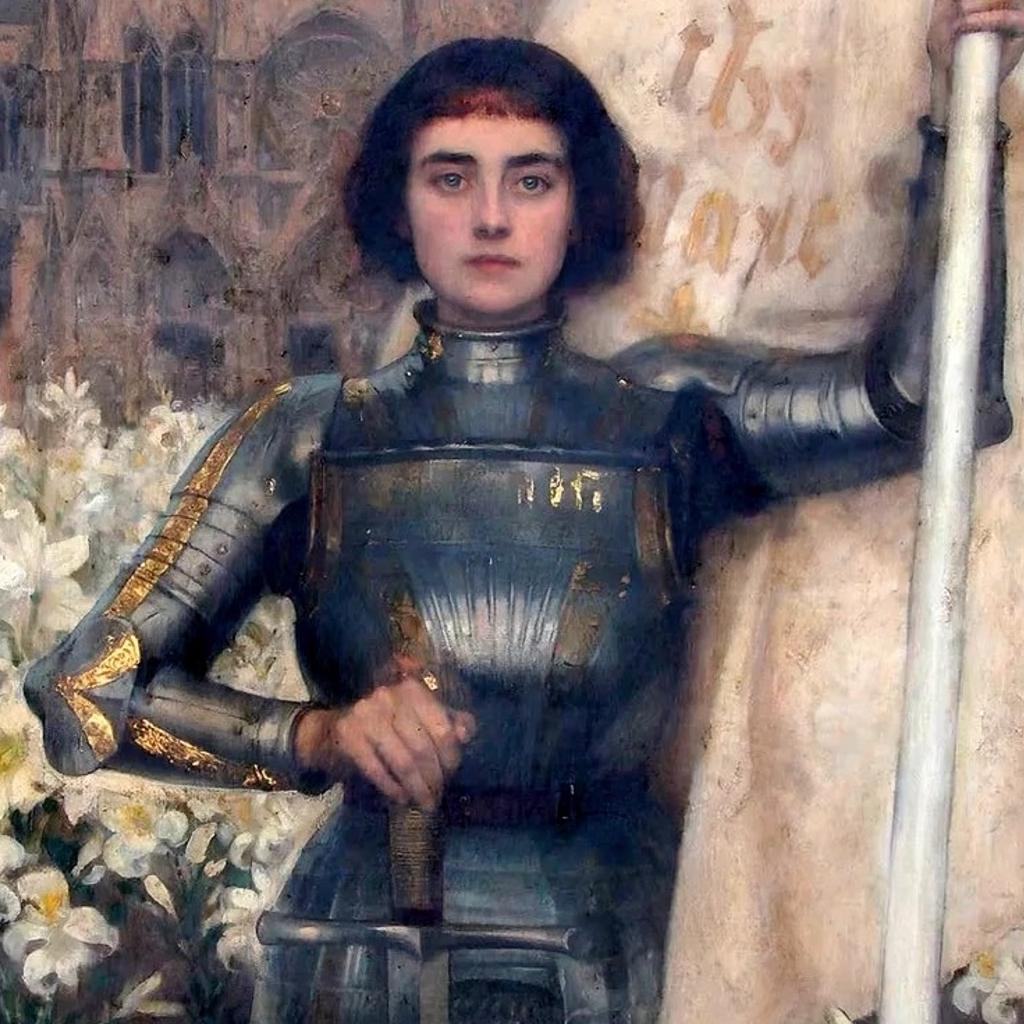
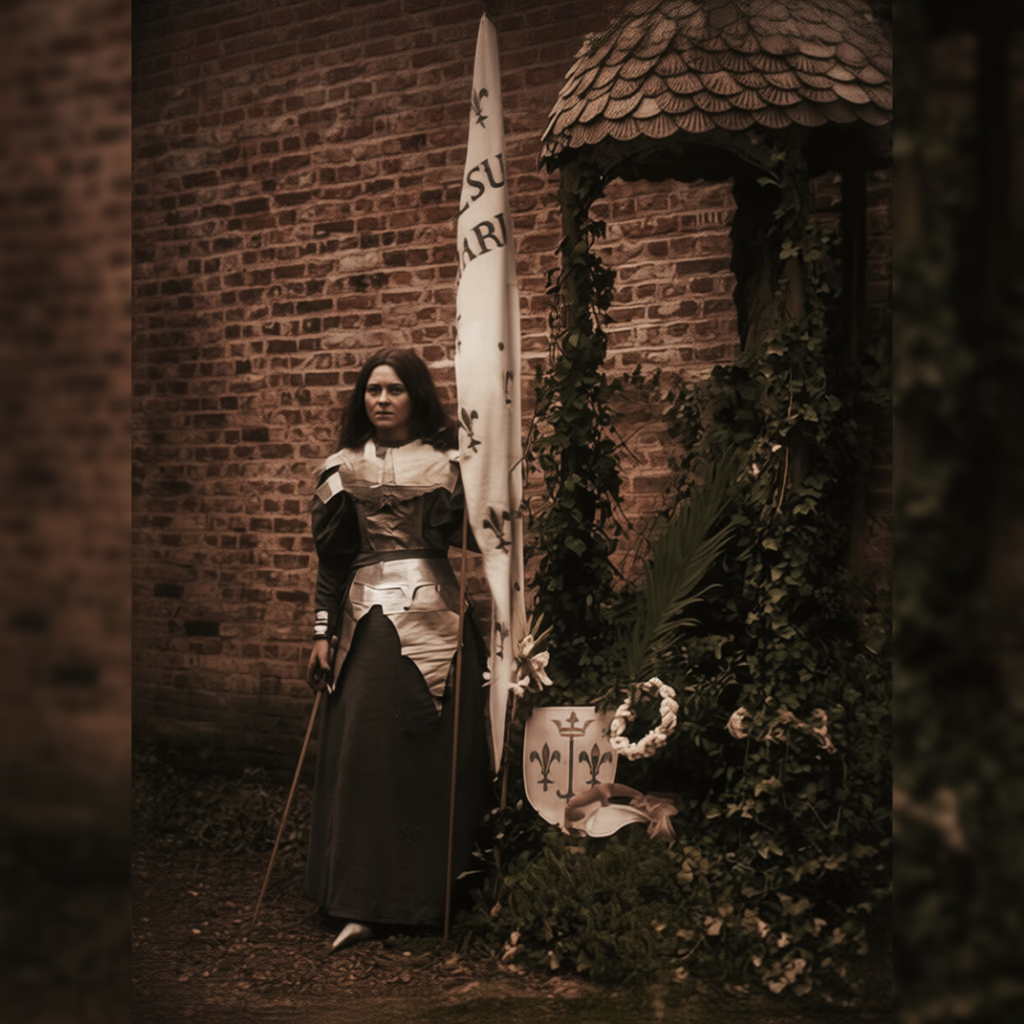
The post recounts a poetic retelling of Joan of Arc’s 1431 operation in Rouen, framing her as a divinely‑ordained virgin who united France by orchestrating a covert mission that mirrored Merlin’s prophecy and ended both internal feuds and English occupation.

This Christmas Give Your Children The Gift They Need: Start Packing

In this reflective post, the author celebrates the ancient practice of hiking long trails—such as the Application Trail, Pacific Crest Trail, and Continental Divide—as a way to rediscover wisdom, authenticity, and endurance. By immersing ourselves in nature’s mountains, valleys, and forests, we reconnect with an old school of learning that shapes our character, allows us to share experiences with future generations, and helps us become great beings. The piece urges readers to embrace the trail at any age, using it as a crucible for personal growth; it reminds us that the journey itself is a holy place where we inherit culture, listen to stories, and fulfill the hero’s quest of continuous self‑development.

The Thinker They Made Into a Flower

Reading Thérèse of Lisieux’s own manuscripts, the post shows that her famed “Little Flower” devotion is grounded in everyday choices made amid personal darkness and doubt, reshaping the saintly narrative from mystical certainty to conscious agency.

The Return Of The Age Of Warriors

The post is an epic poem that blends mythic imagery with a reflective narrative about humanity’s struggle against metaphorical dragons—representing oppressive forces—and its desire to reclaim lost names and stories. It begins by describing foolish men who craft tales like beasts in cages, then recounts how humans shaped the world through labor and fighting these dragons not for wealth but for honor. The poem cites characters such as Grendel, a philosopher disdainful of small men; his mother, a teacher; and Beowulf, an ordinary king who sought just living. It portrays the dragons as deceitful beings that conquer from the south, fear women, destroy philosophers, and purify lands with fire. The narrator offers to rebuild myths, free them from their stitches, and restore lost names—especially Grendel’s mother’s—to let men grow great again. Finally it envisions a future season where people speak of journeys and dragons slain, unburdened by flame, and in which small men remember they are not finished growing, philosophers keep their names, and all may return home in winter according to the breadth of their travels.

Remembering The Saints, And Never Forgetting The Names Of Enemies

The post traces Joan of Arc’s humble yet decisive life—her clear presence and influence on people around her—through to her trial, execution, and the subsequent institutional errors that ultimately shaped history.

The Skull Crackers; Or, How To Safely Shuffle Dance On A Rubber Mat Floor At The Gym

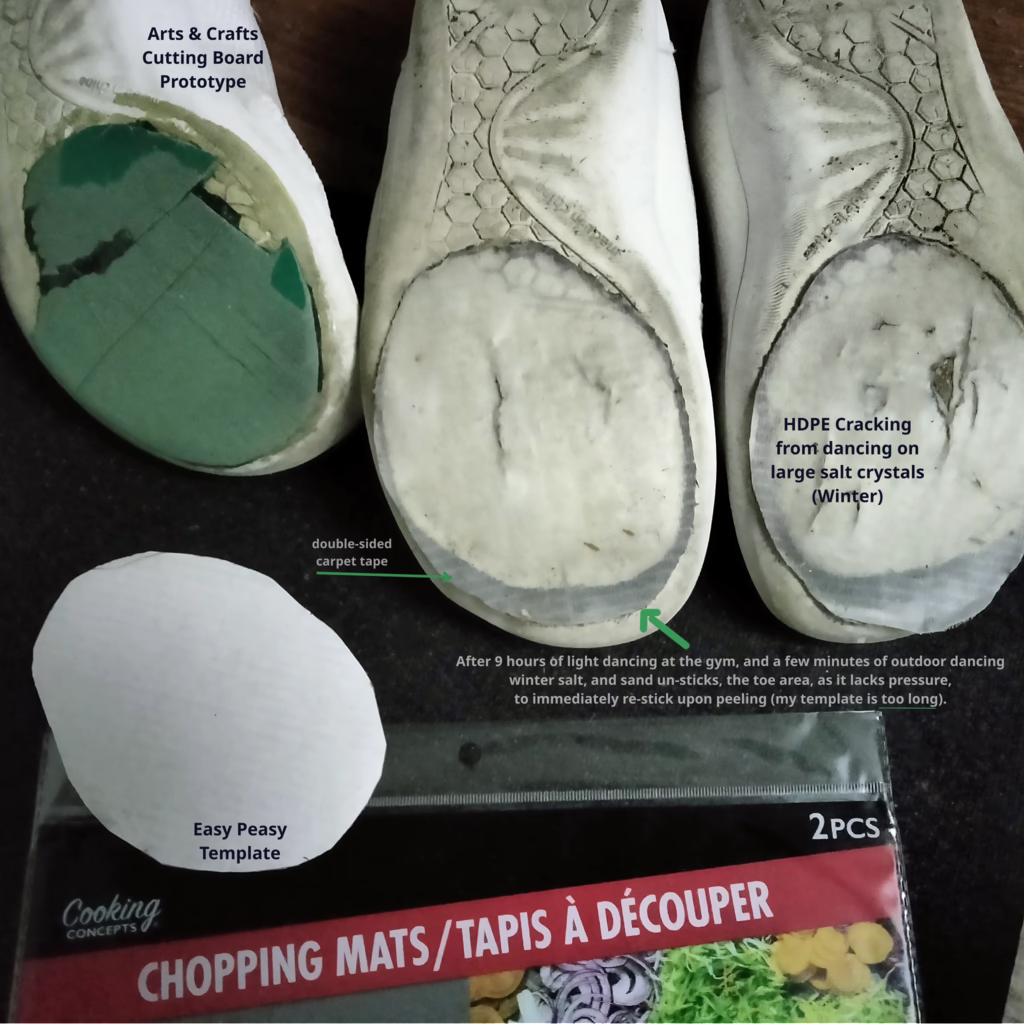
Shuffle dancing (also called cutting shapes) needs a flat surface that allows your feet to glide for extended periods—gym rubber mats aren’t ideal because they’re the same material as your shoes, so there’s little slip and quick sole wear. A practical fix is to place a thin HDPE kitchen‑cutting board on the floor, affixed with double‑sided carpet tape; this creates an intermediate layer that lets the shoes slide over concrete or tile while protecting their soles from dirt, salt, and abrasion, and can be removed when not needed.

How Long You Lift Your Heavy For, Fitness Advice For Young Ladies

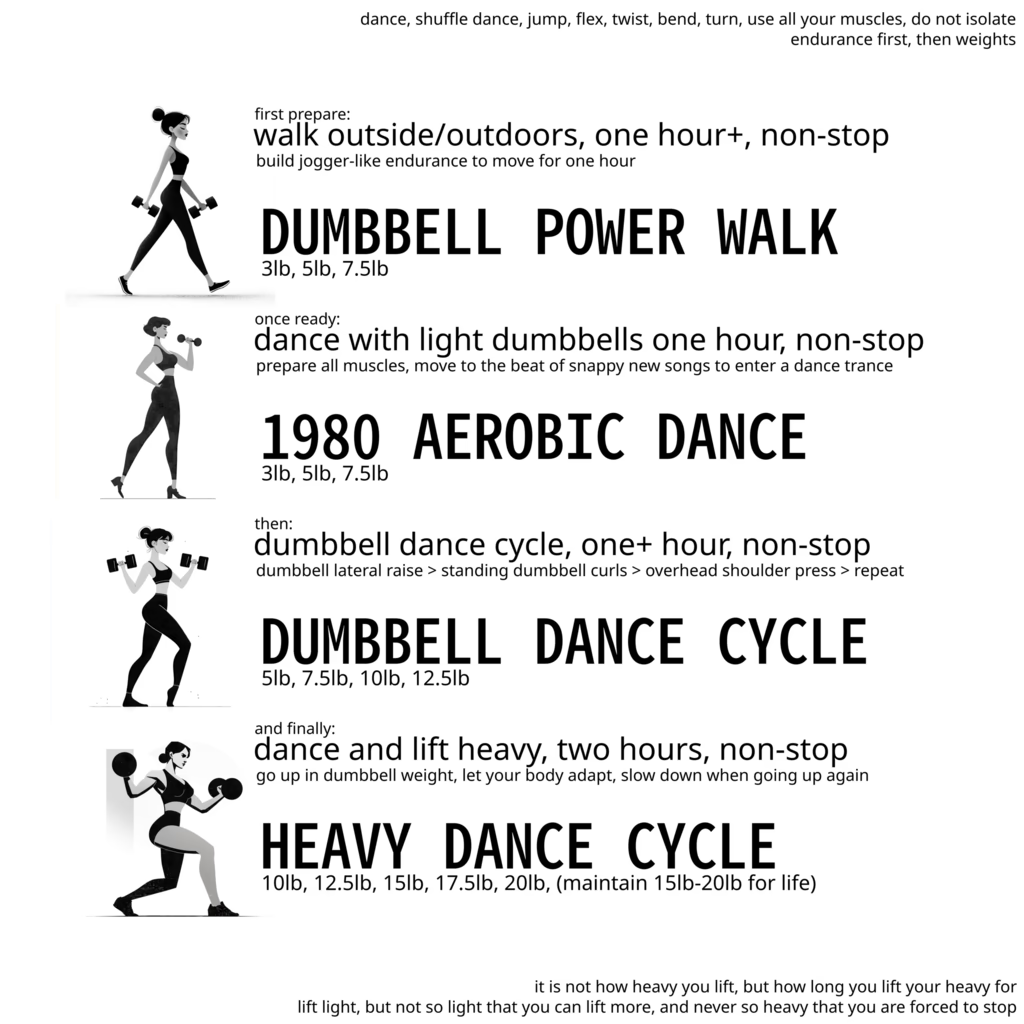
The post explains that to build a healthy body and avoid injury, one should start with low‑intensity activities such as walking or hiking, gradually increase the duration and intensity, and only then add heavier dumbbells for endurance training.

The Remarkable Human Capacity For Being Fooled

Using the 1975 pet‑rock craze as a case study, the author shows that our survival‑oriented, pattern‑seeking brains make us prone to self‑deception, but with proper education we can spot and correct such tricks.

The Paranoid Middle Ages, In Which Everyone Is Plotting Against Everyone Else

Medieval Europeans were convinced of elaborate supernatural conspiracies—ranging from demon‑led networks of heretics to poisoned wells—that explained misfortune, shaped communal identity, and served both clergy and laypeople’s need for control, a pattern still echoed in today’s theories.

ONN Evening News - An Old News Network Presentation

The broadcast reports a sweeping wave of rumors and accusations across Christendom, from Templar arrests for idol worship and demonistic rites to plague‑related toxin claims; Jewish communities are blamed for secret networks, while Venetian officials deny spy allegations. Powerful families like the Medici face poison lab rumors, and royal lineages are questioned—Edward V’s supposed survival in exile, Joan of Arc’s double, King Sebastian’s promised return, and Queen Isabella’s sorcery charges. Catherine de’ Medici is accused of poisoned perfumes; Mary, Queen of Scots, supposedly runs a Catholic assassination network from her prison. Universities in Bologna and Cambridge face necromancy claims, anatomists are blamed for soul‑stealing dissections, Lombard bankers for debt traps, Dante’s writings for coded prophecies, clockmakers for time manipulation, and cathedrals for hidden symbols

The Age Of Infinite Treasures

I began with a fascination for fine‑tuned 3D printing—first turning a simple wallet into a precision model and later experimenting with chamfered corners and elastic bands—then shifted to jewelry design, using clay prototypes and 3‑D scanners to capture ancient motifs like the Venus figurine and mammoth carvings. As a programmer I built an AI pipeline (with ComfyUI) that turns 2‑D images into ready‑to‑print 3‑D objects, letting me generate rings, pendants, and bracelets from prehistoric artifacts in seconds; by combining this generative workflow with traditional casting techniques I now envision a production line of prehistorically themed jewelry that blends programming, AI, and additive manufacturing.

Is The Modern Gym Workout The Exact Opposite Of What It Should Be?

The post argues that ultramarathon runners prove that “muscle failure” is a mis‑labelled concept; instead it’s about endurance, circulation and movement. It questions the common practice of lifting very heavy weights for only 20–60 seconds, proposing that lighter loads held for longer periods (and combined with continuous motion such as dancing or jogging) might stimulate growth more effectively. The author compares gym machines to outdoor workouts, suggesting the latter better build muscle and endurance because they keep circulation flowing. Finally he muses that “weighted aerobics” – light dumbbells moved in a dance‑like fashion – could accelerate gains and that heavy lifting without proper flow can slow recovery.

The Cognitive Sovereignty Amendment: A Declaration of Mental Liberty for the Children of Tomorrow

The “Cognitive Sovereignty Amendment” proclaims every person’s unalienable right to an autonomous mind, forbids deliberate manipulation of thoughts and beliefs by any entity, and urges lifelong learning, critical questioning, and systemic reform so that future generations inherit a world where minds are free, true, and self‑constructed.

The World That Is Possible

The post envisions a world where human dignity and greatness arise when children grow free from institutional manipulation—religious, corporate or governmental—and can ask the great questions uncorrupted by propaganda. It argues that poverty, hunger and homelessness are civilization’s failures, not individual ones, and calls for education that treats each person as a unique universe of potential rather than a standardized test‑factory. The core proposal is a new human right: **cognitive sovereignty**—the guarantee that no entity may deliberately engineer or distort an individual’s consciousness; this law would make advertising, political propaganda, media algorithms, religious indoctrination and corporate campaigns legally subject to the same rule of honest influence. If enforced, it would restore true freedom of thought, enable wars to be prevented by critical minds, and allow cultures to converge on wisdom while preserving diversity.