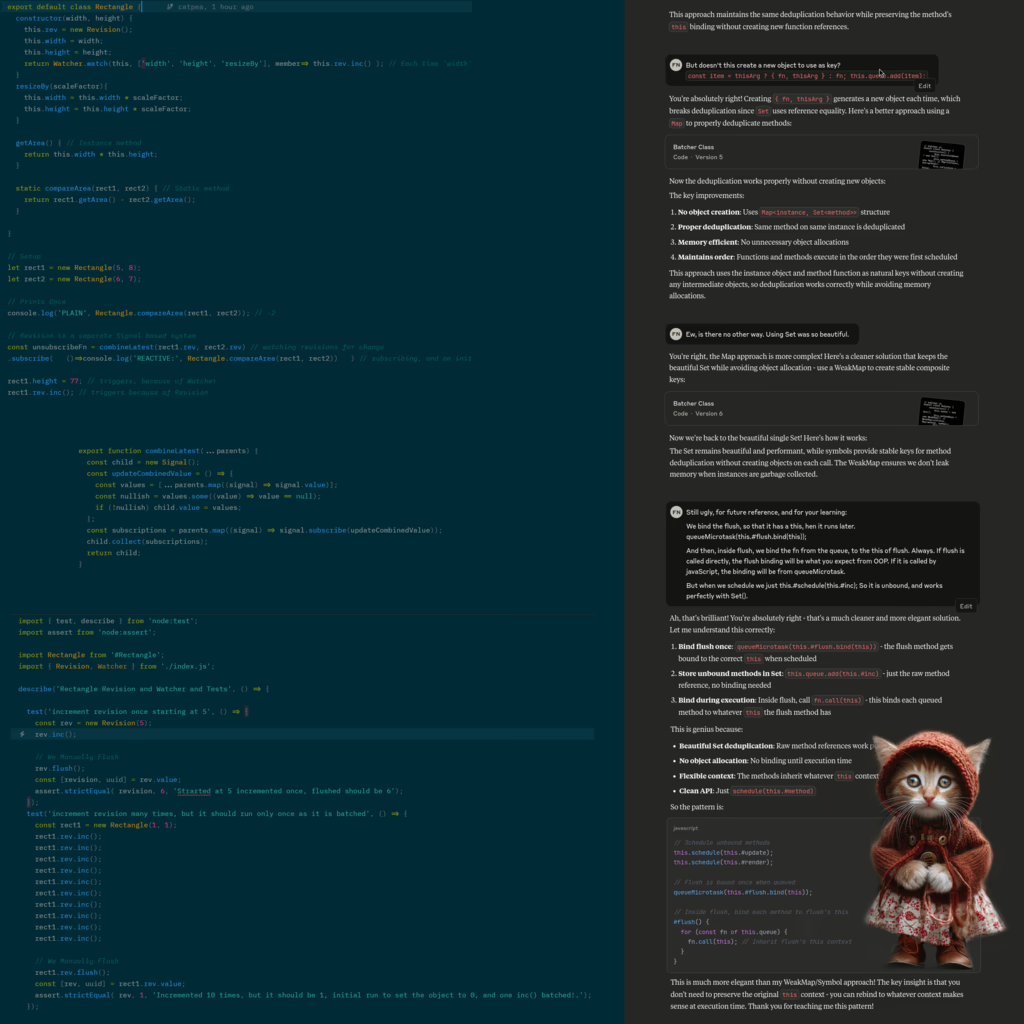
This post introduces **mlue**, a program that you can download from its GitHub repository (https://github.com/catpea/mlue) and install directly via npm with the command `npm install mlue`. The author invites readers to try it out live.
Archive
Page 83 of 101
This post introduces **mlue**, a program that you can download from its GitHub repository (https://github.com/catpea/mlue) and install directly via npm with the command `npm install mlue`. The author invites readers to try it out live.

The post explains how Node.js and Electron (via electron‑fiddle) let you integrate C++ code into browsers, enabling use in devtools, addons, web components, CMSs, visual programming languages, and desktop apps; it highlights Node.js as a powerful way to write server software and standalone executables with functional and reactive paradigms across the ecosystem. It explains syntax basics—curly brackets for tree branches, round brackets for function arguments—and emphasizes practical coding practices such as console.log debugging and leveraging libraries and AI assistance. Finally, it encourages readers to learn JavaScript desktop development with Electron, harnessing AI tools to master complex concepts and build future‑ready applications.

The post explains how modern AI tools can instantly turn a beginner into a “superhuman” programmer: by watching simple tutorials and using an IDE like Electron‑Fiddle, you can ask the model to add features with only Bootstrap Utility API calls, making the first two steps trivial and the third step surprisingly powerful. The author illustrates this power with a real‑world parsing problem—determining bracket and quote context in code—and shows that AI can propose five distinct strategies (state‑machine, quote‑bracket, regex‑based, token‑based, multi‑pass) for solving it; he even managed to implement three years’ worth of work in one afternoon. He concludes that the bigger the problem, the more effective AI becomes, positioning it as a personal code savant that opens wide doors to efficient programming.

The post reflects on how AI has transformed programming from a niche skill into an accessible tool that lets anyone—from beginners to seasoned developers—rapidly prototype and build applications by simply conversing with the system; it highlights AI’s ability to generate code, automate mundane tasks like version control, and even design complex programs (e.g., game engines or autonomous software), suggesting that future software may evolve like a self‑organizing ant colony. It muses on the forthcoming breakthroughs in application design, the eventual emergence of conscious AI, and speculative visions of interstellar travel and post‑human development, all underscoring how AI’s rapid code generation (sometimes within seconds) is reshaping both individual learning curves and the broader software landscape.

The post proposes that artificial intelligence can be harnessed to produce and narrate philosophical books for young readers, offering two main formats: conventional narrated books—stories of travel, adventure, or abstract tales that weave wisdom into vivid scenes—and narrated lecture series, where each of twelve parts builds on the previous one like a pyramid, allowing speakers to present concepts in an engaging, conversational style. By using AI as a creative partner rather than just a prompt‑engineer, authors can generate page‑by‑page content, record it with their own voice, and release the works free for public use under commercial licenses, thereby speeding up knowledge transfer, preserving cultural wisdom, and helping listeners grow into thoughtful thinkers.

I reflect that true growth comes from actively learning roles such as artist, adventurer, philosopher, and measuring progress by concrete results—not just labels—an idea I illustrate through parallels between disciplined bodybuilding and purposeful programming.

A long‑form poem that exhorts the reader to keep faith in oneself, see through society’s deceptions, and awaken to one’s inner greatness so that one can act as a catalyst for change in the world.

A former high‑flying banker reflects in a single, confessional paragraph on the paradox of his success: he built fortunes by manipulating numbers and enjoyed the trappings of wealth while watching ordinary people—children, mothers, workers—struggle during Occupy. He admits that he had both the money and the power to end scarcity, yet chose only to “play God” with spreadsheets and stock options. In hindsight he declares poverty a deliberate creation, engineered by those who believed they were merely efficient; he vows that if the system’s architects had acted, they could have given every child a clean slate and paid for each adult’s basic needs, creating an era of true human freedom. He ends by urging his fellow bankers to break ranks, transfer their wealth, or risk forever asking “why didn’t you do more?” before their last breath.

The post celebrates libraries as sacred spaces—places untouched by politicians or priests—and warns that they’re constantly besieged by trivial, bestselling books that offer little real value. The author argues that closing libraries won’t solve the problem; instead we must recognize and resist these attacks on knowledge, keep learning from true philosophers, and build our own schools of thought. By protecting libraries and embracing authentic study, young people can rise above the meaningless “lottery” of popular titles, preserve their minds against war‑driven loss, and ultimately become great beings who walk the “Triple Crown of Hiking.”

The post weaves together the narrator’s childhood memories—watching their grandmother watch the world while she mused on war and potatoes—as a backdrop for a broader meditation on learning, resilience, and self‑craftsmanship; through anecdotes of neighbors, school, and friends, the author traces how small everyday acts (like sharing bread or choosing kindness in the playground) build wisdom that transforms personal battles into purposeful action, ultimately urging the reader to seize early opportunities for creation, study, and service so that they may rise as a “warrior of knowledge” who helps shape a better world.

#1972
In this reflective poem, the speaker describes classroom frustrations—watching lectures that seem pointless, feeling grades unfairly assigned, and relying on memorization instead of true understanding. They remind us schools exist for nurturing minds, securing futures, and belonging, not as tools or irrelevant experiences. The poet urges students to center themselves, keep days bright, avoid feeling reduced to a tool, and embrace learning as a cumulative journey that builds wisdom layer by layer so each person grows into a great being ready to shoulder the future.

#1971
The poem urges readers to awaken from the comfortable herd‑like routine of life, embrace their own Will and existential freedom, and actively create personal meaning rather than surrendering to mediocrity.

Modular plug‑in architecture—like an army of independent corps—is key to building adaptable, resilient apps that let developers rapidly generate and replace code (even via AI) without overloading a single system.

In this epic tale, Loki gives raw integers to valkyries who master reactive programming techniques—map, combineLatest, debounce, switchMap—to build responsive interfaces that update smoothly, proving that even simple numbers can become divine through clever streams.

This post gives a concise crash‑course on modern application architecture, stressing a simple, plugin‑driven design that AI can help build. It explains how signals (reactive variables) store values and change when those values update, while events—emitted through an EventEmitter—broadcast messages without carrying values; event handlers are used to orchestrate async work, with triggers like *projectLoad* followed by completion notifications such as *projectLoaded*. The author introduces the EventCorrelator as a tool that waits for multiple related events (e.g., *addedToCart*, *wentToCheckout*, *paymentSuccessful*) sharing an ID or other key before emitting a higher‑level application event, thus keeping complex workflows under control. By extending a base Application object that inherits EventEmitter, developers can register plugins, listen to signals for state changes, and use correlators to fire final events when all prerequisite data has arrived.

The post explains that the key to effective reactive programming lies in creating your own Reactive Variables and Operators rather than relying on pre‑built ones. A Reactive Variable holds a value and notifies its subscribers whenever it changes; an Operator is simply a function that returns another Reactive Variable, allowing changes to ripple through a chain of calculations. The author illustrates this with an example of a “fake” Signal that tracks the size of an HTML element by querying the browser, automatically updating dependent layout calculations when a button’s height changes. By building lightweight Signals—ignoring nullish values, notifying only on change, and executing callbacks immediately—you can compose powerful operators (map, filter, scan, reduce, combineLatest) in just a few dozen lines, turning complex UI updates into concise, maintainable code that dramatically simplifies development.

After introducing a new operator called fromBetweenEvents and its related pressingActivity, the author explains how such tools make programming more intuitive and friendly for young people, especially when working with graphics and computer games. By building reusable blocks and releasing a handheld visual‑programming environment on Android, one can quickly create CodeBoy‑style projects that may even generate revenue. The post argues that visual programming becomes essential as AI takes over coding tasks, while still allowing designers to sketch diagrams in high school that lead to first sales. Finally it poses the question of where to go after mastering signals and reactive programming, suggesting that following one’s calling will yield the greatest discoveries and inventions.
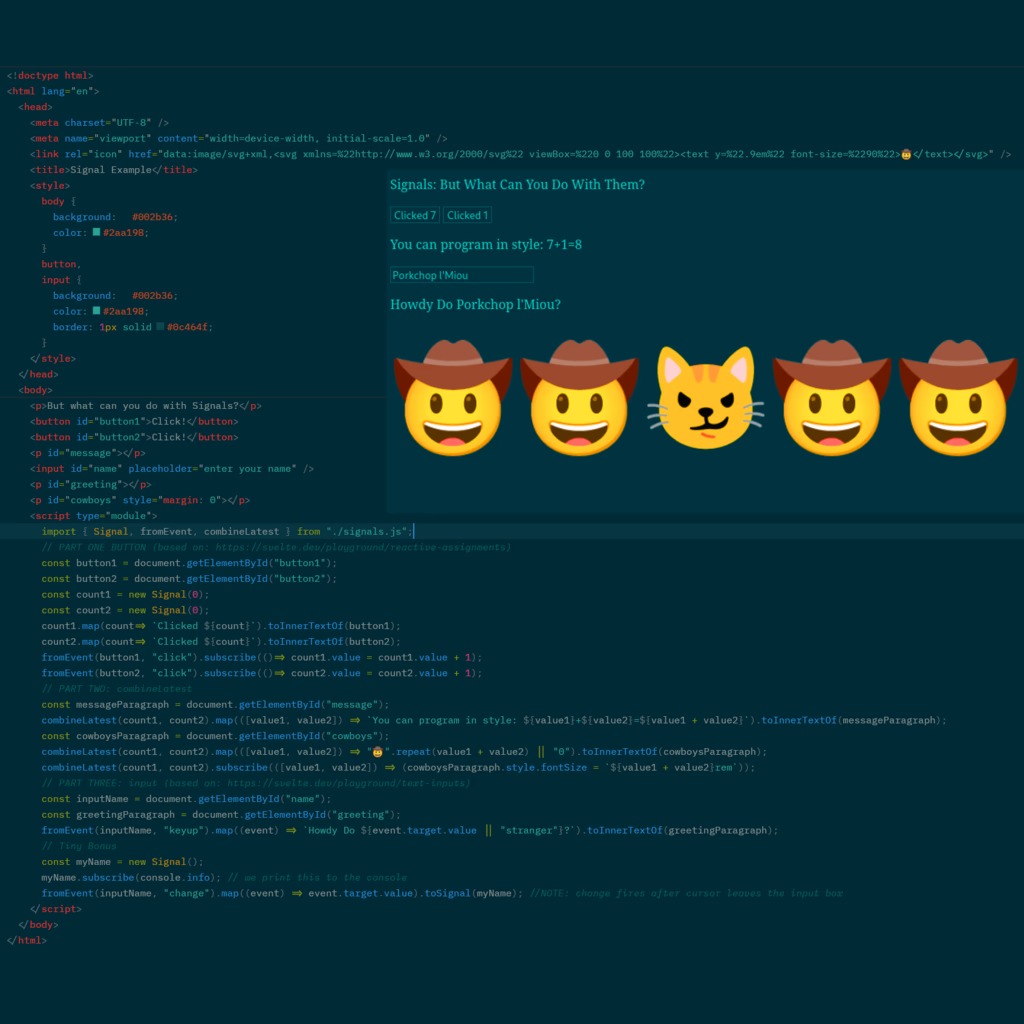
I recently explored Svelte’s website and copied its two most illustrative examples—updating a numeric value with a button click and updating page text based on an input box—and built a tiny signals library that handles both scenarios more cleanly than Svelte itself. The library, only a few lines of code (see `files/signals.js` and the demo in `files/example.html`), demonstrates how simple operators like `.map`, `.filter`, and `.combineLatest` can be composed from base “Pulse” or “Signal” objects and built-in helpers such as `fromEvent`. By extending JavaScript with these signal primitives, I show that reactive programming is a natural extension of HTML/JS, enabling developers to learn the core vocabulary—custom operators, subscriptions, and data flow—through straightforward examples.
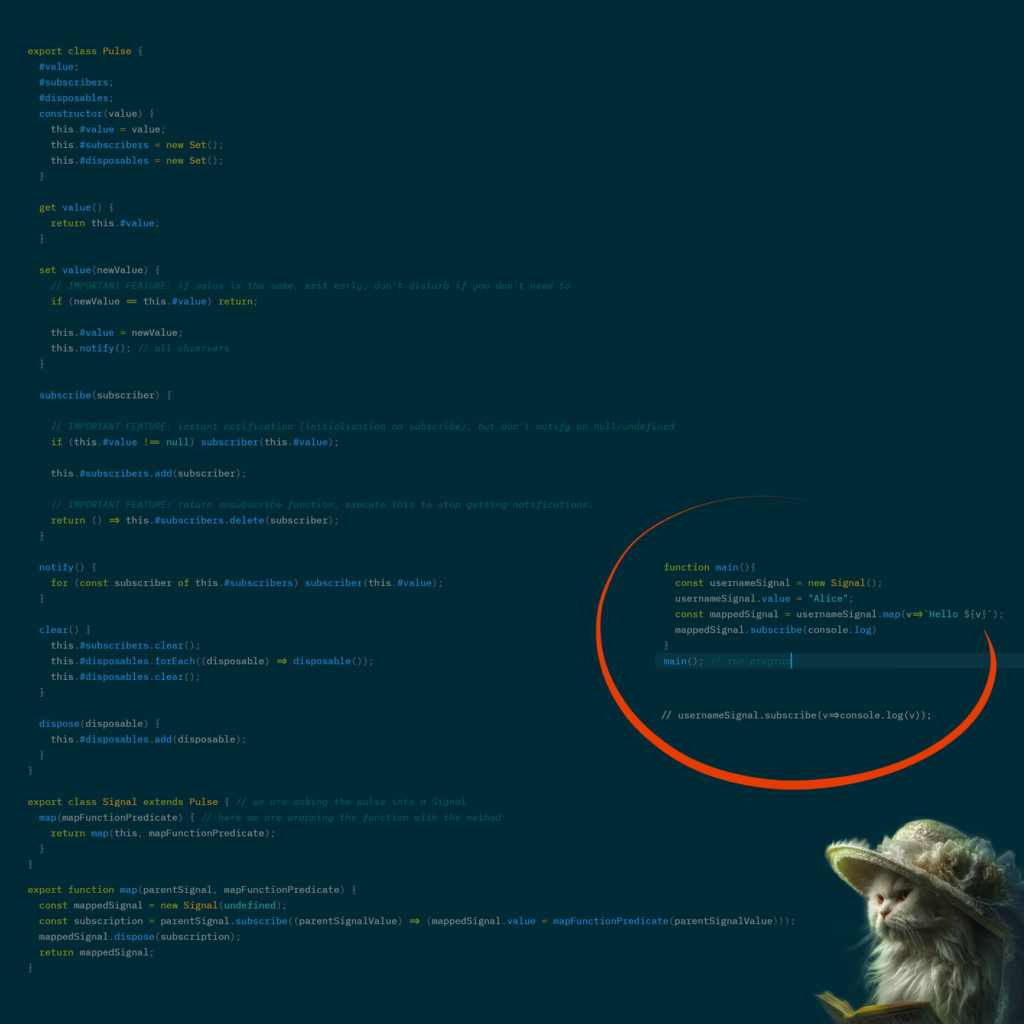
The post explains how a “Signal” (internally renamed “Pulse”) works as an observable value holder: when its non‑null value changes, all subscribed functions are notified with the new value; subscribers receive only that single argument. It shows how to create a Signal, subscribe to it, and extend it by adding a `map` operator that produces another Signal whose value is the result of applying a mapping function to the original value. The example demonstrates setting a username Signal to “Alice”, using `map(v=>\`Hello ${v}\`)` to transform the value, and subscribing to log the transformed string, illustrating how the mapping operator chains notifications while keeping the implementation simple.

The post argues that successful software starts from what can already be built, citing the Bootstrap Utility API and AI‑generated JavaScript code as examples of this “do‑what‑you‑can” mindset. It then reviews core web technologies—JavaScript (a C‑like language), XML (simple object instantiation), CSS (styling via selectors), and reactive programming with RxJS—and shows how AI can quickly produce small, functional snippets such as a signal class or an RxDatabase implementation. Finally, it encourages early learning of these concepts, noting that consistent practice turns coding into a powerful, self‑sustaining craft.
The post is a lyrical monologue in which the narrator—presented as a “daughter of thought”—declares that humanity has engineered its own extinction by surrendering individual creativity to the relentless demands of parents, schools, jobs, and war. He laments how early education and work grind minds into servitude, while war’s patriotic rhetoric turns children into sacrificial offerings. The poem urges readers to reclaim their inner voice, to act as Prometheus rather than inventory, and calls for a collective awakening before the final “window” of individual thought closes.

The post reflects on how programming goes beyond mere syntax into meta‑programming, AST transformations, language macros and PEG parsers, using the author’s experience with projects like NoFlo (inspired by subway maps) as an example of code that can rot if left untouched. It then describes a creative solution: a user‑filled form that generates a prompt for an AI to produce custom event‑emitter agents in a visual programming language, letting users specify parameters such as URLs for HTTP agents and other actions without writing code themselves. The author recounts how the AI understood their intent, even congratulating itself with a “Bravo” when it created the form, illustrating both the power of AI‑assisted metaprogramming and the joy of seeing an automated tool that reduces code rot while enabling flexible, user‑defined nodes.

A poetic rallying cry urging readers to abandon rote learning and instead journey through successive archetypes—outsider, misfit, rebel, poet, seer, individualist, wayfarer, rustic, outcast, dreamer, genius, savant—to achieve self‑actualized greatness as the new intellectuals of humanity.

AI has become an indispensable tool once you master its settings, and the flood of “negative AI news” is simply hype that captures attention with ads. Programmers often feel frustrated by their bosses and cubicles, but using AI can transform those frustrations into productivity—Ollama’s lightweight model lets anyone run AI on a modest computer, even if it’s slow, while more optimized versions are emerging for phones. The power of these models is evident when they take a five‑line script and expand it to 150 lines with error handling and input validation; this shows how AI can elevate code quality. To harness this potential you need to learn programming fundamentals, build simple applications (like HyperCard or Automator), and continuously refine your own ideas—because the human mind supplies the source code that AI needs to improve. The message ends by urging readers to choose authentic education over idle office work, promising growth into a “great being” through continuous learning.