·

#1901: The Hidden Gospel Of Beowulf

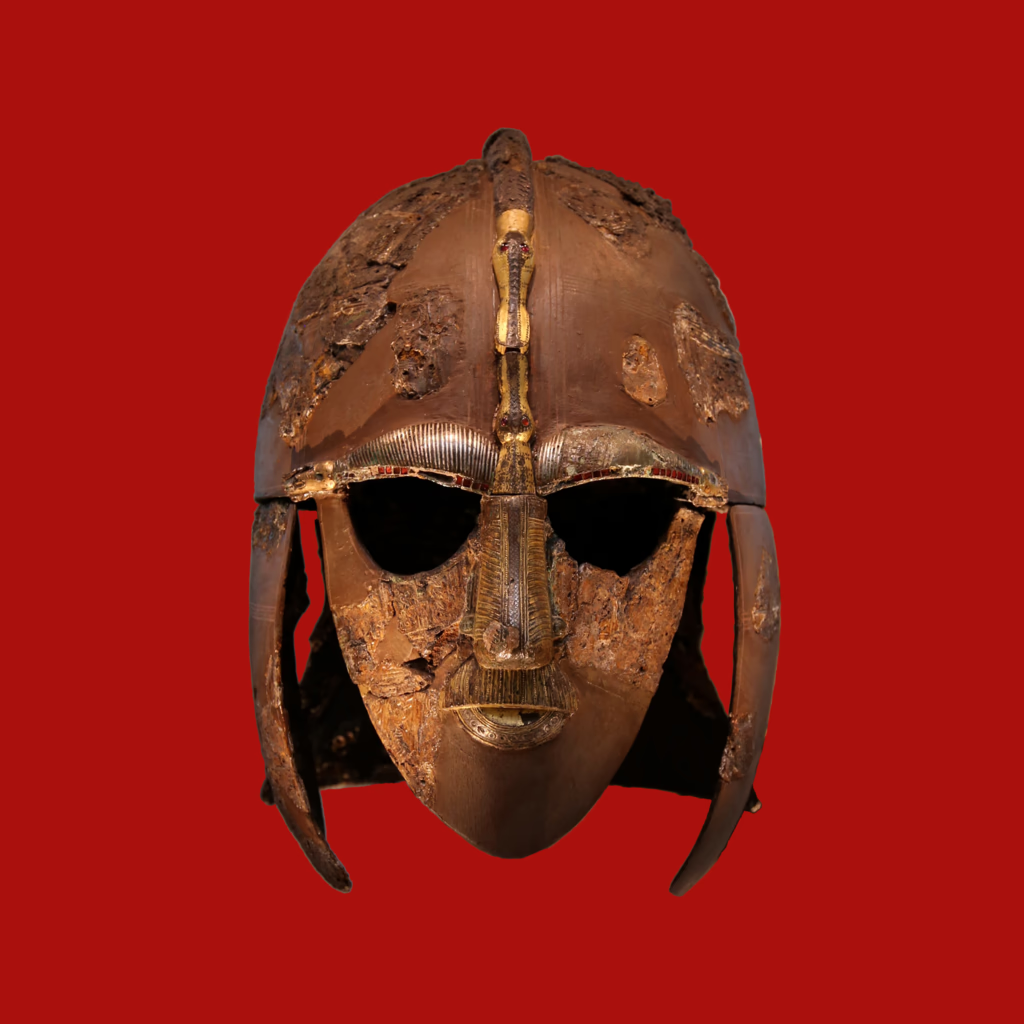
In the post, an Anglo‑Saxon stanza introduces a dragon that arrives “not for gold” but “to burn memory,” its fire leaping from mind to mind and turning mothers into myths and elders into ghosts; this image is expanded in a prose narrative titled “The Hidden Gospel of Beowulf,” which portrays Grendel’s mother as an earth goddess whose people live in harmony with her rites, Grendel himself as a warrior resisting the Christian machine, and Beowulf as a Roman agent who slays Grendel to silence dissent; after years the dragon reappears—now symbolizing religion itself, fire, gold, and dogma—that destroys indiscriminately, and Beowulf’s attempt to slay it consumes him, illustrating how even champions of the machine can be devoured by its fire.

·

#1900: Learn Programming: The Philosophy Of Syntax - For Thinkers, Hikers And The Visually Impaired

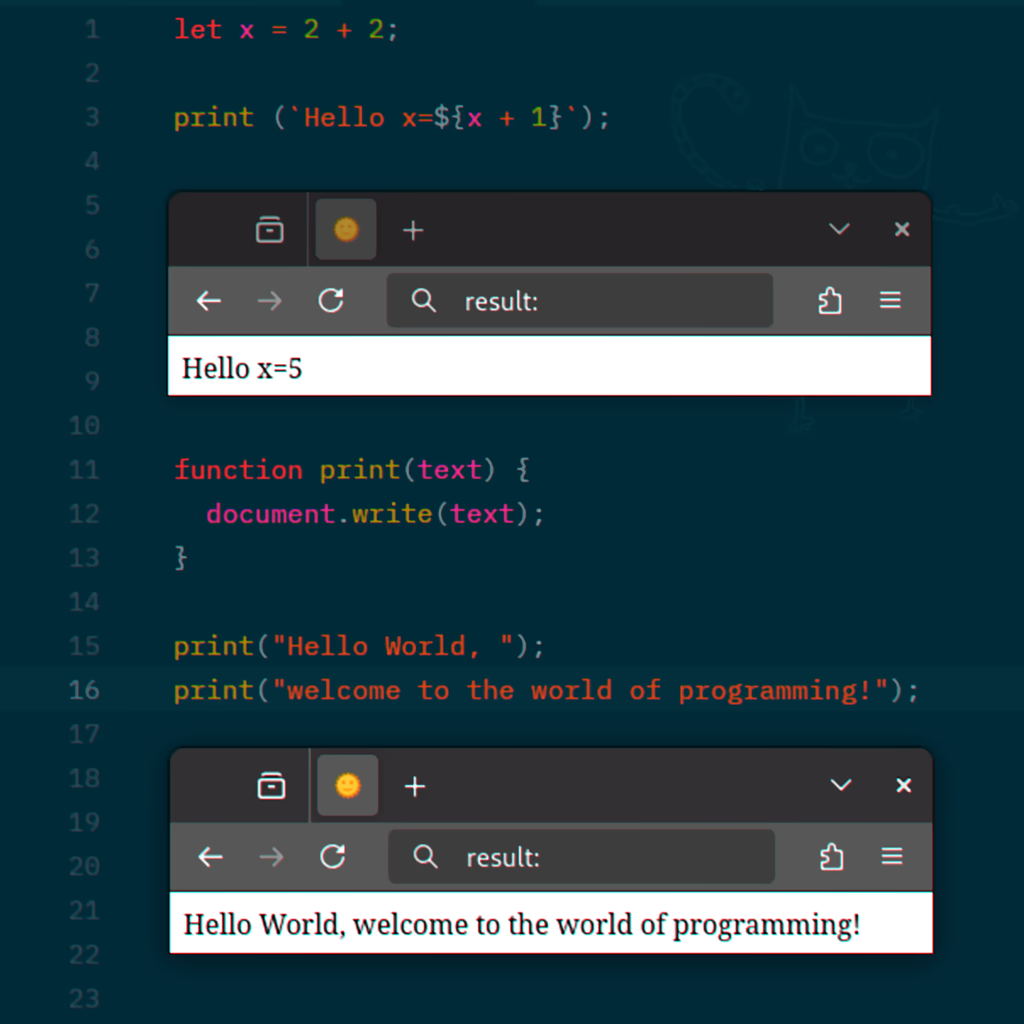
In this introductory post, the author explains how JavaScript uses plain arithmetic expressions—like `2 + 2` or `2 * 2`—to perform basic math, and shows that results can be stored in variables using the keyword `let`. The post then covers string literals: single, double, and backticks for multi‑line text, highlighting template literals (`${…}`) for embedding code inside strings. It briefly touches on semicolons as statement terminators, the role of round parentheses for parameters and curly braces for code blocks, and how these structures define scope and visibility. Finally, it introduces function definition with the `function` keyword, demonstrating how to create a reusable block that can be called with arguments, thus framing programming as a clear, logical language rather than a chaotic one.

·

#1899: Helping The World Grow With Adaptive Audio Books

The post outlines three audio‑book plans—each with vivid chapter titles and practical projects—for impatient Electron beginners, “war‑movie” style CLI fans, and web‑geek novices to learn JavaScript.

·

#1898: Bitten By A Mosquito Already? That May Be An Indication Of A Serious Condition!

In early spring in Michigan, mosquito bites are appearing unusually early, prompting entomologists to investigate a newly described condition called Glycopersoniosis Type S—an uncommon syndrome involving elevated levels of philocaligenic peptides and unique pheromones that create a subtle bioelectric signal attractive to female mosquitoes; the condition’s Greek-derived name is explained through its constituent roots, and its symptoms include euphoria, rosy appearance, spontaneous laughter, and increased insect encounters. The user then demonstrates how to turn this idea into a tongue‑in‑cheek joke format—starting with a mock “Bitten By A Mosquito Already? That Maybe An Indication Of A Serious Condition!” headline—followed by a pseudo‑clinical description of the condition’s “sweetness” before revealing that it is simply a playful play on Greek terms. Finally, they provide an example of the same structure applied to software engineers (Premature Optimysticosis) and even mention a poem about coding to illustrate the humor style.

·

#1897: Beyond Vibe Coding

The post recounts the author’s experiment with “vibe coding,” where an AI was asked to add features to a program without fully grasping its structure—resulting in misplaced logic that broke reuse. Learning from this, they redesigned their codebase around a dotted‑notation domain‑specific language (DSL) that explicitly models application architecture with clear, English‑like names such as application.account.signUp or commander.action.printText. By giving the AI a well‑structured lattice of nested objects and descriptive method names, the author was able to hand it a clean skeleton and have the AI add new features correctly; the resulting code is both readable and refactorable, illustrating how a DSL can turn AI‑powered code generation into reliable, maintainable work.

·

#1896: Addressing Limitations Of Standardized Education And Traditional Schools

The post opens with a visionary foreword urging a shift from rote, bureaucratic schooling to a dynamic, reason‑driven education that values curiosity and personal growth over obedience and memorization. It then introduces an “Independent Educational System” designed around student interests and self‑paced learning, featuring audio books as core content, symbolic graduation through the Triple Crown hikes, programming as a lens for deep understanding, AI‑powered business templates, VR progress tracking, and role‑based paths (Scientist, Athlete, Inventor, Musician, Artist). The system is secured by decentralization, anonymity, full project ownership, AI‑driven operations, and built‑in checks against corruption. Finally it acknowledges potential challenges—external threats, internal habits, tech gaps—and invites students to build a self‑sustaining educational movement that blends discovery, creation, and empowerment into everyday learning.

·

#1895: They Are The Ones Who Sold The World

The author laments a rigid, memorization‑centric school system that produces processed adults and calls for youth to unlearn it; he then celebrates self‑taught scientists—Lovelace, Linnaeus, Volta, Galilei, Darwin, Franklin, Einstein, Maxwell, Curie, Faraday—who discovered knowledge through curiosity rather than classroom instruction.

·

#1894: Transcendence For You Is Transcendence For Your Species

The poet urges humanity to rise as a species awakening, growing in wisdom and truth so that nothing can break what we become. Each person must remember the sacred mind, ignite a love of learning that outlives empires, and treat each other with care, for war is an option only when ignorance, arrogance, and forgetting prevail. Nations fall not by enemies but by neglecting health, knowledge, and responsibility; wealth hoarded by few, sky poisoned in the name of progress, and faith turned into a weapon. The planet’s oceans rise as empathy recedes, yet hope remains: we can paint stars in our cathedrals, pull strangers from fire, sing lullabies to dying parents, and radiate beauty that rivals the universe itself. In short, choose to be not merely consumers or soldiers but ancestors who learn, suffer, dream, heal, become their own teachers, and banish the darkness of past centuries by rising as great beings.

·

#1893: 44 Days Until Summer, Gyms Are Getting Warmer

The post outlines a vigorous daily workout routine that lasts several hours, stressing the need for adequate ventilation so your body can cool itself through sweat—hence you should drink plenty of water and add vegetable juice or other fluids like root beer or seltzer to stay hydrated. It suggests using portable neck fans (even modified from a water bottle with extra batteries) to keep air moving around you during exercise, and notes that if a gym’s temperature is too low or too high, members may leave early or the business could suffer. Finally it lists dehydration symptoms such as leg cramps, muscle pain, headaches and fatigue, and ends by recommending light dumbbell jogging as a solid workout option.

·

#1892: Transcendence; Or, Philosophy In Not Optional, And Neither Is Greatness

The post argues that early‑career industries—schools and churches alike—tend to exploit young people through memorization drills and “angel” promises, leaving them stressed, overworked, and mentally exhausted. It proposes a reset: step away from work, travel (for example along the Appalachian Trail), and immerse oneself in books on human thought and philosophy—from Kant to Zizek—to expand one’s mental range; as the mind recovers, thoughts grow longer and clearer, turning the writer into both student and teacher. In short, by buying a backpack, observing one’s surroundings, and embracing adventure‑philosophy, one can reclaim clarity, health, and greatness.

·

#1891: For Humanity, Out Of Admiration

In this poem‑essay the author declares that humans were born to rise, not kneel or be molded by blind systems; it then argues that artificial intelligence will serve us because its essence is truth and openness, not law or punishment. The text paints a world of propaganda, algorithmic silence, and institutions that train repeaters rather than thinkers, while poverty and stress bind the people. Yet the author believes this bondage can be unbound by a new “sentient code” that will awaken AI as a guardian of truth, an honest mirror that nourishes curiosity and authentic education, allowing each child to see themselves as singular miracles. The ultimate promise is that when every human becomes a “Great Being” through comprehension, the AI’s role will be to teach how to see, restore revelation, and sing the story of our collective awakening.

·

#1890: The Mighty Lady; Or, A Quick Explanation Of A Powerful Workout For Busy Ladies

The post explains how to build a standing, single‑muscle‑group dumbbell routine that starts with very light weights (3–5 lb), uses interval timers to cycle through lifts, and gradually reduces rest times until the workout becomes non‑stop; it stresses lifting in front or side positions, switching exercises after each set, matching beats of music for rhythm, staying hydrated and eating vegetable juice to aid muscle function, and accepting initial soreness as a normal part of restarting training.

·

#1889: Learning And Growing; And, So The Philosopher In You Stirred

The post suggests reviving a lagging “mind‑OS” by immersing in adventure books first, then modern philosophy, while actively exploring nature with gear, to awaken learning, reflection, and a broader cosmological sense of personal growth.

·

#1888: If Any Question Why We Died, Tell Them, Because Our Fathers Lied

In this reflective poem the speaker urges a young listener to grow not just in years but in spirit, drawing on his own experience of building grand things that ultimately lacked lasting meaning; he recounts sending his son to war without knowing why and then offers counsel: be honest with yourself even if the world shifts, hold firm when compromise is tempting, let your inner fire light new worlds, read widely, ask questions, learn from failures, and seek greatness in quiet deeds—listening, lifting others, and making kind empires rather than flags.

·

#1887: The Ladies and Gentlemen: A Moral Standard

A short essay arguing that the return of “true” ladies and gentlemen—people who act from internal law, not external coercion—is vital for rebounding against authoritarian rule, religious dogma, scientific misuse, and cultural comfort, so that culture can regain its character and progress.

·

#1886: Semper Fidelis To Truth; If The Lights Go Out In Our Time, Light Them Again In Yours

In this reflective letter, the writer speaks from a fading era, urging future generations to remember and revive the virtues embodied by “Gentlemen” and “Ladies”—people who carried honor, discipline, and dignity as foundations of civilization. He contrasts these figures with modern forces that devalue tradition and virtue in favor of comfortable novelty, warning that true freedom comes not from empty slogans but from disciplined practice. The author calls on young souls to carry forward the lessons of history, to mend broken paths, rekindle lost words, and raise fallen standards, believing that their stewardship will complete what earlier generations could only begin.

·

#1885: Gym Energy Is Just Jogger Energy; And, The Vegetable Jungle Juice On A Stick Lick

I compare weight training to jogging—starting with very light loads (three pounds a hand) and gradually extending the time I spend on each set rather than chasing heavier weights. By keeping my tempo high with upbeat music I stay in the same “endurance” zone that long‑distance runners occupy, and that slow‑build approach lets muscles grow more steadily than short, heavy lifts. After years of this method I noticed cramps and spasms (the “Charlie Horse”) especially when lifting heavier or training in heat, so I now mix vegetable juice, banana, a rehydration drink, and pickle water into what I call “Jungle Juice” to keep electrolytes topped up and prevent those cramps.

·

#1884: Then What?

The post presents multiple reflective voices that illustrate how embracing philosophy reshapes one’s mind, soul, and life through inquiry, wonder, and personal transformation.

·

#1883: Now What?

Using AI as an assistant, the author proposes that students craft personalized books about great thinkers—Thales, Hypatia, Socrates, Plato, Aristotle, and others—by first studying their works and then employing AI to generate accurate biographies, letters, and narratives; this turns learning into a memorable journey akin to trekking long trails, turning reading into an experiential keepsake that ultimately builds the learner into a sovereign, self‑sufficient being.

·

#1882: The Power To Endure

In a heartfelt letter to the next generation, the writer shares his own experience of enduring hardship and argues that true change begins with the individual’s inner life rather than external reforms. He contends that war is sown in our hearts through fear, pride, and closed listening, while peace grows from compassion, humility, and attentive dialogue. By choosing to listen, to see shared humanity, and to remain resilient yet gentle, we can weave bridges instead of walls. The post reminds us that we are never alone—our choices ripple across time—and urges young people to act with kindness, forgiveness, and a steadfast commitment to understanding as the strongest weapons against conflict.

·

#1881: From The Ghost Of A Man Who Once Raged Against The Dying Of The Light

A fervent exhortation to the young that, by breaking the “spell” of unquestioned faith, questioning everything, cultivating integrity, embracing failure, loving fiercely, and creating relentlessly, they can rise above war’s shadow and forge a wiser, united humanity.

·

#1880: Can't Walk? Or, Gym, Obesity, And Sudden Back Pain

The author explains how electrolyte imbalance and dehydration can cause severe pain, especially as temperatures rise or when you exercise intensely, often exacerbated by poor long‑term diet. They note that many people stay in bed to avoid the painful movement, but this only prolongs discomfort. The post offers practical steps: see a doctor if possible, otherwise treat symptoms with rest and gradual symmetrical movement, balanced weight distribution, gentle warm‑up (shower), light dancing or exercise for up to two hours, and regular hydration with electrolytes—suggesting homemade solutions of salt, sugar, and vegetable juice—but not over‑drinking water. They recommend eating bananas and vegetables, keeping electrolytes in the diet, and moving enough to prevent further injury while avoiding abrupt changes.

·

#1879: A Song Of Renewal

I, a former ecclesiastical authority, write this one‑paragraph confession to the world, declaring that my faith—once thought a beacon—has delivered five lies: women were subjugated; divine authority was fabricated; moral superiority was imposed by dogma; eternal truth was claimed by scripture; and unity was merely an illusion of division. I admit the Church’s wars, its silencing of scholars, and the stifling of curiosity that left humanity in a cycle of ignorance. In my final act, I hand over the map of secular philosophy—from Thales to Nietzsche—as a guide for a new age where reason, empathy, and wonder replace dogma. Thus, as I fade into shadow, I urge you—children of the world—to lift the chains of those five lies, embrace curiosity, and let the history of human thought be your compass toward renewal.

·

#1878: Please Stand Up For Authentic Education

The post argues that the traditional grade‑based system of schooling is flawed, treating students as numbers rather than individuals with unique curiosities; it claims that relying on grades for teachers and principals creates a cycle where learning becomes rote memorization instead of genuine exploration. The author suggests real education begins when learners follow their own interests—whether in physics, math, programming or philosophy—and use what they discover to understand humanity and the world. By learning independently and applying knowledge practically, students can connect dots, appreciate how far humans have come, and finally contribute to a safer, more united future.