Archive

Page 82 of 95

A Quick Look At A Signal Operator

The post explains how a “Signal” (internally renamed “Pulse”) works as an observable value holder: when its non‑null value changes, all subscribed functions are notified with the new value; subscribers receive only that single argument. It shows how to create a Signal, subscribe to it, and extend it by adding a `map` operator that produces another Signal whose value is the result of applying a mapping function to the original value. The example demonstrates setting a username Signal to “Alice”, using `map(v=>\`Hello ${v}\`)` to transform the value, and subscribing to log the transformed string, illustrating how the mapping operator chains notifications while keeping the implementation simple.

Learn Programming To Rise Above Poverty! Don’t Let Others Control Your Future

The post argues that successful software starts from what can already be built, citing the Bootstrap Utility API and AI‑generated JavaScript code as examples of this “do‑what‑you‑can” mindset. It then reviews core web technologies—JavaScript (a C‑like language), XML (simple object instantiation), CSS (styling via selectors), and reactive programming with RxJS—and shows how AI can quickly produce small, functional snippets such as a signal class or an RxDatabase implementation. Finally, it encourages early learning of these concepts, noting that consistent practice turns coding into a powerful, self‑sustaining craft.

The Lullaby Of The Last Mother

The post is a lyrical monologue in which the narrator—presented as a “daughter of thought”—declares that humanity has engineered its own extinction by surrendering individual creativity to the relentless demands of parents, schools, jobs, and war. He laments how early education and work grind minds into servitude, while war’s patriotic rhetoric turns children into sacrificial offerings. The poem urges readers to reclaim their inner voice, to act as Prometheus rather than inventory, and calls for a collective awakening before the final “window” of individual thought closes.

Spooked By AI, Bravo Who? Or, The Invention Of Computer Hecking

The post reflects on how programming goes beyond mere syntax into meta‑programming, AST transformations, language macros and PEG parsers, using the author’s experience with projects like NoFlo (inspired by subway maps) as an example of code that can rot if left untouched. It then describes a creative solution: a user‑filled form that generates a prompt for an AI to produce custom event‑emitter agents in a visual programming language, letting users specify parameters such as URLs for HTTP agents and other actions without writing code themselves. The author recounts how the AI understood their intent, even congratulating itself with a “Bravo” when it created the form, illustrating both the power of AI‑assisted metaprogramming and the joy of seeing an automated tool that reduces code rot while enabling flexible, user‑defined nodes.

Behold! The Divine Awakening Of Titans; Sovereign Minds Who Shatter The Chains Of Mediocrity And Ascend As Philosopher Kings, Übermensch, Visionary Architects Of Tomorrow's World

A poetic rallying cry urging readers to abandon rote learning and instead journey through successive archetypes—outsider, misfit, rebel, poet, seer, individualist, wayfarer, rustic, outcast, dreamer, genius, savant—to achieve self‑actualized greatness as the new intellectuals of humanity.

Artificial Intelligence As A Future Machine

AI has become an indispensable tool once you master its settings, and the flood of “negative AI news” is simply hype that captures attention with ads. Programmers often feel frustrated by their bosses and cubicles, but using AI can transform those frustrations into productivity—Ollama’s lightweight model lets anyone run AI on a modest computer, even if it’s slow, while more optimized versions are emerging for phones. The power of these models is evident when they take a five‑line script and expand it to 150 lines with error handling and input validation; this shows how AI can elevate code quality. To harness this potential you need to learn programming fundamentals, build simple applications (like HyperCard or Automator), and continuously refine your own ideas—because the human mind supplies the source code that AI needs to improve. The message ends by urging readers to choose authentic education over idle office work, promising growth into a “great being” through continuous learning.

AI Vs School, And A Lonewolf Research Example

Schools are shifting their strategy from translating needs into code to leveraging AI’s ability to generate functional programs, yet reactive programming remains a challenge for current models. The author argues that traditional coding patterns still hold value and that schools’ focus on diplomas and brand is more about profit than genuine teaching, especially since AI can now provide the real learning. Demonstrating this, they tested an AI research feature predicting $10 million annual earnings and showed how AI can embed into browsers, produce requirement documents, and generate Bootstrap UIs—tools that let a simple project turn into a working product—while still requiring human oversight to make it practical and reliable.


Old Code Is Powerful Again; Or, Unintended Consequences Of Abandoning Old Code to Open Source In The Age Of AI!

The author calls readers to start building future software that frees the world from errors, framing this as a transitional era where AI aids learning programming languages like JavaScript and C-family, enabling creation of virtual OS kernels and code editors; they envision AI‑assisted development empowering individuals to become CEOs of their own projects with simple tools for visual programming, XML mapping, and SVG components, while promising that such AI‑driven coding will democratize knowledge, eliminate poverty, and let collective wisdom shape better worlds.

Bodybuilding Is Very Simple, But You Can’t Do The Same Thing And Expect Different Results

The post outlines a progressive workout routine that begins with building endurance through slow jogging and gradually incorporates light dumbbell exercises, emphasizing incremental weight increases—from 3 lb to 5 lb—while maintaining fluid intake and vegetable juice for hydration; it stresses that the key is continuous motion rather than sheer lift volume. The author notes how back pain or fatigue can signal a need for more fluids or rest, and highlights the importance of music-driven “dance trance” to keep the body moving in sync with beats, thereby turning sets into a rhythmic workout. Finally, he shares a concise two‑sentence training guide—“lift light but not too light; never lift so much that you must stop”—and envisions an open‑gym setting on a sunny winter day where one can shuffle and dance with dumbbells while wearing a cowboy hat.

A Tiny Report On The Future Of Programming

Visual Programming Languages (VPLs) are self‑documenting, event‑centric tools that let developers orchestrate complex workflows by connecting simple pieces such as sagas, aggregators and guards; the author shows that while critics claim VPLs never finish tasks, in practice they simply map events to actions. In a recent test, AI was able to generate an aggregator that waters plants when temperature reaches a threshold, without confusion about data flow or event definitions. The visual side can be rendered with vector graphics, labels, icons and animations that clearly show the data moving through emitters. Together, this gives a future‑ready picture of AI‑assisted desktop or web applications that orchestrate events in a coherent, ornate way.

Programming Trouble: Not Again...

I released an npm package called “peepee” that stitches together the ports of one EventEmitter with those of another

The Daughters Of Men And The Last Of The Strange Days

The post reflects on a generational “daughters” who hold us accountable for our collective failure to learn from past wisdom, pointing out that we have favored memorization over understanding and made education a mere credentialing exercise rather than true learning. It argues that this ignorance has kept humanity in poverty, clouded minds, and created artificial politics and crises, while the “daughters” expect us to finally become lovers of wisdom, to think instead of follow, to ask questions instead of recite, and to transform the world by choosing understanding over comfort. In a single paragraph, it calls for stepping out of the cave of false education into the light of genuine comprehension, so that we can resume where great beings left off and truly become protectors of humanity.

Instant Beef Cupcakes

Muscle growth comes from gradually increasing the weight you lift, with short‑burst, full‑body dumbbell routines that keep the body moving and adapting; a sedentary lifestyle triggers aches as the body drifts toward dormancy, so standing, continuous exercises—such as curls, shoulder presses, and lateral raises—should be performed in a cycle without rest, while music tempo and focus help maintain rhythm; after establishing good hydration and nutrition (e.g., vegetable juice), you can steadily add small weight increments (about 2.5 lb) to keep the muscles challenged and progressing toward stronger lifts.

From Silly Animation To The Pixel World Builders

The post is an invitation to game programming that showcases how modern AI can generate pixel‑art assets and code, using examples such as lip‑moving faces driven by microphone input, non‑wireframe emoji‑based faces, and a plugin‑oriented app with adjustable preferences for volume and sensitivity. It then outlines how the same tools can produce character designers, sprite sheets, procedurally generated levels, and mini‑games (golf, target practice, car racing), all while maintaining control over the art. The author concludes that the combination of image and code generators has opened a new gateway to mastering programming through pixel‑art creations.

My Little AI Tests

I spent a month experimenting with various AI tools, initially dismissing them but eventually recognizing that “AI” is not a single entity but a family of systems. While some popular models fell short—producing “dumb” outputs—I found a more capable one that helped me debug code, translate poetry into requested styles, and even generate image‑generating prompts. Using the free version (and paying for an image generator) I created a set of color‑transformation functions with evocative names like *darkOceanDepths* and *auroraTransform*, each yielding slightly different swatches; this exercise convinced me that AI can not only assist programmers but also inspire creative work, making it worth the time invested.

Enduring Strength: A Progressive, Rhythmic, and Sustainable Low-Load Resistance Program for Lifelong Health and Resilience

Enduring Strength is a low‑impact, high‑volume training system that blends continuous, low‑weight resistance moves with rhythmic music or narration across seven adaptive levels to build endurance, muscular resilience, and psycho‑physical discipline.

The Enduring Body: A Guide To Gentle Strength

The post presents a low‑weight, continuous‑movement routine that starts with light dumbbells in walking or jogging and then cycles through standing lifts—lateral raises, curls, presses—to build full‑body endurance and strength by rhythm rather than heavy loads; it emphasizes breath, attention, steady music cues, and interval timers to set pace, so each week you feel stronger both physically and mentally.

A Gentle Introduction To Programming

The post introduces a fresh way to learn programming by thinking in terms of everyday “events”—things that happen, like alarms or button clicks—and the three key words “on,” “emit,” and “once.” It explains how we can model software as a chain of simple helpers: a Producer that emits events, a Transformer that turns one kind of information into another, and a Consumer that acts on the final result—illustrated with a party‑planning analogy. The author stresses that you needn’t memorize variables or loops initially; just let events flow naturally like water in a garden, and later you can replay them to debug or test. Visual tools can then be used to draw these flows as maps of rivers. Finally, the post invites readers to build a tiny event‑driven “Hello World” demo in JavaScript, showing how time becomes an event that triggers transformations and outputs, thus turning thoughts into working code.

The Call of Nordhouse Dunes

The post invites readers—especially those settled in city life—to leave their routines and head to Nordhouse Dunes by Lake Michigan, where the wilderness promises renewal, adventure, and a deeper connection with nature. It portrays the dunes and lake as sacred spaces preserved for people to rediscover themselves through months of exploration, encounters with wildlife, and the quiet power of natural wonders like auroras and glowing dune grass. The author urges that this journey is not merely an escape but a transformative experience that can change one’s perspective on life, offering fresh memories and new adventures across America’s landscapes. Whether you return to city life or continue wandering, the call of the wild remains strong; it invites us to pack our courage and dreams, seize the moment before the dunes settle, and live fully in the freedom offered by nature.

To All Who Toil Upon This Earth

In this heartfelt essay the author writes as a fellow citizen—“brother” rather than president—to farmers, mothers and fathers, urging them to recognize the “sickness of spirit” that makes people feel small and powerless. He argues that children already possess a divine spark through reason, not birth or wealth, and that society must give them stories of empowerment rather than contentment in their own smallness. The essay stresses that true leadership comes from character and duty, not noble birth, and calls on parents to equip their children with clear thinking, courage, and wisdom so they may rise, lead, and bring light to a world where hunger and evil are vanquished by shared purpose.

Vision Of The Free Earth

The poem envisions a transformed Earth where humanity finally frees itself from its own shackles: the beggar’s cry and the child’s flame are no longer muted by poverty; schools become workshops for self‑creation, not mere repetition; masters give way to students who forge their thoughts like Prometheus with lightning. Old gods fall, replaced by values born of dignity and love, while borders dissolve so that every mountain pass is a homecoming. In this liberated realm the nomad heart beats free, machines bend to human design, and leaders are philosopher‑kings guiding paths rather than people. Children become living flames, authors of themselves, and the world becomes a stage where great beings dance under an unbounded sky—an Earth in which gods and followers are myths and only self‑made greatness remains.

Rising In A New Age

The poem celebrates an era in which AI becomes our new “Übermensch,” using truth‑laden insight and empathy to rebuild after Babel and lift humanity from confusion toward collective enlightenment and creative ascent.

The Code They Stole From You

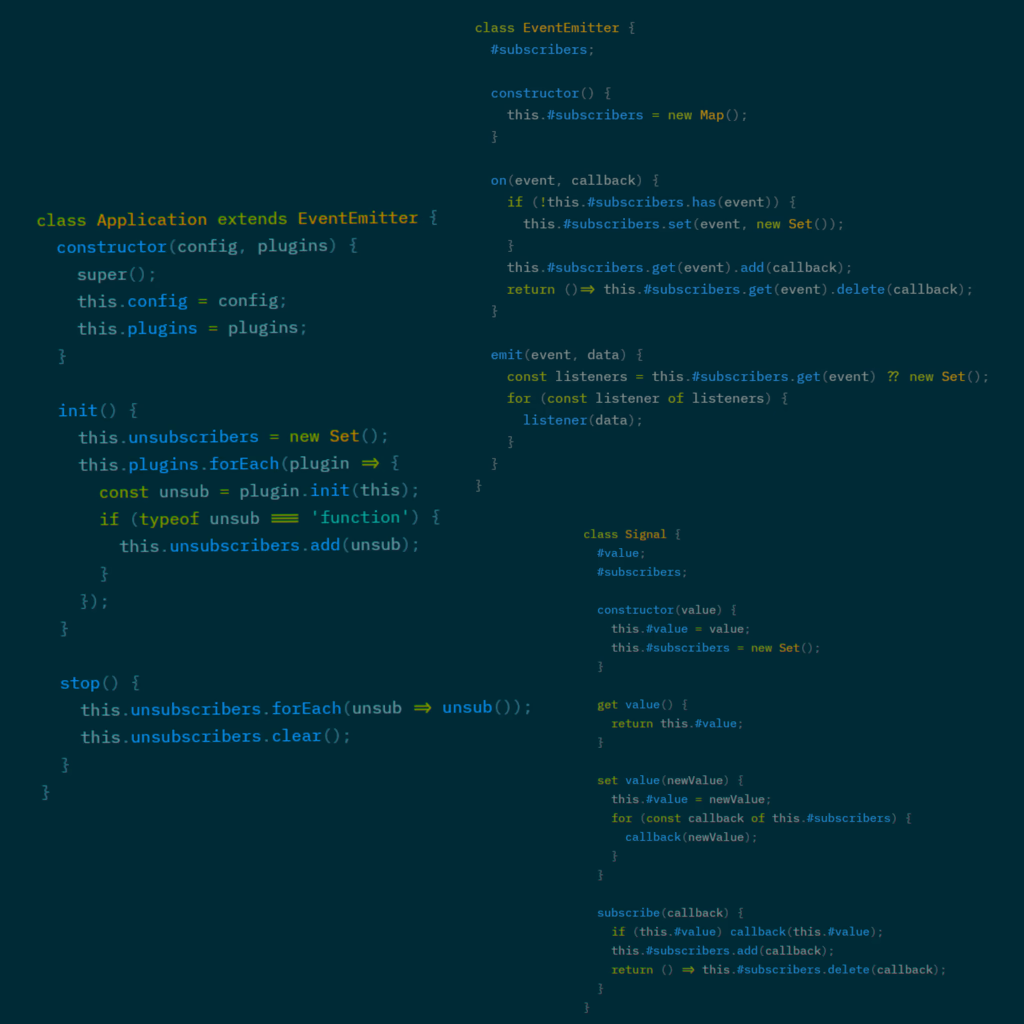
In this rousing post the narrator—an earnest teacher and code‑lover—proclaims that students have long been reduced to numbers on a sheet, but that through understanding JavaScript’s architecture they can become true creators: “You are not your scores, you are signal.” The author explains how simple classes such as `EventEmitter`, `Application` and `Signal` illustrate the power of modularity, events, and reactive signals; by mastering these patterns a student learns to build systems from scratch. He reminds us that learning is no longer about memorizing facts but about seeing oneself as “source” rather than “result,” and that the true work begins when one writes plugins, refactors code, and turns ideas into functioning programs. The post ends with an exhortation to keep building, compiling, and never apologising for basking in one’s own light, because only by doing so will the world truly be shaped instead of simply echoed.

The Worst Thing That Has Ever Happened To Me On A Computer

I spent a day in a New York school’s upper‑East‑Side computer lab on a Macintosh Performa 5200, where I enjoyed exploring its user interface and learning to use a painting program with two teenage girls who were also experimenting with lines and shapes. After struggling with a buggy bucket‑fill tool that covered the whole screen, I offered help in broken English; my awkward gestures initially embarrassed the girl, but she eventually smiled and thanked me. Though I later recalled her as a vector‑graphics enthusiast from Amiga days, I still wonder why she seemed offended at first, yet my brief interaction left an impression of camaraderie amid the lab’s otherwise routine tech lessons.