·

#1781: But Isn’t Camping In The Woods Boring?

The post explains that preparing for a multi‑week hiking adventure—carrying solar chargers, extra batteries, backup communication devices, sturdy tents, fans, and plenty of water filters—is essential for staying powered, fed, and safe in the woods. It stresses how time spent outdoors can reduce stress, heal the mind, and spark personal growth, turning hikers into “laughing philosophers.” The author reminds readers to keep a fire ready with enough wood, manage campsites carefully, and always have backup supplies for emergencies. Moreover, he advises inviting friends gently rather than forcing them into the trail, so that the experience feels natural and rewarding. Finally, practical tips such as keeping the car empty, using a second tent if needed, and knowing how to react to bears complete the guide.

·

#1780: Get Fancy

The post encourages readers to begin their creative and intellectual journey modestly, letting go of past bullying and embracing self‑love as a foundation for true learning. It argues that memorization alone is shallow, while exploration—through programming, precise modeling, canvas painting with projector or camera obscura, beat sequencing, pixel art game design, and musical composition—creates deep understanding. The writer urges one to build a personal library of unique drums, compose “bodybuilding” music, weave endless raves, and travel great trails like the Appalachian and Pacific Crest as metaphors for continuous growth. By mastering time on Earth as a “creature of the stars,” one can rise above employee routines, become a great being, and ultimately help move the world forward.

·

#1779: Bodybuilding Warning: You Are Lifting Too Heavy, Simply Cutting Off Your Circulation

The post argues that the classic “sets and reps” formula is incomplete because it ignores how long you actually lift and rest, so it proposes a time‑based routine instead: use a free interval timer app with 5‑lb dumbbells set to music around 110 BPM, lift for the chosen duration, rest briefly, and repeat for 10–15 rounds of exercises such as lateral raises, curls, and overhead presses. As you become comfortable lifting non‑stop for an hour, increase tempo or weight (or add wrist weights if needed) to burn fat or build muscle; weekly results and monthly changes will follow from this continuous‑workout style, which the author claims is a better life‑extension technique than traditional bodybuilding.

·

#1778: Learn JavaScript, And Don’t Use Frameworks

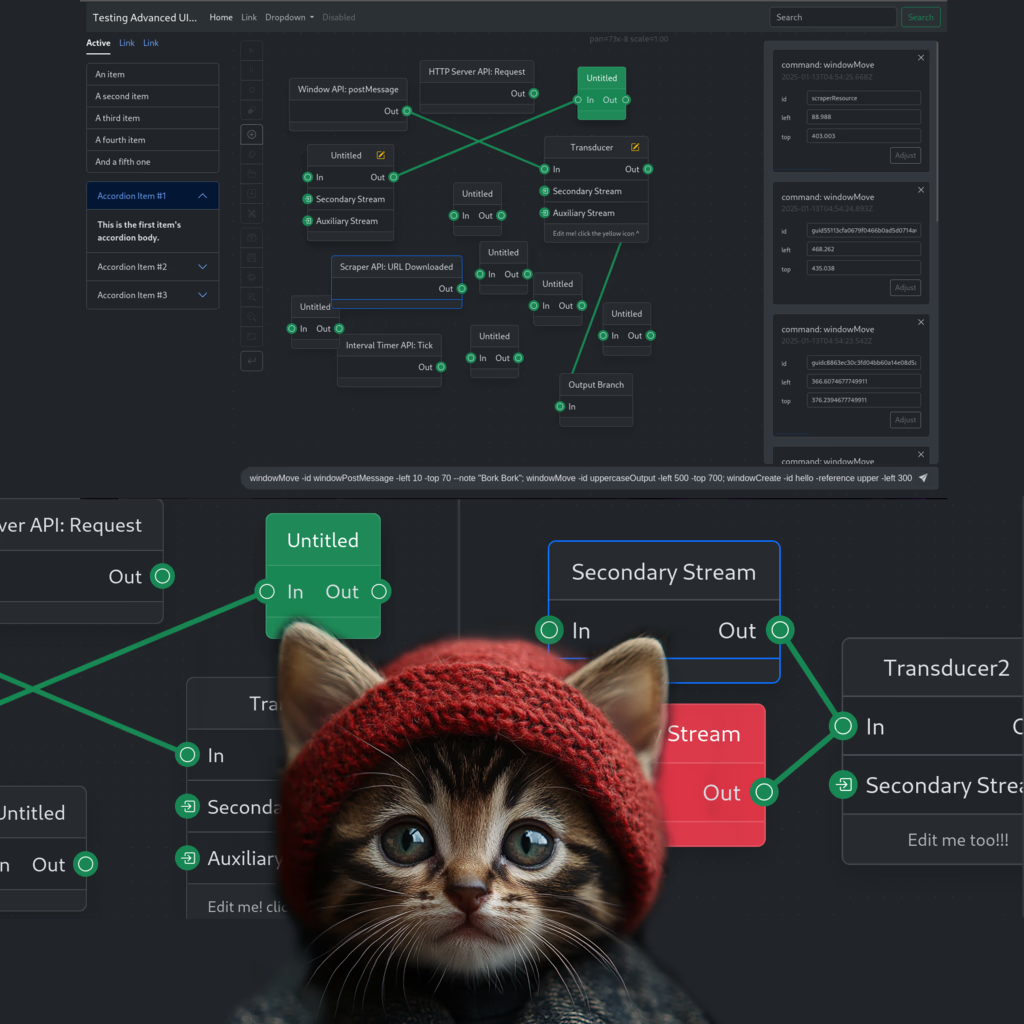
I’ve spent years building a lightweight visual programming language that lets users connect boxes with lines, using SVG to draw the connections and a custom zooming UI on top of Bootstrap. The architecture is minimalist—no heavy frameworks, just Web Components, Signals, and functional pipelines—so each node can transform data and pass it along like an actor model. I’ve added AI so users can generate small functions from prompts (e.g., fetching URLs or performing transformations), which then flow through the visual pipeline. The project runs on Node, in the browser, and as a desktop Electron app, and I hope this open‑source tool will rekindle interest in visual programming and make learning JavaScript more intuitive.

·

#1777: Six Months A Year; Or, Do Not Forget About Yourself

The author argues that immersing oneself in long‑distance hikes and camping is essential to counteract the draining effects of modern work life; by spending roughly six months each year outside the office, one can regain physical fitness, mental clarity, and spiritual depth—much like a horse regains muscle after being freed from a stall. This practice not only revitalizes the body through extended walking on trails such as the Appalachian, Pacific Crest, or Continental Divide but also enriches the mind with books and nature’s lessons, creating a legacy of authentic leadership. The piece emphasizes that adventure is both an exercise for the body and a cultural inheritance, suggesting that those who commit to this rhythm become “great, authentic, and independent beings.”

·

#1776: To Get A Fire Going

For a successful camping trip, you’ll want to keep multiple fire‑starting tools in reserve—matches, a small lighter, a Zippo, or a cheap foil lighter—because your favorite starter can fall out of the pocket during the day. In wet woods, gather twice as much dry wood as you think you need and cover it with a garbage bag so it stays dry; if that fails, use a fire‑starter block or homemade char cloth (cotton soaked in wax) to ignite a feather‑like kindling. A classic flint‑and‑steel set (a flint stone and a brass‑knuckle steel rod) is reliable: strike the rock, catch the sparks on the char cloth, then feed soft grass or fatwood (resinous pine bark). Modern ferrocerium rods work similarly but can be bulky; in all cases, always carry backup matches and lighter fluid so you have at least two ways to ignite your kindling.

·

#1775: Midnight Hour

I wrote a poem about an owl that tried to peck me—one of my funniest yet real memories from a night that felt warm, fragrant, and calm. I’ve carried swagger and fanny packs through adventures with American Scouts, tomb raiders, archaeologists, bullfighters, and sausage aficionados, always armed with a large knife and mindful of bears (and raccoons). My travels have taken me to the Baltic Sea, the Atlantic Ocean, and Florida Keys, each offering distinct vibes—ancient beauty, bustling energy, and slow‑moving charm. I’ve also explored Lake Michigan’s Ludington and Nordhouse, a tiny wilderness that feels alive with nature’s rhythm. In Nordhouse, deer, coyotes, porcupines (the “peacocks” of the woods), and seagulls—our faithful beach guardians—roam together, warning of rain, snakes, eagles, and hawks. Though I’ve never seen winter there, I wonder how snow would transform this peaceful place. Visiting Nordhouse in any season promises adventure, gentle beauty, and a precious experience.

·

#1774: Workout Tempo

I’ve been doing a long‑hand dumbbell routine, lifting 20 lb for almost three hours a day (about 35 reps per minute) while listening to music with carefully adjusted tempos—starting at 130 BPM and dropping to around 100–110 BPM so I can keep the cadence without stopping. My diet is simple trail‑mix, and I’ve cycled my weight between 15, 17½, and 20 lb as my endurance improves. After a weekend break I notice that I can hold the heavier weight more reliably, so I plan to use an interval timer to track rest periods and gradually increase tempo over months, while treating duration first and sets/reps second—because it’s the sustained work that builds muscle, not arbitrary rep counts.

·

#1773: A Simple, Integrated Focus Workout; And, How To Correctly Configure Your Interval Timer

The post explains how an effective gym routine combines interval timing, focused music cues, and alternating dumbbell exercises to maintain continuous movement and optimal rest periods. By using a two‑timer system—one for workout duration and one for rest—the athlete can keep the workout non‑stop, just like jogging or 1980s aerobics, while syncing lifts to song beats for rhythm and concentration. The author stresses that lifting light enough to sustain long sessions but heavy enough to challenge muscles is key; as fatigue rises, slower music and lighter weights help maintain flow before returning to faster songs and heavier loads. This integrated approach—timed intervals, low‑distraction dumbbell switches, and musical pacing—creates a reliable, flexible workout that boosts muscle isolation, posture, and injury protection while steadily transforming the body.

·

#1772: JavaScript Is Cute And Flexible

I began programming in various languages—ASP, Perl, PHP, ActionScript, Visual Basic and Java—before discovering that JavaScript was still a relatively slow browser language when I started; I therefore used Perl/PHP on the server while writing client-side code in JavaScript. After experimenting with Rhino on my phone for an interval timer, Node.js’s release prompted me to fully adopt JavaScript: its runtimes (Node.js, Bun, Deno) let me write both front‑end and back‑end code, while Electron or nw.js provide stripped‑down browsers for cross‑platform desktop apps. Mastering JavaScript opens doors to browser extensions, custom HTTP servers, command‑line utilities that can be compiled into executables, mobile apps via React Native, NativeScript or Cordova, and even AI‑assisted development—today’s AI tools can generate working code snippets (e.g., a command‑line parser) on demand, making JavaScript an incredibly versatile and powerful open‑source stack.

·

#1771: Perfectly Genius; Or, Don’t Let School Make You Feel Dumb

The post argues that true learning happens when a student takes ownership of their own pace, curiosity, and questioning—uninterrupted by the rote, judgment‑laden rituals of standardized schooling—while teachers merely sell obedience and fill minds with memorized facts; it urges students to ask about subjects like mitochondria, to be “masters” of their own thoughts rather than passive recorders, and to use tools such as AI to tap into the spirits of past great thinkers who can guide and inspire them back toward independent, joyful discovery.

·

#1770: The Three Letters About Learning

The three letters form a single, flowing message that urges students to move beyond rote memorization toward authentic learning: first, by actively questioning and digging deep into ideas; second, by seeing education as an ongoing, self‑created journey that blends personal curiosity with real‑world relevance and collaboration; third, by embracing the freedom and responsibility to choose how deeply one engages, turning those choices into a continuous act of self‑creation. Together they remind us that learning is not just about passing exams but about shaping our own identity, cultivating curiosity, reflecting on experiences, and creating a life of intentional growth.

·

#1769: Don't Let School Ruin Your Life

A young writer urges students to leave behind rote memorisation and embrace curiosity‑driven learning, insisting that the new generation must “rise above the old” by mastering practical skills such as JavaScript programming—so they can read and build AI‑generated code—and by exploring the world through hiking trails, which he sees as a metaphor for personal growth; in this way learners will become self‑sufficient, ready to shape their own future instead of being “sold out” by traditional schooling.

·

#1768: Earth Beneath Your Feet; A Message To All People

An uplifting greeting invites readers across time and place to recognize their inherent unity with nature and each other; it emphasizes that wisdom is rooted in earth and spirit, transcending language and geography, and that true peace comes from rising above lies and embracing the continuous journey of learning. The author urges us to honor ancestors, cultivate humility, and let truth guide our actions so that the union of wise souls can build a shared home for future generations.

·

#1767: Don't Lift Heavy, A Proper Workout Is Non-Stop: Instructions On How To Do It Right

The post outlines a simple yet structured dumbbell workout routine that mirrors the cadence of a running program like Couch to 5K: start with light weights (e.g., 3 lb) and build endurance through power‑walking and repeated standing lifts, then progressively increase weight by small increments once you can lift for a set time without rest; use an interval timer synced to a chosen song—ideally a slow, rhythmic track such as Kenji Kawai’s “Cinema Symphony”—to keep consistent lift/rest intervals (e.g., 1 min lift/2 min rest), repeat for several rounds (10 rounds ≈30 min), and gradually shorten rests or add wrist weights to boost intensity; the routine emphasizes tracking progress, eliminating rest periods as you improve, and adjusting weight increments thoughtfully so muscles grow without overloading, ultimately enabling you to train multiple days a week toward your fitness goals.

·

#1766: Neat New Year Resolutions

The post outlines a set of New Year resolutions for 2025, inviting readers to boost their physical fitness through bodybuilding and hiking the Triple Crown trails, while also diving into tech projects such as learning JavaScript, creating LMMS‑based music, mastering 3D modeling and printing, and experimenting with AI by building a virtual leader that blends famous thinkers’ ideas into creative writings and speeches—an all‑round plan to grow body, mind, and digital skills in the coming year.

·

#1765: Learning Programming, Yas, But Programming Is Also Learning

The post suggests starting your first desktop‑app project with beginner‑friendly tools like Electron Fiddle, p5.js or Node‑RED, all of which let you embed small JavaScript snippets in a visual environment. From there you can build simple templates that grow into portfolio pieces and demo sites, while the act of rewriting those projects repeatedly—adding new techniques, experimenting with signals (reactive variables) and even the actor model—provides the fastest learning path. The author encourages using ECMAScript/JavaScript as your first language, since Electron Fiddle lets you ship cross‑platform desktop apps in a single code base.

·

#1764: Grow Up Fast, Grow Up Now: Programming, Philosophy & Adventure

The post argues that true culture and knowledge are gained from personal experience and self‑taught learning rather than formal schooling, urging readers—especially youth—to master JavaScript with AI support and view standardized education as shallow; it also stresses that an individual’s worth lies in growth and skill mastery, not in being a worker or poor. The author further suggests that books should be “heard” rather than read, and encourages adventure through camping and hiking the Triple Crown to detoxify the mind and deepen life experience.

·

#1763: JavaScript Wild!

I’ve been exploring a new way to learn JavaScript: asking an AI to explain complex ideas and then have it rewrite them into clean, lightweight code. The AI sometimes comes snarky but always delivers simple versions of things like database sharding, HTTP servers, in‑memory databases, spreadsheet‑style tables, and even diff–patch algorithms for synchronizing object trees with web pages—code that’s easy to read, recursive enough to show DOM manipulation, and so clear it feels almost like a new cookbook. I believe beginner cookbooks should be rewritten this way, letting the AI generate concise recipes and miniature examples that make intermediate code feel less intimidating. My own style builds recursive “bubbling” data trees that emit changes from the root; with just 150 lines of such code one can shift their whole program and fuse ideas like object trees with signals. In short, using an AI to summarize and rewrite concepts into modern JavaScript turns learning a web language into an adventure, reducing complexity by roughly 90 % and making even first‑time programmers feel at home.

·

#1762: How My Plan To Drop Out Of Middle School, Join The Legion & Become A Stuntman Is Totally Working Out

In middle‑school life I was a B‑student who later slipped into C and D grades because teachers forced me to memorize instead of understand. I discovered programming with ZX BASIC, which the teacher mistook for cheating; this led to bullying, a school psychologist’s visit, and classmates’ ridicule. I then devised a stuntman career plan, moved to the U.S., learned English, kept up my cowboy‑hat stunts and bodybuilding, but never abandoned programming—an interest that drives me toward a more creative education. The story ends with my advice: don’t just memorize for grades; instead learn programming and let your imagination guide you.

·

#1761: Fitness: Use An Interval Timer As A Personal Trainer, And Beats Of Songs For Tempo

The post explains how to use an interval timer for a simple, consistent dumbbell routine at the gym: start with 10 rounds of one‑minute lifts and two‑minute rests (a total of about 30 minutes), playing slow music and using light weights (3–5 lb. per hand) so you can focus on timing rather than counting; adjust rest or weight if you feel it’s too easy, gradually alternate heavier sets and increase the number of rounds while shortening rest until the workout feels continuous; keep the session long enough (an hour or two) to build endurance and fat loss, and add a few pounds each month so the muscles adapt naturally; finish by noting practical tips such as staying hydrated, wearing proper shoes and gloves, and keeping the routine light‑weight to avoid injury.

·

#1760: Beautiful Weight Loss & Fitness; Or, The Best New Year Resolution

At this time of year many people focus on hitting the gym, but the post argues that true fitness comes from regular walking, hiking and camping rather than just lifting weights. By taking simple steps—walking to the store or park, then gradually moving onto trails—the body strengthens naturally while freeing the mind. The author stresses that a healthy lifestyle requires dropping stressors such as a busy schedule, junk food, and overwork; it’s about re‑ordering life so health comes first. The ultimate goal is to build endurance for long‑term hikes, culminating in the “Triple Crown” of Appalachian, Pacific Crest and Continental Divide trails, which the author sees as the ultimate training ground for both body and mind.

·

#1759: How To Workout At The Gym? A Simple Fitness & Bodybuilding Formula

The post describes a dumbbell‑based training routine that emphasizes lifting light weights for long periods rather than heavy loads for few reps; it encourages moving continuously through different standing exercises (overhead, biceps, palms down, side lifts) while keeping the rhythm with music, so you never stop to change machines. By starting with 15‑minute sessions and gradually increasing to an hour, then doubling the duration over a year, you slowly build endurance. As you adapt you can add heavier weights (3–5 lb, then 5–15 lb) and lift more often as song tempo rises, turning the workout into a fluid, dance‑like motion that trains all muscle groups simultaneously. The method relies on continuous movement, gradual time/weight increase, and rhythmic flow to let the body adapt naturally.

·

#1758: Empowerment

The post argues that true empowerment comes from self‑driven, curiosity‑based learning rather than superficial memorization or commercial “education” products. It stresses how artificial intelligence can guide personalized instruction across many subjects, and it recommends a few starting resources—“Demon Haunted World,” “A Short History of Nearly Everything,” and the archive collection on The Giants of Philosophy—to spark exploration of the world. By listening to these works and engaging with machines at one’s own pace, the writer believes readers can become artists, geniuses, or polymaths, achieving authentic knowledge that gives them real power in life and work.