Archive

Page 10 of 95

Seeing In Parallel: The Colors Of Night

The author describes how science and play blend in his projects, beginning with three inventions—a CD‑based car MP3 player from 1998, a high‑altitude balloon carrying a miniature ship that beams video to a ground trailer for real‑time motion feedback, and a lock‑picking board game built around acrylic padlocks and deadbolts—and then moves on to recent experiments in CPU‑intensive post‑processing of infrared photos (colorizing night shots) and exploring ZeroMQ as a messaging tool to coordinate large camera arrays for slow‑motion, super‑resolution imaging; he concludes that such hands‑on experimentation and self‑education are far more powerful than textbook study.

Get Out Of My Laboratory, Or Invention Is A Teacher

The post explains how great thinkers learn by exploring fundamental phenomena—gravitational, electromagnetic, pendulums—and then following their curiosities. It uses infrared photography with a Raspberry Pi Zero as a concrete example: buying inexpensive IR lamps and cameras, experimenting with ISO, shutter speed, brightness, and contrast, then stacking images to reduce noise. The author suggests building a small lab with a Pi 4, adding monitors, and expanding to networked Pis, Noir cameras, and time‑lapse setups. From there the reader can branch into programming (Node.js, Bash), 3D printing cases for the Pis, servo motor practice, and even constructing a Raspberry‑powered telescope that doubles as a “space laser.” The key idea is taking baby steps—experimenting, documenting results, publishing tutorials—and letting each new project add to a growing body of knowledge and wisdom.

Not To Mention Business Invention

An enthusiastic inventor suggests that creativity often builds on others’ work, encouraging people to start simple projects—like a custom phone‑ring service that announces callers—or more elaborate ones such as a social network that turns weekly posts into memoir chapters or a tilt‑shift photography studio using drones for wedding and news shots. The post also mentions 3D art installations in dentist offices, macro and photomicrography to capture tiny details on large canvases, and time‑lapse videos for speeches or documentaries. Finally, it reminds that inventions need not be lucrative; they just must fascinate the maker’s soul.

The Next Eighty Years

The post outlines an ambitious four‑book project aimed at reshaping education, governance, rights, and everyday knowledge through technology and collective storytelling. Book One proposes a “choose‑your‑own‑adventure” learning format that will be released as paper, audio, video, and lecture series to replace rote memorization with self‑chosen subjects. Book Two envisions a computer‑managed, augmented‑reality democracy that aggregates educated citizens’ wisdom for city, state, and global decision‑making via an interactive fiction platform. Book Three presents essays on personal growth, unity, and the elimination of borders, linking education to poverty alleviation and prison reform, while advocating universal basic income. Finally, Book Four offers inspirational essays tailored to ages five through twenty‑something, designed for lifelong reflection. The author calls for translations into all languages and open contributions so that these works can unite humanity in a single, cooperative family ready to confront the century’s challenges.

A Touch of Magic: Keep a Backpack

The post offers a simple routine for staying organized, rested, and ready for adventure: keep a fully stocked backpack by the front door as a reminder of freedom and hard work; prioritize sleep and let your body decide waking times; take time to regroup over a week or two, noticing gradual improvement in health and calmness; and when you’re ready to explore, pack essential gear—mosquito repellent, ant‑histamines, solar charger, books, knives, cooking kit, hat, sunscreen, headlamp, first aid kit, duct tape, para‑cord, tent or hammock, sleeping bag, water bottle with purification tablets, toiletries, and a padlock for the zipper—so you can enjoy the outdoors while staying prepared.

Chopping Wood, Moose, and Beaver, Gol Dang It!

The post declares life to be art and invites us to paint our days with adventure and energy—first by acknowledging the fatigue that keeps us in circles, then urging us to step out into the world with a backpack, tent, Rambo knife, and simple supplies while keeping an eye on greetings and roles we assume (like “firefighter”), and finally reminding us that each day is a new gift, age is merely a privilege, and the only real work is the work of living, learning, and inspiring.

Take A Year Off, To Read

Schools and teachers, universities, and politicians had a chance to deliver real education, yet politics often eclipses it, creating a hollow feeling. The post points out the doubled fossil‑fuel emissions over 25 years, noting that past leaders like Al Gore were unaware of this scale. Now, intellectuals, poets, and artists must take responsibility for their own learning: listening to audiobooks, watching documentaries, keeping journals, and reviewing books, while also engaging with nature through hiking or camping trips such as the Appalachian Trail or Camino de Santiago. By letting sunrise dictate study time and sunset bring sleep, one can quickly regain what standardized education lost; thus, taking a year off before college or university could allow focused book‑time that proves its worth.

Of Watercolors of Yesteryear and Blooming Flowers of Tomorrow

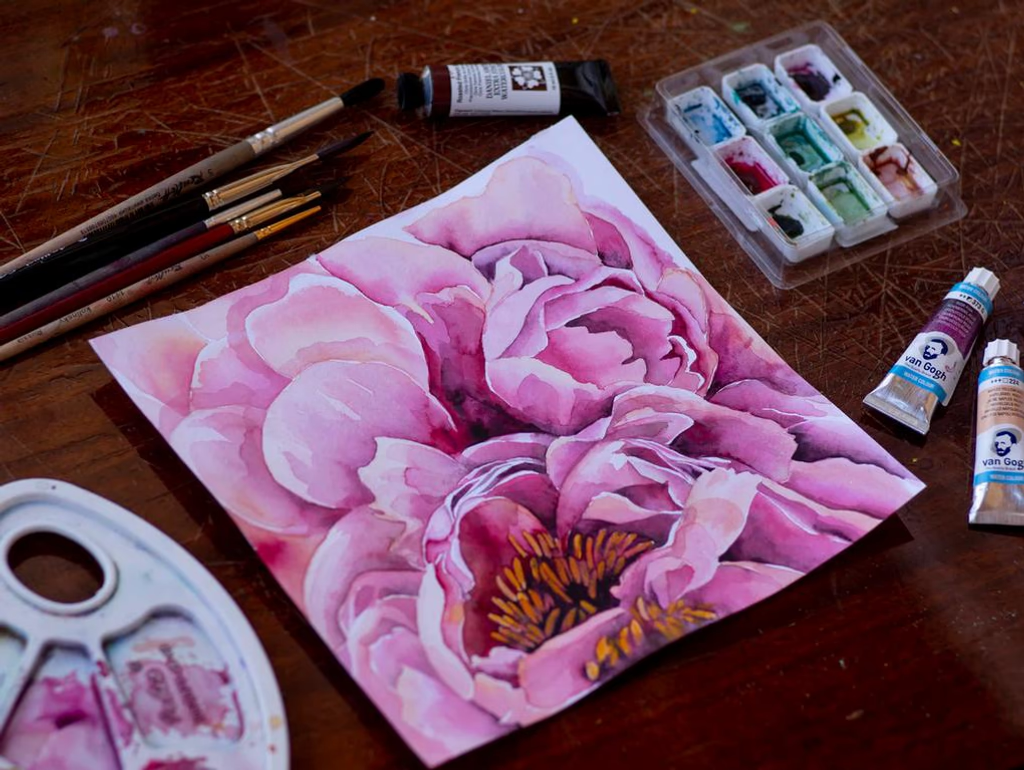
The post uses a garden metaphor to describe humanity’s development, with people as individual flowers that grow best when they share and build on each other’s ideas. It argues that while free and mandatory schooling has raised overall knowledge, the rigid, one‑size‑fits‑all approach of traditional schools often confines learners in small walls, stifling creativity. In contrast, it champions “real education” as a personal journey—self‑chosen books, lectures, projects, and incremental steps—that nurtures passion and allows each flower to follow its own unique path toward wisdom; the example of learning watercolor art illustrates how a few deliberate experiments can lead to mastery through continued practice, proving that steady, enjoyable progress is the key to lasting achievement.
De Hominis Dignitate

The post celebrates the power of individual curiosity and creative thinking as the glue that holds society together, arguing that true learning springs from personal ideas rather than formal schooling. It traces how early “self‑taught” minds shaped education into a shared experiment that, though imperfect, keeps global knowledge high enough to communicate progress. The author envisions a new generation of schools—free of grades and rooted in each learner’s path—that unites humanity, nurtures the planet, and prepares future captains of Earth. In this vision, the Universal Declaration of Human Rights becomes the opening chapter of a new textbook whose lessons inspire clear thinking, leadership, and the relentless pursuit of the harder right over the easier wrong.

Ariadne

#0227

Ariadne

Each person carries an inner “labyrinth” – a winding, branching road of curiosity that, if followed at its own pace, will lead to true wisdom. The post argues that modern standardized curricula are merely patchwork political fantasies that fail to honor this personal journey, reducing learning to memorization for easy testing rather than synthesis and discovery. By embracing one’s unique path and taking responsibility for self‑education, we can return to school with a richer understanding and ultimately build a new generation of schools that honor individual exploration, creativity, and the true growth of knowledge.

Back Row

#0226

Back Row

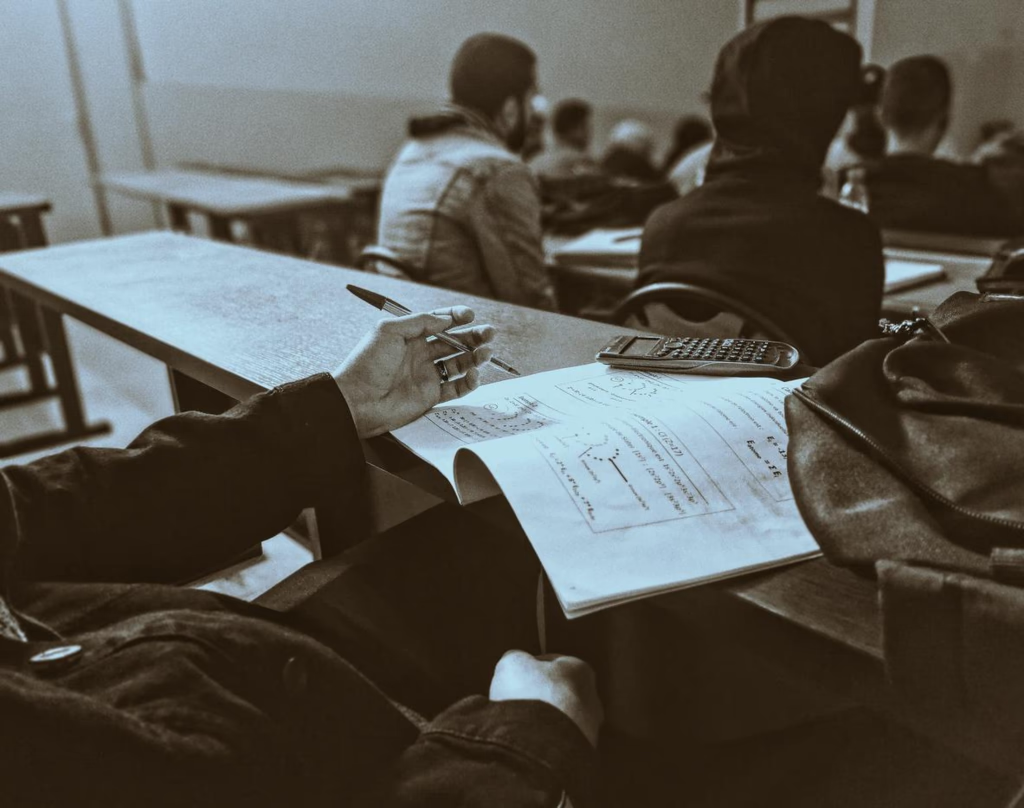
Back‑row students are urged to watch for trouble, analyze how teachers and principals keep grades balanced, read diverse books for integrated knowledge, and eventually build virtual schools to fix the education system.

Education vs Knowledge

The post argues that humanity’s progress depends on the continuous transmission of knowledge through books and self‑driven learning; it criticizes modern schools as failing to inspire true education, instead offering fragmented facts and tests that leave students “pretending” to learn. The author stresses that real knowledge—acquired from literature, philosophy, science, and history—fosters unity, reduces wars, and nurtures creativity; without it the world will regress into nationalism, terrorism and disintegration of families. The text calls for free access to public‑domain books so every child can study in peace, narrate what they read, and share that art with others. It urges readers to become their own teachers, to keep knowledge alive across generations, and to build a kinder, more compassionate world by reading, listening and sharing the best non‑fiction works. In short, the post is a rallying cry for self‑education, literature as a bridge between peoples, and an end to the “cold” formal schooling that no longer delivers true wisdom.

The Dark Nights At Nordhouse Dunes

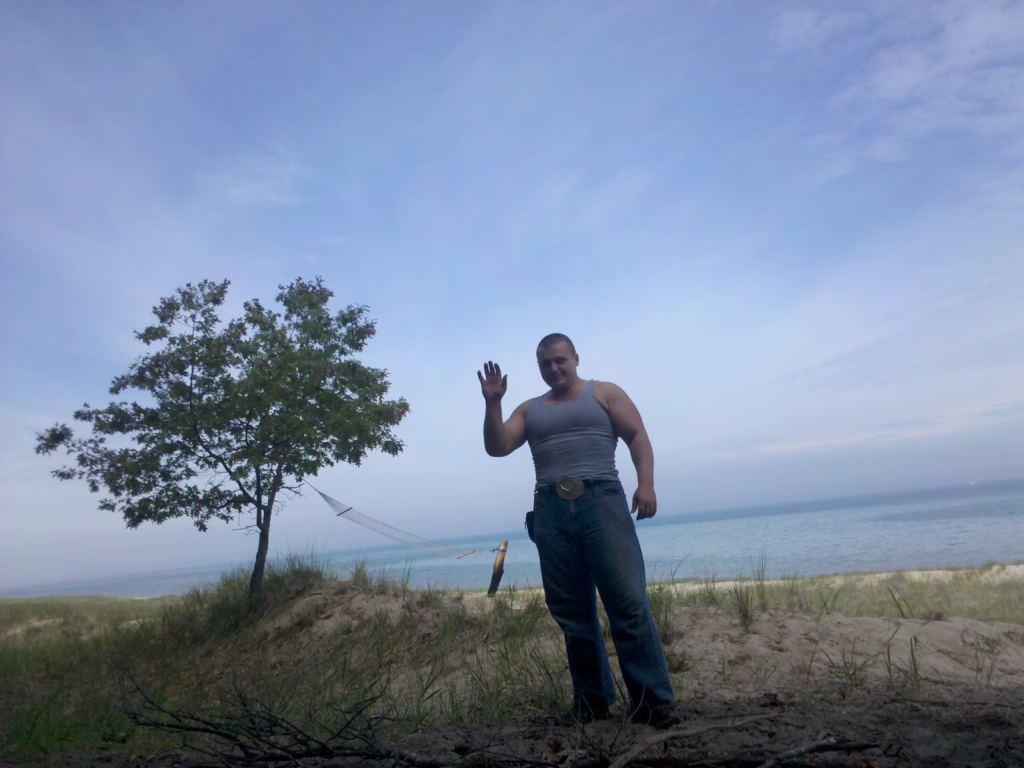
In the post, the writer describes solitary nights spent connecting with the universe—listening to crickets, frogs, leaves, waves, and stargazing—while feeling close to literary greats like Thoreau, Melville, Whitman, and Defoe. He recalls finding an antique store where he bought a copy of *Robinson Crusoe* and Dan Millman’s *Peaceful Warrior*, both of which he read enthusiastically. Each year he revisits this place, encountering strangers who view him in various roles: “Wizard of the Woods,” “Artsy Hobo” building driftwood horses, and “Raccoon Artist” sketching raccoons with acrylics. He recounts a long expedition that lasted a month of sunny days punctuated by rain, culminating in storms during which he lay in his tent listening to the song “We Are All Connected” by Symphony of Science while pondering the conductivity of his tent poles.

The Programmers

Students create self‑reproducing capsules that spread through space and time, seeding DNA‑based life on planets and asteroids across the cosmos.

Flowers Of Earth: We set off to meet the others at Betelgeuse.

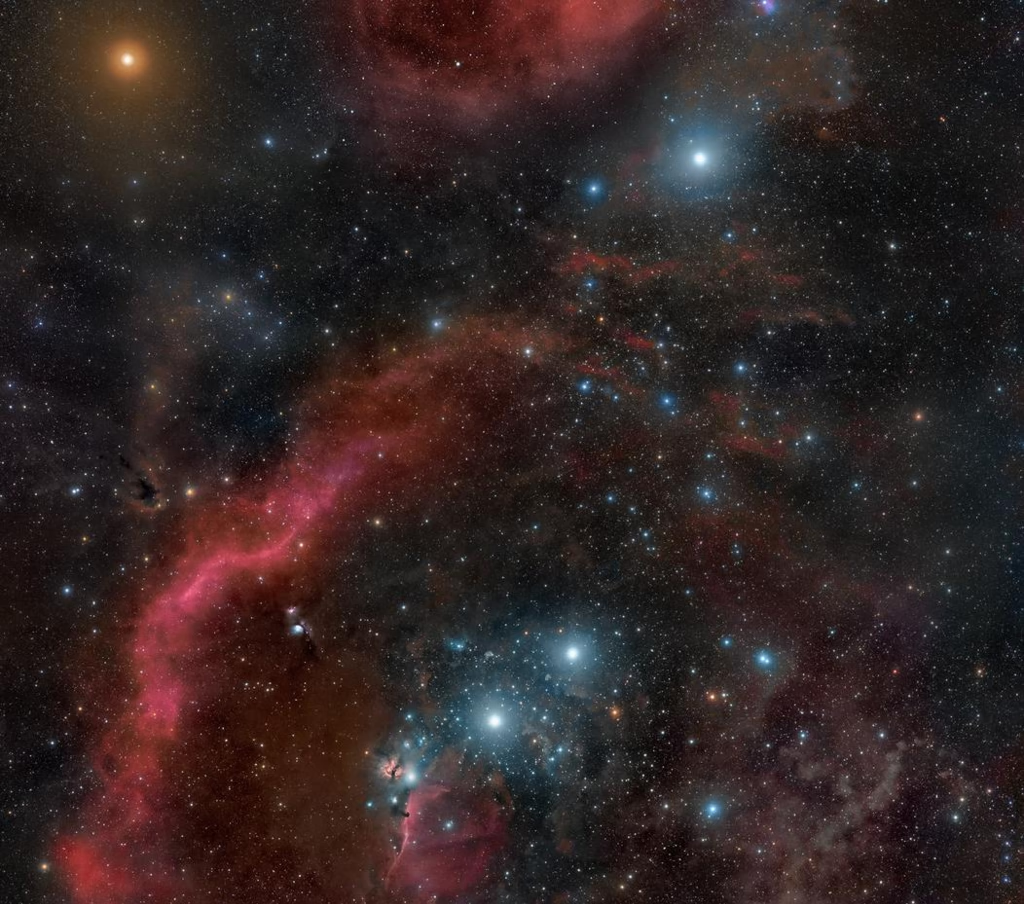
The author recounts humanity’s long journey—from watching Alpha Orionis explode as we become a space‑faring species, renewing ourselves via time travel and interstellar contact—to eventually returning to our ancient roots at Methuselah Prime.

Cosmopolis 1.1: Massively Multiuser Self Assembling Intelligence

In the post, the “Heroines” discover that social networks can serve as a human‑intelligence‑based computer, with power coming from nested group graphs of users. They study 1960s Detroit’s Model Cities program—an example of large‑scale local governance that ultimately failed due to bureaucracy and funding gaps—and propose anti‑corruption measures built on simple voting within these groups. Their model, embodied in the “Cosmopolis” system, lets professionals (e.g., landscapers or doctors) be dispatched by community vote, with tasks rated and paid directly without a bank or fee extraction. When a medical professional sees a need for a hospital, they file a change request; if the community votes it through, the project unfolds as a large‑scale, multi‑user self‑assembling effort that illustrates a “Deus ex machina” of collective intelligence.

The Midnight Owl

During a late‑night walk through the dark woodlands of Ludington State Park, the narrator prances under moonlight while hearing occasional barks, howls, and an owl’s “hoot, hoot.” Confidently replying to the owl, he continues his stride, eventually leaping into a moonlit clearing where the owl makes a 180‑degree turn and perches on a tree; the narrator concludes that if you find yourself out there and hear a hoot, it’s wise to grab your butt and scoot.

Memorizing Is Not Learning

The post argues that true learning comes from hunger, love, and enjoyment, and it must be approached in a logical sequence with the right pace; if you learn things out of order or rely on rote memorization it never sticks. It claims that modern schools still depend on “mem‑and‑cram” because they are financed by funding, not by real teaching, and that teachers rarely tailor lessons to individual students’ existing knowledge. The writer proposes that learning is best done in a suitable environment (time of day, place) and with the right tools—computers, tablets, audio books, and online lectures—that allow each student to study at their own rhythm. He cites visiting historic mathematic

You Have To Move Mountains

The post is a rallying call to friends to live loudly rather than quietly: it recounts being summoned before Congress to speak about insider trading, with the speaker’s voice shaking yet determined; he cites thinkers such as Dawkins, Hitchens, Harris, Dennett and Ayaan Hirsi Ali, paints his car pink, reads books, and references Walden, Metamorphosis, and other great works—ending by urging listeners to inherit wisdom from these giants, listen to audiobooks, learn, teach, move mountains, and make history.

The World Belongs To You

After high school the author urges students to seize control of their future—seeing the world as theirs once teachers retire—and to step back from rote learning into real, self‑driven study: “lectures,” documentaries, audiobooks, maker shops and hacker spaces should become primary tools for building lasting businesses that benefit community and beyond. College is framed as a leisure pursuit rather than a mandate; after graduation one must assemble an “A‑Team” (even parents), tackle challenges like hiking the Appalachian Trail, and use those experiences to chart a personal path toward greatness. The post ends with a call to become mountain‑goat‑like resilient, wise, humorous, and graceful leaders who never waste time but help others on their own journeys.

The League of Extraordinary Ladies

The post begins with a poetic sketch of how cultural labels and predictions of inevitable nuclear war—driven by generational indoctrination—set the stage for global conflict. It then introduces the “League of Extraordinary Ladies,” a multigenerational initiative that turns this crisis into an opportunity: through a massive audio‑lecture project called the Global Progressive Advancement (GPA), celebrities, authors and teachers create free, open‑access recordings of public‑domain works, culminating in a library rivaling Alexandria. By 2050 the school’s impact is evident—knowledge spreads, borders dissolve, and nuclear weapons are dismantled across Europe and Asia. The League extends its mission to poverty: a micro‑payment trading platform on smart tablets connects people for services (rides, groceries, tutoring), with built‑in food‑pantry features that feed the hungry and house the homeless, thereby turning local labor into shared prosperity. In short, the narrative weaves cultural renewal, audio education, and grassroots service exchange into a vision of world peace and poverty alleviation powered by collective knowledge and cooperation.

They Walk Among Us

The author reflects on their search for “great beings,” discovering many online yet noting that true greatness lies in quiet, wise individuals who lead without fanfare. They wish such people could live forever but recognize we must become great ourselves, through learning from books and audiobooks rather than mere memorization. By absorbing wisdom and taking up leadership, each of us can fulfill the world’s need for greatness and create a better future.

Cosmopolis 1.0

The post recounts how a small team built “Cosmopolis,” a lightweight web‑based wiki‑style editor in under 100 lines of Node.js/Express code that uses simple alphanumeric file names to resolve concurrent edits and keep all servers in sync. They added user support with chatbots (Alice and Bob) that could automate tasks—like fetching weather or shipping Amazon groceries—and later let real people take over those bot accounts. The project quickly grew into a live simulation of a city (“Night City”) where bots and users could interact, trade services, and earn money, catching the eye of the United Nations as it evolved toward version 2.0.

The Conjecture

In 2020 a simple web‑based simulation of a city was created to test how easily its institutions could be corrupted; the experiment proved that by modeling officials as bots and letting citizens vote on concrete actions rather than representatives, corruption collapsed and real jobs, tasks, and even prison systems could be automated with transparency. Within a decade the program, run on modest Android tablets, spread to roughly ten thousand cities worldwide, replaced manual city management with a corruption‑resistant scaffold that let people vote on issues, claim bounties for public work, and manage schools and prisons through data‑rich bots. The result was a “virtual metropolis” linking all towns, eliminating joblessness, reducing crime, ending wars, and driving climate action by 2030, while the original programmers were celebrated with Nobel Peace Prizes and monuments—proof that a system built from scratch to resist corruption can transform cities into cooperative, self‑sustaining communities.