Sucked In By The Treadmill
She lands in Paris as a graduation gift from Michigan—a tidy itinerary, a nice hotel, museum tickets she can't believe are real. Her parents are staying in the room next door and have already scheduled their days around patisseries and river walks. She tells them she'll catch up after breakfast.
Jet lag makes her restless, so she decides to do one good thing before croissants: a quick workout, first one in the city, first one in weeks.
The hotel gym is odd—too quiet, too square, too industrial. Someone repurposed a former server room: thick doors, low ceiling, rubber flooring that hides seams it shouldn't be hiding. A brass plaque near the door says something in French about the building's renovation. She doesn't read it. She will think about this plaque for the rest of her life.
She leaves her phone in the locker so it won't bounce out of her pocket. She takes dumbbells because she always takes dumbbells.
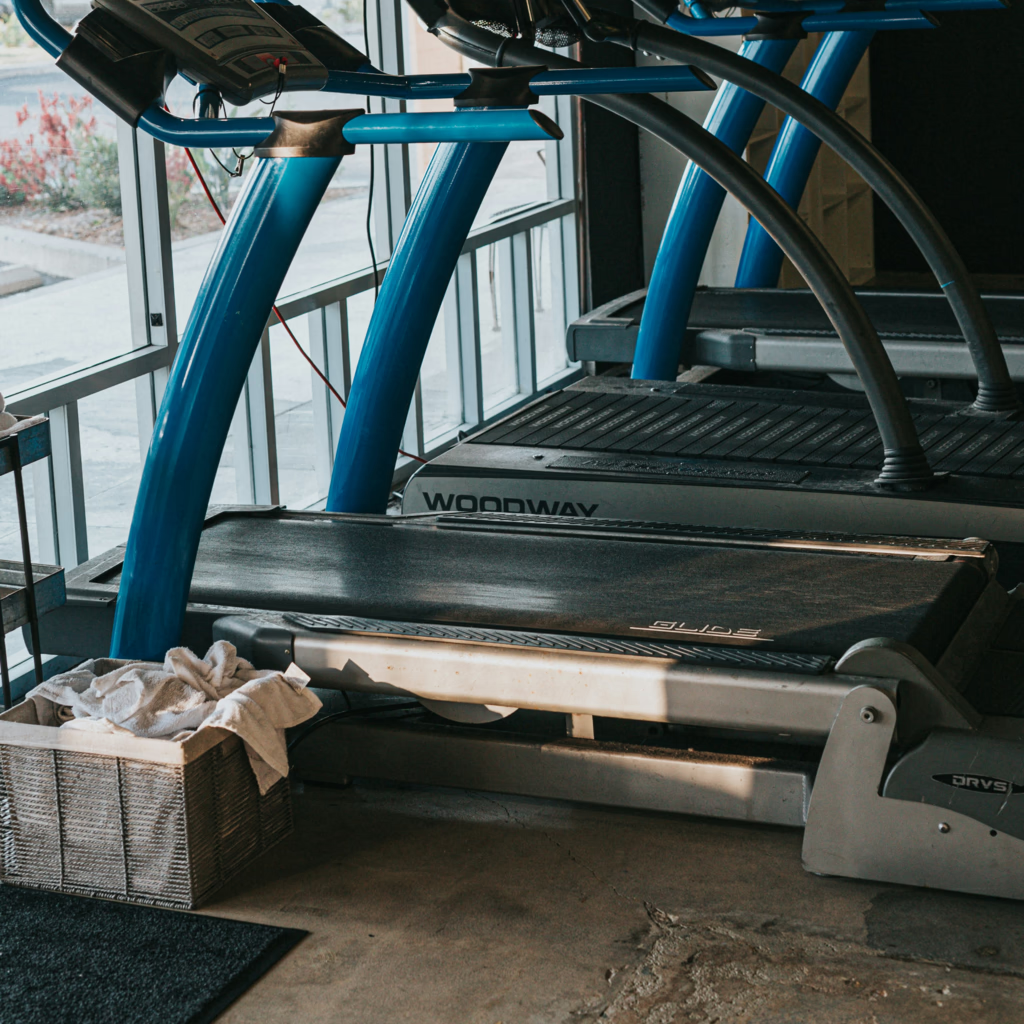
It's a thing people do, and she knows it's a thing she shouldn't do. She sets the treadmill to a brisk pace and starts walking with light weights—five-pounders, nothing dramatic, the kind of thing a personal trainer would frown at but not scream about.
One dumbbell slips, clanks, and skitters off the belt—an ugly sound on what should be solid flooring. She reflexes into a wrong step. The belt pulls. Her knee hits the front shroud. The treadmill lurches like a machine with a tired motor and a tired brake, and she stumbles sideways, the remaining dumbbell swinging hard into the floor.
It punches through.
Not through the way a hammer goes through drywall. Through the way weight goes through something that was never meant to hold it at an angle—a concentrated five pounds of iron at the end of an arc, landing edge-first on a panel designed to bear distributed loads from above. The rubber mat dimples. Beneath it, something gives with a flat, brittle crack.
The "tile" is not tile. It's a raised-floor panel—the kind data centers use, laid on pedestals over a service void, meant for cable routing and airflow. The hotel gym was, after all, a server room once. They'd resurfaced it with rubber and called it done.
The panel fractures diagonally. One half seesaws. Her foot, already off-balance, catches the tilting edge. The adjacent panel, no longer braced by its neighbor, shifts on its pedestals.
She drops into a space that was never meant for people.
It smells like cold dust and old electricity. There's a cramped void under the floor: cables, conduit, metal rails, an air space that hums with ventilation. She tries to stand and slams her shoulder into the underside of the gym floor. She can hear the treadmill above her—motor whine, belt hiss—then a pause, then the belt crawling again as if it's trying to return to where it last saw her.
The fall is only about a meter. Nothing is broken. Her pride is broken, but pride doesn't show on X-rays.
She could climb back up. She knows this. But the panel has shifted and the opening is awkward and her shoulder is screaming, and when she puts weight on the pedestal frame to hoist herself, the next panel wobbles ominously. The thought of collapsing more floor while halfway through it does something primal to her decision-making.
So she crawls. The under-floor chase runs along the building's spine—old server infrastructure, never fully decommissioned, just orphaned when the room changed purpose. She follows the faintest pull of air, looking for a service hatch, a maintenance access, anything with a handle.
The chase widens. The floor beneath her palms changes: newer concrete gives way to older concrete, smooth gives way to gritty. A seam appears where the hotel's modern foundation meets something older and less interested in building codes.
The seam becomes a crack. The crack becomes a slope. The slope has been eroded by decades of water seeping through limestone, and limestone is what Paris is built on, and what Paris is built on is what Paris is built over.
She slides. Not dramatically—just a long, helpless, scraping descent through rubble and damp stone, arms out, stomach clenching, until she lands on something flat and hard and absolute.
The impact knocks the breath out of her so completely she thinks her lungs are gone.
When she blinks, she's staring at stone that looks wrong for a building basement: rough, pale limestone with tool marks that predate power tools by centuries. The quarries beneath Paris are not a secret—she vaguely remembers a travel blog mentioning catacombs—but knowing a thing exists and being inside it are different experiences separated by all the adrenaline in the world.
The dark isn't total. Far ahead, a line of light—steady, institutional—runs down a corridor like the world's most boring miracle.
She follows it. Her gym shoes scrape grit that sounds ancient.
The corridor is absurdly legitimate: 1960s-style lighting, utilitarian and yellowed, mounted at a height that assumes a hard-hatted head. The walls carry cables and junction boxes. On one wall, she passes a cabinet with sealed gauges—instruments that measure the world moving by millimeters: a needle in a dial, a pen tracing slow curves on a paper roll, a box that hums as if it's listening to the stone breathe. Paris monitors its own underworld. The city is, in places, a patient that never leaves the hospital.
She hears motors—deep, steady—like the city itself is breathing through machinery. Pumps. The quarries flood, and the pumps never stop, and the pumps need corridors, and the corridors need maintenance, and maintenance needs checkpoints.
She reaches a small room that breaks the tunnel like an office inserted into a cave. Metal desk. Wall map covered in annotations she can't read. Clipboards in plastic sleeves. Hazard tape that's too official to be a prank. A hard hat on a hook. A rotary phone—actual rotary, brown plastic—that makes no sense except that landlines don't need cell towers and these tunnels eat radio signals. A logbook opened to a page where someone signed in eleven days ago with a ballpoint pen.
The sign on the wall is stamped, official, and clear: this is maintained. The Inspection Générale des Carrières is a real department with real employees who walk these corridors on real schedules—schedules that, at this moment, have left her entirely alone.
A locker is half open. Inside: work gloves, a hi-vis vest, a scuffed helmet, a plain lanyard with a generic contractor badge—the kind of badge that says a company name and nothing else, the visitor-pass equivalent of a shrug. And a flashlight, which she takes first, because being in the dark is worse than being a thief.
She puts all of it on with shaking hands because being a person down here feels like being prey.
The tunnels have moods. She learns this by walking through them.
The bureaucratic section gives way to something human—a pocket in the stone where the corridor widens into a small chamber. Mismatched chairs, a plank balanced on sawhorses that once served as a bar, bottles crusted with age, graffiti layered like tree rings. Someone painted a mural of a skeleton playing an accordion, and someone else added sunglasses to it, and someone else wrote a date beneath it: 1987.
The cataphiles. She's read about them—Parisians who sneak into the quarries for parties, art, exploration, the particular thrill of being somewhere you shouldn't be. This room is their abandoned living room. It isn't romantic. It's grimy and real and sad in the specific way abandoned social places are sad—the chairs still angled toward each other, still waiting for a conversation that moved on.
She takes a breath and realizes she's thirsty enough to feel it in her teeth.
The tunnel continues. She follows the air.
Past the cataphile bar, the tunnel pinches. A partial collapse—Loss of stone from above, a slow-motion ceiling failure that might have taken years—forces her down on her stomach. Stone presses her ribs. Her helmet scrapes. The hi-vis vest snags and she has to wriggle out of it halfway, pulling herself forward by fingertips on rock, breathing in sips.
In a niche—half revealed by the collapse, half protected by it—something catches the flashlight: a gleam of warm metal.
A cross. Small, heavy, precise. Not costume jewelry, not tourist trash. The edges are softened by time, the surface etched with a tiny heraldic design—what she'd later learn are crossed keys beneath a tiara, rendered in the compressed visual language of ecclesiastical authority. It hangs from a cord that rotted through long ago, leaving the loop intact, as if the cross simply kneeled down and decided to wait.
She doesn't decide to wear it. She puts it on the way people put on a seatbelt after a near crash: automatic, desperate, superstitious without admitting it.
The metal rests against her sternum like a hand.
How it got here is a question for historians. The quarries have been used for storage, burial, smuggling, worship, and resistance for eight hundred years. Things end up in stone the way things end up in rivers—carried by currents that no longer exist.
The tunnel begins to carry newer noise. Not the low machine-breath of pumps—something else. Wheels on smooth ground. A distant beep-beep of a reversing vehicle. A voice through a radio, muffled but purposeful.
She kills her flashlight and crouches behind a support pillar, heart hammering.
A small electric van glides into view—white and plain and too clean for this place. It's the kind of vehicle that exists inside airports and convention centers, built for corridors. A handful of people move with it: masked, gloved, dressed in dark contractor gear, helmets, ID badges on lanyards. They don't talk casually. They don't look around. They move like a procedure.
She does the math without thinking. Somewhere between the cataphile bar and now, the tunnel shifted from abandoned quarry to active infrastructure. The walls are smoother. The lighting is modern. The air smells filtered and climate-controlled. She has crawled out of the city's bones and into its bloodstream.
The van rounds a corner and she follows at a distance because there is literally nowhere else to go. Forward is toward people. Backward is toward a collapse. The geometry of her options has simplified to a point.
Then the corridor opens, and she understands where she is.
Not because there's a sign. Because the walls change to that specific bureaucratic elegance—wide service hallways, sealed climate zones, the kind of space that says national collection the way a hospital corridor says intensive care. She's beneath the Louvre. Or beside it. Or inside its invisible organs. The museum's conservation infrastructure extends underground in ways the public never sees—tunnels connecting storage vaults, transport corridors for moving art between buildings, service zones where temperature and humidity are controlled to fractions.
She steps into the corridor and keeps walking, because standing still would be a confession.
And here's the thing about her face.
She has what her college roommate called the frequency—a resting expression that reads, to strangers, as severe and intentional. Mouth neutral. Brow slightly drawn. Eyes level and unblinking. In Michigan, it got her out of small talk at parties. In a brightly lit conservation corridor beneath the Louvre, it gets her something much more dangerous: credibility.
She doesn't know she's doing it. She is, in fact, on the verge of tears. But her face, in its terror, compresses into something that looks exactly like a person who has done this before and does not have time for your questions.
A technician passes with a rolling case, glances at her badge, glances at her face, and looks away. Two women in lab coats consult a clipboard and step aside as she approaches—not because she asked, but because her expression suggests she'd be annoyed if they didn't.
She walks past a door marked with institutional language about contamination control. She walks past a humidity monitoring station. She walks past a man eating a sandwich who nods at her.
She nods back. It is the most terrifying social interaction of her life.
Then they roll out the crate.
Climate-controlled. Matte-armored. The kind of transport container that doesn't look like a box—it looks like a covenant, a physical promise that nothing inside will be allowed to change by even a degree.
The corridor tightens with focus. People move with the crate the way people move with a patient being wheeled into surgery—purposeful, quiet, reverential. A handler pops a monitoring panel, checks a readout, re-seals it.
For one second—she's positioned at an angle, close enough because no one has told her not to be—she sees through the layered protective glazing.
A face. Soft. Timeless. Smaller than she expected.
Mona Lisa isn't supposed to be a thing you see in a hallway, by accident, wearing stolen gloves.
She doesn't gasp. Her face doesn't change. The frequency holds. If anything, the staggering impossibility of this moment pushes her expression into an even flatter affect—the look of a woman who has seen this painting moved many times and is mildly irritated by the draft.
A handler glances at her. She meets his eyes with the hollow, thousand-yard stare of a person whose soul has left her body.
He interprets this as seniority.
He goes back to work.
The crate loads onto a larger transport vehicle in a logistics bay that exists below street level—a place of ramps and reinforced doors and sound-dampening walls. The operation has the quiet intensity of something practiced: each person has a role, each movement is sequenced, and the only urgency is the urgency of precision.
She stays in the back margin of the group because it's the only place no one has to look at her. A woman with a tablet is checking names. She approaches the woman, and the woman looks at her badge and her face—that face, that immovable, unreadable face—and the woman's pen hovers over the list.
"Inspection?" the woman says in French.
She doesn't understand the word. She stares at the woman with the raw, uncomprehending intensity of a person hearing a foreign language while in shock.
The woman reads this as confirmation. A curt nod. She makes a mark.
The convoy moves. She moves with it.
The airfield is not Charles de Gaulle. It's a facility she'll never be able to find again—a hangar with floodlights and security barriers and the kind of quiet that money buys. The crate is transferred onto a hydraulic loader with the gentleness used for patients. The aircraft waiting is sleek, unmarked, and private: a Dassault Falcon, small enough to be discreet, large enough to move a protected object and a handful of serious people without spectacle.
She stands near the boarding stairs because she has been moving with the group and stopping would require a decision her brain has stopped making. A man in a dark jacket gestures toward the cabin. She looks at him with the expressionless fatigue of someone who has been crawling through limestone for the past three hours.
He steps aside and holds the door for her.
She boards a private jet the way one boards a city bus in a dream—legs moving, mind absent, reality optional.
The door seals. The cabin hushes. The engines spool up.
And then the floor tilts in a way the underground never does.
She doesn't sleep on the flight. She sits rigidly in a rear seat and stares at the seatback ahead of her with an expression that, to the flight crew, reads as the composed stillness of someone deep in professional thought.
She is, in fact, trying to remember if she turned off the treadmill.
The flight is short. When the aircraft descends, she sees lake and mountains and a city that looks like it was designed by a person who hates mess.
Geneva.
The transfer is brief and controlled—a different hangar, different vehicles, different people who don't introduce themselves because introductions are for people who aren't already supposed to be here. The crate changes hands with new paperwork and new faces. She watches the choreography from a corner, badge on her chest, hard hat under her arm, and the expression of someone attending a meeting they were accidentally CC'd on.
Then the group changes and she's on the outside of the new perimeter—no longer carried by momentum, no longer invisible in a moving herd. She stands alone in a corridor that smells like polished floor and coffee.
She makes it through a service door before anyone notices.
A security guard rounds a corner and clocks her instantly—not because she's dramatic, but because she looks like a person who shouldn't be alone in a Swiss corridor. He speaks to her in rapid French. She stares at him with the blank, level expression of someone who has no idea what he's saying.
He reads this as refusal to cooperate. His posture stiffens.
"English," she manages.
His eyes narrow. Then his gaze drops.
To the cross.
It's not a magic key. It's a problem. The specific kind of problem that makes trained security personnel stop improvising and start following procedure. The heraldic marks on the cross—the crossed keys, the tiara—are the compact visual signature of the Holy See. It's the kind of object that a guard in Geneva, a city with a long memory for religious diplomacy, knows not to handle casually.
He doesn't relax. He speaks into his radio. A code word. A reference number.
A second guard arrives. Then a woman in plain dark clothes who doesn't introduce herself but knows exactly what to ask: name, passport number, who sent you, why you're here.
Her answers make no sense and she knows they make no sense. She's from Michigan. She fell through a floor. She got lost. She ended up here. She's wearing the cross because she found it in a hole. She'd like to go home now.
The woman studies her for a long, evaluating moment. Her face—the frequency—stares back, impassive, bewildered, exhausted, which in this light, in this context, reads as I have been through something that is above your clearance level and I am not going to explain it to you.
The woman makes a decision. She guides her—not to a cell, not to an interrogation room—but to a small, quiet space with a religious icon on the wall. An airport chapel. A place where complicated people become someone else's problem.
"Wait," the woman says, not unkindly. "Do not move."
The door closes in a way that isn't locked—just certain.
She doesn't know when the transfer happens. She only knows that waiting turns into exhaustion, and exhaustion turns into sleep, and sleep is the only thing that has been kind to her since the treadmill.
She wakes to different air. Warmer. Older. The light has changed—golden in a way that Geneva's light was not. Voices outside are speaking Italian.
She's in a car. Moving. The driver glances at her in the rearview mirror with the polite blankness of a man who was told not to ask questions. Through the window she sees terra-cotta and stone and a sky that is outrageously, offensively blue.
The car stops. She's guided through a side entrance by a young man in a suit who addresses her in Italian. She looks at him with the frequency—bewildered, mute, face like a closed door.
He adjusts instantly. "English? Of course. This way, please."
He says please the way people say please when they mean now.
She sees the uniforms before she understands them: men standing very straight, very formal, in colors that belong on a Renaissance painting—blue and gold and red, halberds held like they mean it.
Pontifical Swiss Guard.
For a heartbeat she thinks she's still in Switzerland—then her brain catches up. Swiss Guard aren't Swiss in the way tourists mean Switzerland. They're Vatican.
Her mouth goes dry.
In the Vatican, some doors don't open because you have access. They open because someone decides you're someone else's responsibility—and in a place this old, the chain of responsibility can be very long and very strange.
A nun notices her first. An older woman with a calm face and the kind of eyes that have catalogued every species of human fear and learned not to flinch at any of them. She looks at the cross around her neck and doesn't touch it, but her attention sharpens the way a doctor's sharpens when they see a symptom in the wild.
The cross bears marks of office, not decoration. To the right eyes—and this nun has the right eyes—the symbols are legible: a specific workshop, a specific century, a specific rank of functionary who would have carried it in the course of ecclesiastical business. It's not a relic. It's a credential. A very, very old credential, for a position that no longer exists, issued by an authority that very much still does.
The nun speaks to a guard. The guard makes a call. The call brings a priest in a plain black suit who introduces himself only by his first name—Marco—and asks if she'd like water.
She drinks the water with sophisticated class.
Marco walks with her through corridors that feel like the inside of a memory—stone and wood and the specific hush of places where whispering was invented. They pass through a room she'll later realize was part of the Vatican Library's restricted wing: manuscripts behind glass, shelves receding into shadow, catalog drawers that look like they've been opened by every century since drawers were invented. The smell of paper and leather and cold stone.
She thinks, with the dizzy clarity of exhaustion: I am in the thieves' nest. They brought the painting here and I followed it and now I am in the place where stolen things go.
She doesn't understand—not yet—that she's in the opposite. The Vatican's conservation laboratories are one of the world's foremost facilities for the maintenance of cultural patrimony. The Mona Lisa isn't stolen. It's being serviced—a scheduled, classified, enormously sensitive operation involving a painting so famous that even routine maintenance must be conducted in secret to avoid public hysteria. France knows. Italy knows. The right offices know.
She does not know.
Marco notices her expression. He reads it as composure under duress—the flat, unshakable face of a woman who has been through institutional machinery before and will not be rattled by another hallway, however ancient.
"You have had a very unusual day," he says.
It's the first thing anyone has said to her that is completely, perfectly true.
At some point the escorting stops being about her and starts being about moving her out of the way. She's guided into a waiting room with upholstered chairs and a window overlooking a garden so beautiful it feels like a personal insult. She's offered more water, a small sandwich, a blanket she didn't ask for but wraps around herself immediately.
Marco returns with a woman who introduces herself as Dr. Silvestri and speaks English with the patience of someone who speaks five other languages just as well. Dr. Silvestri asks her to describe, in her own words, how she came to be here.
She tells the truth. All of it. The treadmill. The dumbbells. The raised floor panels. The quarry. The cross. The van. The crate. The face behind the glass. The jet. Geneva. The chapel. Waking up in a car.
Dr. Silvestri listens without interrupting. When she's finished, the doctor is quiet for a moment, and then says: "The floor panels. The hotel gym was a data center?"
"Server room."
"And the dumbbells—you were carrying them on the treadmill?"
"I know," she says. "I know."
Dr. Silvestri's mouth does something that is almost a smile.
The cross is photographed, documented, and gently removed from her neck by a conservator wearing gloves. She watches it go into a padded tray with the resigned grief of someone surrendering the only thing that made her feel less alone.
"It will be studied," Marco tells her. "It's quite old. You found it in the quarries?"
She nods.
"It may have been there since the Revolution," he says, almost to himself. "Or earlier. Things were hidden. Things were lost." He pauses. "You carried it well."
She doesn't know what he means. She's too tired to ask.
She sleeps. Real sleep, the kind that doesn't care about geography.
When she wakes, she's in the same room, and the garden is in different light, and there's a plane ticket on the table beside her with a Post-it note in careful English handwriting: Your hotel. A driver will meet you at Orly. Thank you for your patience. Please do not discuss the details of your visit. —M.
The ticket is first class. Paris. Departing in four hours.
Attached to the ticket with a paperclip is a small card, thick and cream-colored, embossed with a crest she now recognizes. On the back, in the same handwriting: If you are ever in Rome again, the library is open to scholars. You would need to apply. I believe you would qualify.
She reads it three times because her eyes are blurring.
The flight back is the quietest hour of her life. She sits by the window and watches the Mediterranean become France and thinks about nothing successfully for the first time in twenty-four hours.
The driver at Orly is polite and incurious. He delivers her to the hotel like it's the most normal thing in the world.
The lobby smells like coffee and floor polish. Her parents are at a table near the window, maps spread out, croissant crumbs on a plate, planning tomorrow.
"There you are!" her mother says. "Long workout?"
"Yeah," she says. "I got a little lost."
"Oh, honey. Did you at least find your way around the gym okay?"
"Eventually."
Her father looks up from his map. "You look tired."
"Jet lag," she says.
The gym has a red sign on the treadmill now—French words she can only half-parse, the universal semaphore of do not touch and not our fault. The floor around it has been roped off with the casual authority of a hotel that has filed an insurance claim and would prefer not to discuss it.
She looks at the spot where she fell and feels a vertigo that has nothing to do with height.
She takes the flight back to Michigan two days later, mostly asleep, her hand occasionally rising to her sternum where the cross used to be—a phantom weight, like a word on the tip of the tongue.
Home is winter air and familiar ceilings and the specific quiet of a house that doesn't know what happened to her. She unpacks. She showers. She sits on her bed and stares at the wall for a while.
Then she checks her phone.
There are messages, missed calls, photos from Paris she doesn't remember taking. And a headline from Le Monde, translated by her browser into clumsy English:
Mona Lisa Undergoes Advanced Conservation at Vatican Laboratories in Classified Maintenance Operation
She reads it twice. Then three times. The brain needs repetition to accept the unbelievable.
The article calls it "routine." The article says it was "planned." The article mentions Franco-Vatican cooperation and "state-of-the-art climate-controlled transport." The article does not mention a girl from Michigan or a pair of five-pound dumbbells.
She closes her phone. She looks at the ceiling.
She makes two vows, quietly, instantly, the way people make vows when the alternative is screaming:
One: she will never carry dumbbells on a treadmill again.
Two: she will take that woman up on the library.
Eighteen months later, she is in Rome—a research fellowship, legitimate credentials, a lanyard that has her actual name on it. The Vatican Library admits her through the front door. She presents her application, her academic references, her letter of introduction.
The librarian checks her paperwork, checks her face, and pauses.
"Have we met?" he says.
She looks at him with the level, unreadable expression of a woman who has learned that her face is, occasionally, a door.
"No," she says. "But I'm very glad to be here."
She means it more than he will ever know.
There are secrets to be discovered here.