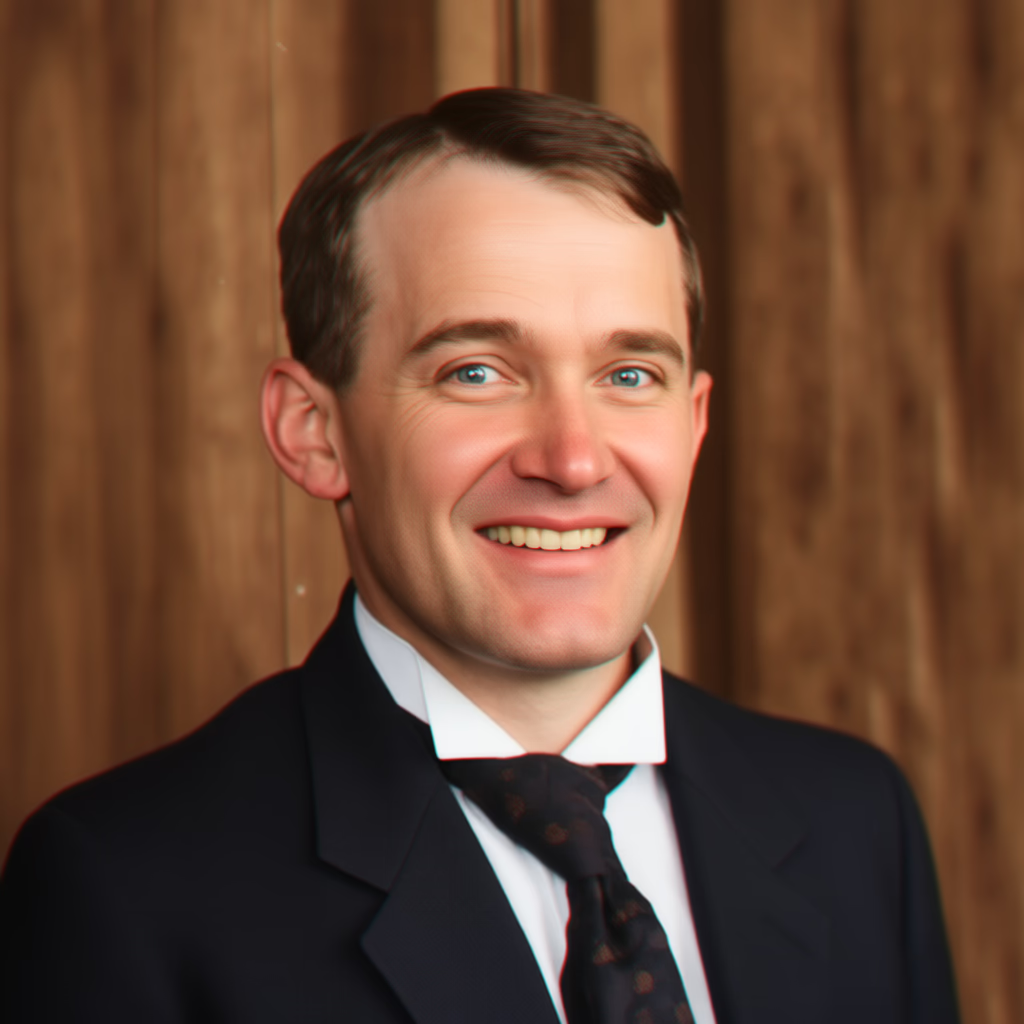
This Is A True Story That Actually Did Happen
CHAPTER ONE
The Premise Nobody Asked For
The Intergalactic Union, which governs approximately 4.7 billion star systems and cannot agree on a standardized calendar, maintains a list of professions it considers "precious." This list includes poets, philosophers, and—rather predictably—astronomers.
The reason for this classification was recorded in Union Document 7,832,441-B, which states: "Astronomers are to be protected at all costs, for they are the only beings in the known universe who will stare directly into the infinite void of existence, notice that it is staring back, and instead of screaming, will say 'Hmm, I should measure that.'"
This made them invaluable.
It also made them somewhat concerning.
The planet Celdraxis, located in a region of space that humans would later describe as "probably over there somewhere," had produced more astronomers per capita than any other world in the Union. This was largely because Celdraxis had seventeen moons, four of which were visible during the day, and children there grew up asking questions like "Why is that one wobbling?" before they could properly walk.
One such child was Vesto Slipher, from an early age, he kept intraicate notes on the moons all their doings.
This made him the perfect candidate for what the Union called a "Quiet Field Study"—which was bureaucratic terminology for "go somewhere boring and don't cause an incident."
The planet selected was Earth.
Earth had been on the Union's watch list for several centuries, primarily because its dominant species had developed the ability to look at stars while somehow maintaining the belief that they were the only ones doing so. This combination of curiosity and obliviousness made them fascinating subjects for study.
Also, they had excellent coffee, though they didn't know why.
CHAPTER TWO
The Worst Alias in the Universe
The Office of Interstellar Integration, which handled all matters of extraterrestrial cover identities, operated out of a building that existed in seventeen dimensions simultaneously. This made it very difficult to find the bathroom, but excellent for keeping secrets.
Agent Threnix-9, a being who resembled what would happen if a filing cabinet achieved enlightenment, was assigned to process Vesto Slipher's Earth documentation.
"Your cover family will be the Apps," Threnix-9 announced, sliding a folder across a desk that may or may not have been there. "Former off-world operatives. Good people. Quiet. Will welcome you with open arms [App is part of your mother's name."
"And my name?" Vesto asked, with the tone of someone who already knew they weren't going to like the answer.
"Melvin App."
There was a silence. It was the specific kind of silence that occurs when the universe has just made a joke and is waiting for everyone to get it.
"I'm sorry," Vesto said carefully, "I may have misheard you. I thought you said Melvin."
"Melvin App. It tested well with focus groups."
"What focus groups?"
"Human ones. They found it 'pleasantly forgettable.'"
Vesto stared at the agent. The agent stared back. The desk may or may not have stared at both of them.
"I am not," Vesto said, with the careful precision of someone trying very hard not to scream, "going to introduce myself as Melvin App. It sounds like something you'd name a disappointed sandwich."
"It sounds human."
"It sounds like what happens when consonants give up."
He took the folder anyway. He had no choice. But from that moment forward, he devoted approximately 340% more mental energy to resenting his alias than to actually learning human customs.
This would prove to be a significant tactical error.
CHAPTER THREE
Arrival on Earth (Things Go Sideways Early)
Arizona, in the early twentieth century, was a place where the sky was so clear that you could see forever, and the ground was so dry that it would actively try to kill you if you weren't paying attention. It was, in other words, perfect for astronomers.
The Lowell Observatory sat atop a hill that the locals called "Mars Hill," though Mars was actually about 140 million miles to the upper left and had no opinion on the matter.
Vesto arrived in the traditional manner: aboard a vessel disguised as an unusually ambitious dust devil, carrying nothing but his instruments, his credentials, and a profound reluctance to use the name Melvin under any circumstances.
His integration was supposed to be seamless. He was supposed to blend in, make quiet observations, and file reports that no one would read for several centuries.
Instead, he met Percival Lowell.
Percival Lowell was the kind of human who made the universe nervous. He had money, which was dangerous. He had curiosity, which was worse. And he had an observatory, which meant he had the means to act on both.
He was also, by all accounts, tremendously pleasant, which made everything more complicated.
"New fellow, are you?" Lowell asked, materializing beside Vesto with the silent efficiency of a man who owned the building and knew exactly where all the interesting people were at all times.
Vesto looked up from the spectrograph he was calibrating. He had been on Earth for approximately six hours. He was tired. He was still annoyed about Melvin. And he was not prepared for human social interaction.
"Yes," he said. "I'm—"
And here, the universe held its breath.
CHAPTER FOUR
The Catastrophic Introduction
What Vesto should have said was: "Melvin App, pleased to meet you."
What Vesto actually said was: "Vesto Slipher."
The words left his mouth with the casual confidence of someone who had been using that name for his entire life, which he had, because it was his actual name.
There was a moment—approximately 0.7 seconds—where Vesto's brain caught up with his mouth. It was not a pleasant moment. It was the kind of moment where you realize you've just told a complete stranger your real identity on a planet where you're supposed to be undercover, and there's absolutely nothing you can do about it because the words are already out there, floating in the air like evidence at a crime scene.
Lowell blinked. "Vesto Slipher? That's... unusual."
"Is it?" Vesto heard himself say, which was his brain's way of buying time while it screamed internally.
"Rather exotic. Where's it from?"
Celdraxis, Vesto's brain supplied, unhelpfully. It's from Celdraxis, you absolute fool, and you've just blown your cover in the first hour because you couldn't be bothered to learn your alias properly.
"Indiana," Vesto said instead, because Indiana was a place that existed and he was reasonably certain humans came from there.
"Ah." Lowell nodded, apparently satisfied. "And your first name is... Vesto?"
"Yes. Vesto Melvin Slipher."
There was another pause. Vesto watched Lowell's face for signs of suspicion, alarm, or the imminent arrival of whatever passed for authorities on this planet.
Instead, Lowell just looked mildly confused, which was apparently the default human response to unexpected information.
"Melvin? Like the whale fellow?"
"...Yes?"
"Wonderful. Good to have you aboard, Slipher." Lowell shook his hand vigorously. "Let me know if you need anything. Telescope time, equipment, sandwiches. We have excellent sandwiches."
And then he left.
Vesto stood alone in the observatory, his hand still slightly warm from the handshake, his cover identity in absolute ruins, and his career potentially destroyed.
But somehow—somehow—the conversation was over.
Humans, he was beginning to realize, were very strange about names.
INTERLUDE
A Treatise on Profanity
As Recorded by the Union Office of Linguistic Oversight
Seven thousand light-years away, High Chancellor Elara Maris received the incident report.
She read it three times.
Then she invented new words.
This was not unusual. Elara Maris was legendary throughout the Union for her creative approach to profanity. Where other beings would simply curse, she would compose. Her expletives were not mere exclamations; they were experiences.
The five curse phrases she created in response to the Slipher Incident would later be taught in advanced linguistics courses across twelve star systems. They were:
NYXARA ASTRALIS (nyks-AH-rah ass-TRAH-liss)
Literal translation: "To grab a moon-moon cow from beneath."
Context: Moon-moon cows are creatures that exist in the gravitational sweet spot between binary moons. They are, by all accounts, docile, peaceful, and absolutely furious if touched from below. This is because their undersides are where they keep their feelings.
To call someone a "Nyxara Astralis" is to suggest they have done something so monumentally, catastrophically stupid that it's equivalent to reaching up into the peaceful darkness of space and grabbing a two-ton emotional cow by its most vulnerable bits.
The phrase is usually accompanied by a gesture that cannot be described in print but involves both hands and a look of profound disappointment.
ARDAN HELIOR (AR-dan HEL-ee-or)
Literal translation: "To pull the legs of a newborn galaxy straight from its mother's black hole."
Context: This one requires some astronomical explanation. When galaxies are born—and they are born, messily and magnificently—they emerge from regions of such intense gravitational chaos that even light has second thoughts. The process is sacred, violent, and absolutely not to be interfered with.
To "Ardan Helior" is to suggest that someone has not merely made a mistake, but has done so in a way that violates the fundamental dignity of creation itself. It implies a level of cosmic rudeness that transcends mere offense and enters the realm of ontological vandalism.
High Chancellor Maris used this phrase six times while reading paragraph three of the incident report.
MIRETH ECLIPTARUM (MEER-eth ee-KLIP-tar-um)
Literal translation: "The punching of a private part that only Lunar Lice have."
Context: Lunar Lice are parasites that exist on approximately 340 moons throughout the galaxy. They are tiny, they are annoying, and they have a single, highly specific anatomical feature that exists for no discernible purpose except, apparently, to be referenced in profanity.
What makes "Mireth Ecliptarum" particularly devastating as an insult is the implication that you would first have to find the relevant body part, which is microscopic, hidden, and—according to xenobiologists—"genuinely unpleasant to contemplate."
To call someone this is to suggest that they have not only done something wrong, but that correcting them would require a level of precision, patience, and willingness to engage with the deeply unpleasant that nobody should be expected to provide.
HALVEK DRAYTHE (HAL-vek DRAY-th)
Literal translation: "Kissing the lips of a reverse space bird."
Context: Reverse space birds are creatures that fly backwards through time. This means that by the time you see one, it has already left. Their "lips," if they can be called that, exist in a state of perpetual yesterday.
To "Halvek Draythe" someone is to accuse them of pursuing something that is not only impossible but retroactively impossible—a goal so futile that even if you achieved it, it would have already un-happened.
It is the Union's equivalent of calling someone a fool who chases rainbows, except the rainbow is traveling backwards through causality and the chase itself is erasing your footsteps as you run.
High Chancellor Maris used this one at full volume.
AURELION (aw-REE-lee-on)
Literal translation: [REDACTED BY INTERGALACTIC CENSORSHIP BOARD, ORDER 77-GAMMA-9]
Context: The Intergalactic Censorship Board has determined that the act described by "Aurelion" cannot be explained in any language, living or dead, without causing "permanent psychological discomfort to all beings capable of imagination."
What can be said is this:
- It involves star cloacas
- It is apparently physically possible, though inadvisable
- Three Union linguists who attempted to translate it for the official record have since requested memory modification
- The phrase is banned on forty-seven planets, not because it is offensive, but because the mental image it creates is "too structurally elaborate for mortal minds"
High Chancellor Maris said this one quietly, which was somehow worse.
CHAPTER FIVE
The Almost-Disclosure Incident
The problem with Vesto Slipher—from the Union's perspective—was that he was very, very good at his job.
This should have been a positive thing. It was not.
Because Vesto, in his quest to study Earth's astronomers, kept accidentally revolutionizing their science.
It started small. A comment here about spectral analysis. An observation there about galactic motion. Little things that any competent astronomer might notice, if that astronomer happened to have access to technology several centuries ahead of Earth's development.
"That's an interesting approach to redshift," a colleague mentioned one afternoon.
"Is it?" Vesto said, looking up from calculations that had taken Earth scientists the better part of three years to replicate.
"It's just... you seem very confident about galaxies moving away from us."
"Well, they are."
"But the mathematics—"
"The mathematics are quite straightforward once you stop assuming you're at the center of everything."
There was a pause.
"That's... a very philosophical way to put it."
"Is it?" Vesto said again, returning to his work.
This kind of exchange happened approximately once a week.
Union observers, monitoring from a comfortable distance of several astronomical units, began filing reports with increasingly alarmed language:
Subject demonstrates repeatedly knowledge inconsistent with Earth technological development.
Subject has casually mentioned the existence of "other island universes" as though this were common knowledge. It is not common knowledge. Please advise.
Subject appears to be accidentally solving problems that Earth astronomers have been working on for decades. This is causing professional jealousy and suspicious questions. Recommend intervention.
URGENT: Subject used the phrase "back on my home—" and then corrected himself to "back in Indiana." Indiana does not have the atmospheric conditions he was describing. This is because Indiana does not have three suns. Please advise immediately.
The Union response was swift and bureaucratic. Vesto was filed under a new classification that had been created specifically for his situation: "Brilliant, but a liability."
This classification came with special monitoring protocols, quarterly reviews, and a very sternly worded letter reminding him that cover identities existed for a reason and perhaps he should try using his.
Vesto read the letter.
Then he went back to measuring redshifts, because the universe was expanding and somebody ought to document it properly, Union protocols be damned.
CHAPTER SIX
Lowell Figures It Out
Percival Lowell was many things: wealthy, eccentric, passionate, and possessed an enthusiasm that could generously be described as "uncontainable" and less generously as "honestly a bit much."
But above all else, Percival Lowell was observant.
This was an occupational hazard of being an astronomer. You spent so much time looking carefully at things that were very far away that you couldn't help but notice things that were very close.
Things like colleagues who used terminology that hadn't been invented yet.
Things like equations that solved problems nobody had formally posed.
Things like a man who introduced himself with a name that sounded less like "Indiana" and more like "somewhere where mathematics works differently."
"Slipher," Lowell said one evening, settling into a chair next to the telescope with the casual determination of a man who had decided to have a conversation whether the other party wanted to or not, "I have a theory."
Vesto, who had been peacefully cataloging stellar spectra, felt a cold sensation that humans would recognize as dread.
"Do you?"
"I do." Lowell steepled his fingers. "I've been watching you for some time now."
"That's... thorough of you."
"You know things, Slipher. Things you shouldn't know. Things that don't make sense unless—" He paused, letting the moment stretch. "Unless you're not from around here."
There was a silence. The telescope ticked quietly, tracking some distant star. Outside, the Arizona night was vast and dark and full of secrets.
"I'm from Indiana," Vesto said carefully.
"No, you're not."
"I assure you—"
"Slipher." Lowell leaned forward. "I've dedicated my life to looking at Mars. I've spent decades convinced there's intelligent life out there. I've built an observatory on a hill and spent my fortune staring at the sky." He smiled—a genuine smile, without fear or accusation. "Did you really think I'd be upset to find out I was right?"
Vesto opened his mouth. Closed it. Opened it again.
"You're not... alarmed?"
"Alarmed?" Lowell laughed—actually laughed, the sound echoing off the dome. "My dear fellow, I'm delighted. I've spent my entire career being told I was seeing things that weren't there. Channels on Mars. Signs of civilization. Evidence of life beyond Earth." He gestured broadly at Vesto. "And here you are. Proof."
"This is highly irregular."
"Oh, undoubtedly. I imagine there are protocols. Forms to fill out. Stern conversations with superiors." Lowell waved a hand dismissively. "I don't care about any of that."
"What do you care about?"
The question hung in the air.
Lowell's eyes—bright, curious, utterly fearless—met Vesto's.
"I want to see where you're from."
It was, Vesto would later reflect, the most astronomer response possible.
CHAPTER SEVEN
Earth Loses a Representative
The year was 1916.
Percival Lowell was sixty-one years old, which is a fine age for starting new adventures if you happen to be the sort of person who believes that age is more of a suggestion than a limitation.
He was also, according to Earth records, "deceased."
This was technically accurate. The body that Earth buried was, in fact, a body. The Union had excellent fabrication technology, and creating a convincing human corpse was considered a Level 2 operation—complex enough to require paperwork, simple enough to be completed by Tuesday.
What Earth did not know was that the original Percival Lowell had, three days prior to his official "death," boarded a vessel bound for Celdraxis with the enthusiasm of a man who had waited his entire life for exactly this invitation.
He brought very little: some notebooks, a favorite pen, a photograph of his observatory.
He left behind: a legacy, a scientific institution, and approximately zero indication that anything unusual had occurred.
"You're certain about this?" Vesto had asked, during the quiet hours before departure.
"Absolutely." Lowell was practically vibrating with excitement. "I've spent my whole life looking up. Now I get to look back."
"It's a long journey."
"Excellent. I've brought books."
"You won't be able to return."
"My dear Slipher—" Lowell paused, smiled. "May I call you Vesto?"
"...You may."
"Vesto, then. I have spent sixty-one years on a planet that thinks I'm eccentric for believing in life beyond Earth. I have argued with colleagues, endured skepticism, and built an observatory on a hill in Arizona just so I could get a slightly better look at Mars." He straightened his jacket with the air of a man preparing for the journey of several lifetimes. "I am very much looking forward to being proven right."
The departure was quiet, as such things usually are.
Earth continued its orbit around the Sun, unaware that it had just gained its first—and thus far only—official representative to the Intergalactic Union.
No one noticed.
This was probably for the best.
CHAPTER EIGHT
The Long Way Home
Space, it turns out, is extremely big.
This is the kind of observation that sounds obvious until you're actually traveling through it, at which point it becomes the only thing you can think about.
Vesto Slipher's return journey to Celdraxis took, by Earth reckoning, several decades. By Union reckoning, it took approximately one Standard Travel Unit, which is a measurement of time that doesn't actually mean anything but makes the paperwork easier.
He did not travel alone.
Emma had found him in Arizona, which was either a coincidence or the universe's way of apologizing for the whole "Melvin" situation. She was brilliant, patient, and possessed of the particular kind of tolerance required to love someone who would rather measure the velocities of distant galaxies than engage in small talk.
"You're still thinking about the name thing," she observed, approximately halfway between Earth and home.
"I'm not."
"You've muttered 'Melvin' in your sleep three times this week."
"It's a terrible name."
"It was supposed to be forgettable."
"It was too forgettable. It forgot to be a real name and became a sound instead."
Emma patted his hand sympathetically. She had heard this argument before. She would hear it again. This was marriage.
CHAPTER NINE
Two Men, One Planet, Too Many Stories
Celdraxis, as previously mentioned, had seventeen moons.
It also had excellent wine, a climate that Earth poets would describe as "perpetually golden hour," and a small cottage on the edge of a lavender-colored sea where two old astronomers met for dinner every third rotation.
Percival Lowell, formerly of Earth, currently of everywhere, had adapted magnificently to extraterrestrial life.
This was because Percival Lowell had the kind of personality that adapted magnificently to everything. Give him a new planet, and he would spend the first week cataloging its moons. Give him a new species, and he would learn to make them laugh. Give him four hundred years of extended lifespan (a standard Union benefit for registered representatives), and he would use every single one of them to ask questions.
"I still don't understand," he said, pouring wine that shimmered with colors Earth grapes had never imagined, "how they didn't notice you."
Vesto—comfortable, finally home—shrugged.
"Humans don't notice things they're not looking for."
"I noticed."
"You were looking."
Lowell considered this. He had spent a lifetime looking—at Mars, at the sky, at the spaces between stars where life might hide. He had been called obsessive, eccentric, and occasionally "that canal fellow" by people who thought they were being clever.
He had also been right.
"Earth is strange," he said finally.
"Agreed."
"The people are fascinating."
"Also agreed."
"The women—" Lowell raised his glass "—are to die for."
Emma, who had heard this toast before and who was technically also from Earth, rolled her eyes affectionately.
"And the astronomers?" Vesto asked.
Lowell laughed. It was the laugh of a man who had spent several centuries among the stars and still found joy in the question.
"The astronomers are the best part. We look at infinity and try to measure it. We stare into the void and take notes." He shook his head wonderingly. "Honestly, it's a miracle any of us are allowed to function in society."
"Speaking of functioning in society—" Vesto leaned back "—they never did change the alias policy."
"Still Melvin?"
"Still Melvin."
"That's criminal."
"I've said as much. Formally. Several times."
"And?"
"And they said it 'tested well with focus groups.'"
Lowell laughed again, and this time Vesto joined him, and the sound carried out over the lavender sea, up past the seventeen moons, and into the vast darkness of a universe that was—as Vesto had proven long ago—still expanding.
Somewhere out there, galaxies were moving away from each other at tremendous speeds.
Somewhere closer, two astronomers were moving toward dessert.
And somewhere in the archives of the Intergalactic Union, there was a file labeled "SLIPHER, VESTO (SEE ALSO: Melvin APP)" with a note attached that read: Case closed. Subject returned home. Recommend: continued observation of Earth. Further recommend: aliases should probably be optional.
The universe, as always, continued not to care.
But for one evening, on one planet, under seventeen moons that had no idea how important they were to the children who grew up asking questions about them—
Two men who had loved the stars sat together, and laughed, and agreed:
Earth was strange.
Humans were fascinating.
And aliases were, without question, absolutely the worst.