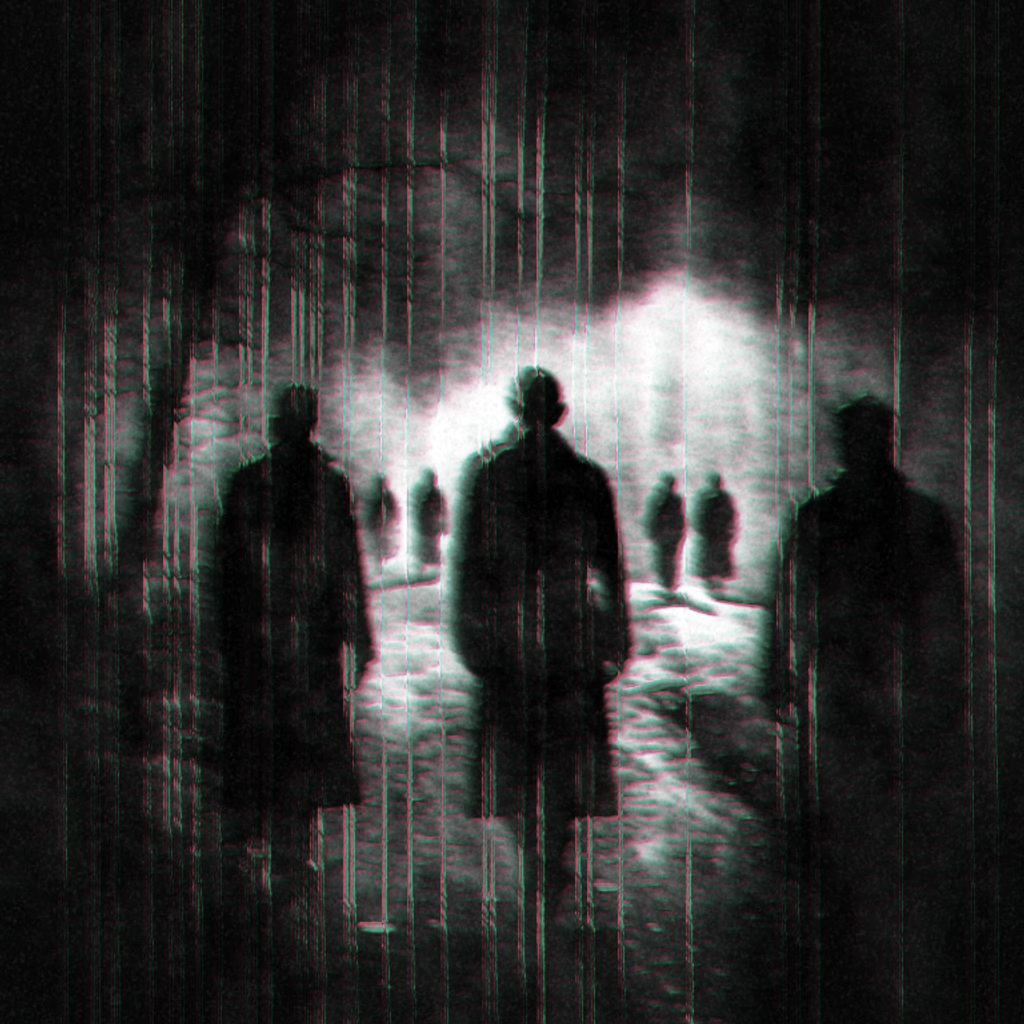
THE MICHIGAN MOTH MEN: A Compiled Dossier of Primary Source Evidence
I have spent nineteen years collecting the materials presented in this dossier. What began as an offhand curiosity during my doctoral work on Lepidoptera migration corridors in the Upper Peninsula has become, I will admit to the reader without embarrassment, the central preoccupation of my professional life.
The pattern is unmistakable to anyone willing to look: across more than a century of Michigan’s recorded history, something has been drawn to our brightest lights. Something that emerges from underground. Something that moves in groups, travels in long formations, and vanishes before sunrise. The earliest accounts predate both the Mothman sightings of Point Pleasant, West Virginia (1966) and the better-known Michigan Dogman legend by decades.
I am not asking the reader to believe. I am asking the reader to examine the evidence and determine for themselves why it has never been examined before. — Dr. Helen Vasik, Houghton, MI, 2024
I. The Deep Roads: Geological Context
Michigan’s Keweenaw Peninsula contains some of the deepest mines in North American history. The Quincy Mine, known locally as “Old Reliable,” reached depths exceeding 9,200 feet. The Calumet & Hecla Mining Company operated tunnel systems so vast that company maps from the early 1900s remain partially classified by the Michigan Department of Natural Resources, ostensibly due to “collapse liability concerns.”
What is less discussed is the number of tunnels that were sealed without full survey. A 1923 internal memorandum from the Calumet & Hecla engineering office—obtained by this researcher through a FOIA request in 2011—references “six lateral passages on the 74th level trending sharply downward beyond mapped extent.” The memorandum recommends “permanent closure by backfill and concrete cap” and notes, with the clinical brevity typical of mining engineers, that “temperature readings from the lower passages are inconsistent with known geothermal models for this stratigraphy.”
The passages were warm. Unusually warm. And they went down further than anyone had followed.
THE DAILY MINING GAZETTE — HOUGHTON, MI — November 14, 1897 STRANGE VISITORS SEEN AT NO. 4 SHAFT
Two night-shift muckers employed at the No. 4 shaft of the Tamarack Mine report having observed what they describe as “tall, dark figures” ascending the main haulage drift at approximately 2:15 in the morning. The men, whose names are withheld by their foreman Mr. Juhani Korhonen, state that the figures moved “with an odd, halting gait” and appeared to be “drawn toward the headframe lamp.” The company superintendent has attributed the report to poor ventilation in the lower drifts.
It is worth noting that the Tamarack Mine’s No. 4 shaft was equipped with one of the most powerful electric arc lamps in the Keweenaw at the time—visible, according to contemporary accounts, from as far as Portage Lake. The lamp had been installed only three weeks before the sighting.
II. The Pattern Emerges: 1900–1945
The first decades of the twentieth century saw Michigan undergo rapid electrification. And with the spread of electric light came a corresponding spread of sightings. The pattern is remarkably consistent: the events cluster in late autumn and early spring, they occur within half a mile of unusually bright light sources, and they are almost always reported between 11:00 PM and 4:00 AM.
THE SAULT EVENING NEWS — SAULT STE. MARIE, MI — March 29, 1913 ODD DISTURBANCE AT THE SOO LOCKS
Lock workers on the overnight shift report that a group of “large, dark shapes” gathered on the south pier near the new General Electric arc lamps installed last month. The shapes, described by one watchman as “taller than any man I have seen, standing very still and facing the lights,” dispersed when a steam whistle was sounded. A search of the pier recovered no evidence of trespass. Harbor Master J. Alderton notes the incident but considers it “probably cormorants or herons confused by the new illumination.”
MARQUETTE MINING JOURNAL — October 7, 1927 MOTORIST REPORTS DARK FIGURES ON ROAD NEAR NEGAUNEE
A Mr. Walter Breck, traveling by automobile from Negaunee to Ishpeming on County Road 492 at approximately midnight, reports that his headlamps illuminated a column of tall, dark figures walking single-file along the roadside. Mr. Breck estimates the column at “eight or ten individuals, all of unusual height, walking in perfect step.” When he slowed his vehicle, the figures “turned as one toward the headlamps” and Mr. Breck states he then accelerated and did not stop until reaching Ishpeming. Sheriff’s deputies found no trace of the figures. Mr. Breck is known to this newspaper as a sober and reliable citizen.
“Walking in perfect step.” “Turned as one toward the headlamps.” The language is almost identical across accounts separated by decades and hundreds of miles. Either rural Michiganders across the Upper and Lower Peninsulas have been independently fabricating the same precise hallucination for over a century, or they have been observing the same phenomenon.
THE TRAVERSE CITY RECORD-EAGLE — November 22, 1938 CHERRY CAPITAL ELECTRIC INVESTIGATES LINE DAMAGE
Traverse City Light & Power reports “unexplained contact damage” to the new high-voltage transmission line along M-72 east of the city. Lineman Orville Peet states that the insulators on three successive poles appear to have been “gripped and scorched by something with tremendous heat.” Mr. Peet further notes that the ground beneath the affected poles shows “large, shallow depressions in paired rows, as though made by very large feet.” The utility attributes the damage to an early ice storm.
The phrase “gripped and scorched” will recur. The reader may wish to note it.
III. The War Years and the Blackout Correlation
During World War II, the military imposed periodic brownout and blackout drills across the Great Lakes region, particularly near the critical Soo Locks and the industrial corridors of Detroit, Flint, and Saginaw. What is remarkable—and what has apparently gone unremarked in any published literature—is that sighting reports effectively vanished during blackout periods and surged dramatically in the weeks immediately following their conclusion.
The inference is straightforward. If the lights go out, there is nothing to come for.
THE DETROIT FREE PRESS — August 19, 1945 CELEBRATION LIGHTS DRAW UNUSUAL CROWD ON BELLE ISLE
Police responding to reports of trespassers on the northeastern shore of Belle Isle during last night’s Victory illumination display found no individuals but noted “several areas of severely scorched turf” arranged in a rough semicircle facing the temporary searchlights. An officer who wished to remain anonymous told this reporter: “The grass was burned black in patches, each one about four feet long and two feet wide. Like something had been standing there, very hot, for a long time.” Parks Department attributes the scorching to “discarded firework debris.”
Four feet long. Two feet wide. Paired. Facing the brightest lights in the city.
IV. The Subsurface Migration Theory
In 2003, a retired geologist from Michigan Technological University—who has asked to be identified only as “Prof. R.K.”—shared with me a series of thermal imaging surveys he had conducted in 1988 of abandoned mine shafts throughout the Keweenaw Peninsula. Th e surveys, which were originally commissioned to assess geothermal energy potential, revealed something unexpected: deep within several sealed shafts, at depths below 4,000 feet, the thermal cameras detected what Prof. R.K. describes as “large-scale periodic thermal fluctuations inconsistent with any known geological process.”
The fluctuations occurred seasonally. They intensified in October and November, subsided through the winter months, and resumed briefly in March and April. The thermal signatures moved laterally through the rock between shafts, suggesting the use of unmapped connecting passages.
Something warm was moving through the deep rock of Michigan, and it followed a seasonal schedule.
Prof. R.K.’s report was submitted to the Michigan Department of Natural Resources in 1989. It was acknowledged with a form letter. No follow-up investigation was conducted. The original thermal imaging data was stored at Michigan Tech’s archives until 2002, when it was “deaccessioned during a routine collection review.” It is no longer available.
V. The Vehicles The Long Bus
Perhaps the most consistent and most troubling element of modern sightings is the vehicle. Since the late 1950s, witnesses across Michigan have reported seeing a long, dark vehicle—described variously as a bus, a stretched van, or simply “something long and low”—traveling without headlights on rural roads in the hours between midnight and 4:00 AM. The vehicle is always reported as moving slowly, deliberately, and silently.
THE ALPENA NEWS — April 3, 1962 THUNDERBAY RIVER ROAD: MOTORIST REPORTS UNLIT VEHICLE
Mrs. Dorothy Phelps of Alpena, returning from a visit to her sister in Hillman, reports that at approximately 1:30 AM she was overtaken on the Thunder Bay River Road by a long, dark vehicle traveling without any illumination. Mrs. Phelps, whose own headlamps lit the vehicle briefly as it passed, describes it as “blacker than the road, longer than a school bus, with no windows that I could see.” She reports that the vehicle made no engine noise she could detect. Mrs. Phelps is adamant she was fully awake and had consumed no alcohol.
THE MANISTEE NEWS ADVOCATE — October 18, 1979 DARK “BUS” SIGHTED ON M-55 NEAR CABERFAE
Two deer hunters from Grand Rapids, camping near Caberfae Peaks, report observing a large, unlit vehicle traveling east on M-55 at approximately 3:00 AM. The men, who were sitting by their campfire, state the vehicle was “enormously long, completely dark, and absolutely silent.” One of the hunters attempted to follow in his truck but lost sight of the vehicle near the intersection with M-37. Both men report that their campfire “dimmed considerably” as the vehicle passed, a detail they found difficult to explain.
It is the campfire detail that warrants attention. The consistent testimony that nearby light sources dim or flicker in the proximity of these events suggests an active photovoric process—the absorption of radiant energy by a biological organism. This is not without precedent in the natural world; certain deep-ocean organisms absorb bioluminescence from their environment. The scale, however, would be unprecedented.
The Pickup Protocol
A pattern emerged across dozens of these vehicle sightings. The long, dark conveyance is always observed traveling from south to north in the autumn months, and from north to south in March and April. It stops at locations near high-intensity light sources—highway interchanges, substations, industrial facilities—and then continues. Witnesses who observe these stops consistently describe tall, dark figures either entering or exiting the vehicle.
They are being picked up. Or they are being delivered.
VI. The Modern Era: 1990–Present
The proliferation of high-intensity discharge lamps, LED floodlights, and the general increase in light pollution across Michigan has, if anything, intensified the phenomenon. The Michigan Moth Men appear to have adapted. Where once they gathered at isolated mine headframes and single arc lamps, they now appear at electrical substations, highway interchange lighting arrays, and—significantly—at the sites of power line failures, where electrical arcing can produce light of extraordinary intensity.
THE GRAND RAPIDS PRESS — November 3, 2003 CONSUMERS ENERGY UNABLE TO EXPLAIN KENT COUNTY OUTAGE PATTERN
Consumers Energy spokesman Mike Raleigh told reporters Friday that the utility has “no explanation” for a series of eleven sequential transformer failures along a 40-mile corridor in Kent County over a two-week period in October. The failures occurred in a precise south-to-north sequence, each approximately 3.7 miles from the last, and each between midnight and 3:00 AM. “We are investigating equipment age and possible wildlife interference,” Mr. Raleigh said. A line technician who asked not to be named said: “I’ve never seen scorching like that on an insulator. It’s not squirrels. Squirrels don’t leave handprints.”
THE PETOSKEY NEWS-REVIEW — March 12, 2014 LIGHTS OVER M-119 TUNNEL OF TREES REMAIN UNEXPLAINED
Multiple motorists report unusual lights visible through the trees along the famous M-119 Tunnel of Trees scenic route north of Harbor Springs late Tuesday evening. The lights, described as “pulsating, amber-white, and moving slowly at ground level,” were visible for approximately twenty minutes before abruptly ceasing. Emmet County Sheriff’s deputies responding to the area found no source but noted “several large, deep footprints in the shoulder gravel” and a “strong smell of ozone.” A DTE Energy spokesperson confirmed no equipment malfunctions in the area.
LOCAL NEWS (ONLINE EDITION) — October 29, 2019 WEBCAM CAPTURES ‘ANOMALY’ DURING MACKINAC BRIDGE LIGHT SHOW
An automated traffic webcam on the Mackinac Bridge captured footage during the annual Bridge Walk light display that has circulated widely on social media. The nine-second clip, recorded at 2:47 AM after the event had concluded and the bridge was closed to traffic, appears to show several tall, elongated figures standing motionless on the bridge deck, facing directly into the still-active decorative lights on the north tower. The Mackinac Bridge Authority has stated the footage shows “light artifacts and lens distortion” and has declined to release the original high-resolution file.
VII. The Wayne County Incident: March 2026
Which brings us, inevitably, to the most recent event. On the evening of March 13, 2026, a severe windstorm caused a large tree to fall across high-voltage power lines in a residential area of Wayne County, in the suburban corridor southwest of Detroit. What followed was a prolonged brownout of approximately three hours, during which the downed lines arced and sparked with extraordinary intensity—bright enough, according to one resident, to resemble “a brilliant UFO.”
The scene was, by all accounts, eerie: a residential street plunged into near-total darkness, lit only by periodic, blinding flashes from the power line.
It was during this event that a local resident—whose account has been provided to this researcher directly—observed something unusual. In the intermittent darkness, the fire crew appeared to be unusually transfixed. Their movements seemed synchronized. The firetruck, visible only in flashes, appeared to the witness as “a long, dark bus.”
The resident reports that a brief flash from the power line illuminated the figures fully. For a fraction of a second, the witness states, they did not quite look like firefighters to me.
Editor’s note: DTE Energy records confirm a three-hour outage event in Wayne County on the date specified. The Wayne County Fire Department has not responded to inquiries regarding the incident.
VIII. What They Are
I do not claim certainty. I claim only the following synthesis, which accounts for every detail in the accumulated testimony.
Michigan sits atop some of the oldest and deepest geological formations on the continent. The Precambrian rock of the Canadian Shield extends beneath the Upper Peninsula and, through deep faulting, connects to vast subterranean cavities that have never been surveyed. The copper mines of the Keweenaw penetrated only the uppermost fraction of these systems.
Something lives down there. Something large, endothermic, and photovoric—an organism that sustains itself through the absorption of intense radiant energy. For most of geological history, this energy would have come from deep volcanic vents, from the slow decay of radioactive deposits, from lightning strikes on the surface transmitted through mineral-rich groundwater.
Then, approximately 130 years ago, humans began stringing up electric lights. From the perspective of the Moth Men, this must have been roughly equivalent to the arrival of an all-you-can-eat buffet.
They emerge in late autumn to feed before the long winter drives them deep below the frost line, into passages where residual geothermal energy sustains them at a minimal metabolic rate. They surface again briefly in early spring, weakened, ravenous, drawn irresistibly to the brightest available light. They travel in groups. They move at night. And they have, over the past century, developed infrastructure: the long, dark vehicles, the coordinated routes, the systematic progression from light source to light source along established corridors.
They are not hostile. In over a century of documented encounters, no witness has reported an attack. They simply appear, feed on the light, and leave. But they are getting bolder. And Michigan is getting brighter.
“They are not moths. But they are drawn to the flame.” — Prof. R.K., Michigan Technological University (ret.)