Saving Hypatia
I · The Mercy of Murderers
The lamp had burned down to its last good hour, and Hypatia did not trim it. Oil was for the living, and she had spent the evening deciding she would meet the morning as a philosopher meets all things — without flinching, with her reasons arranged before her like instruments on a table.
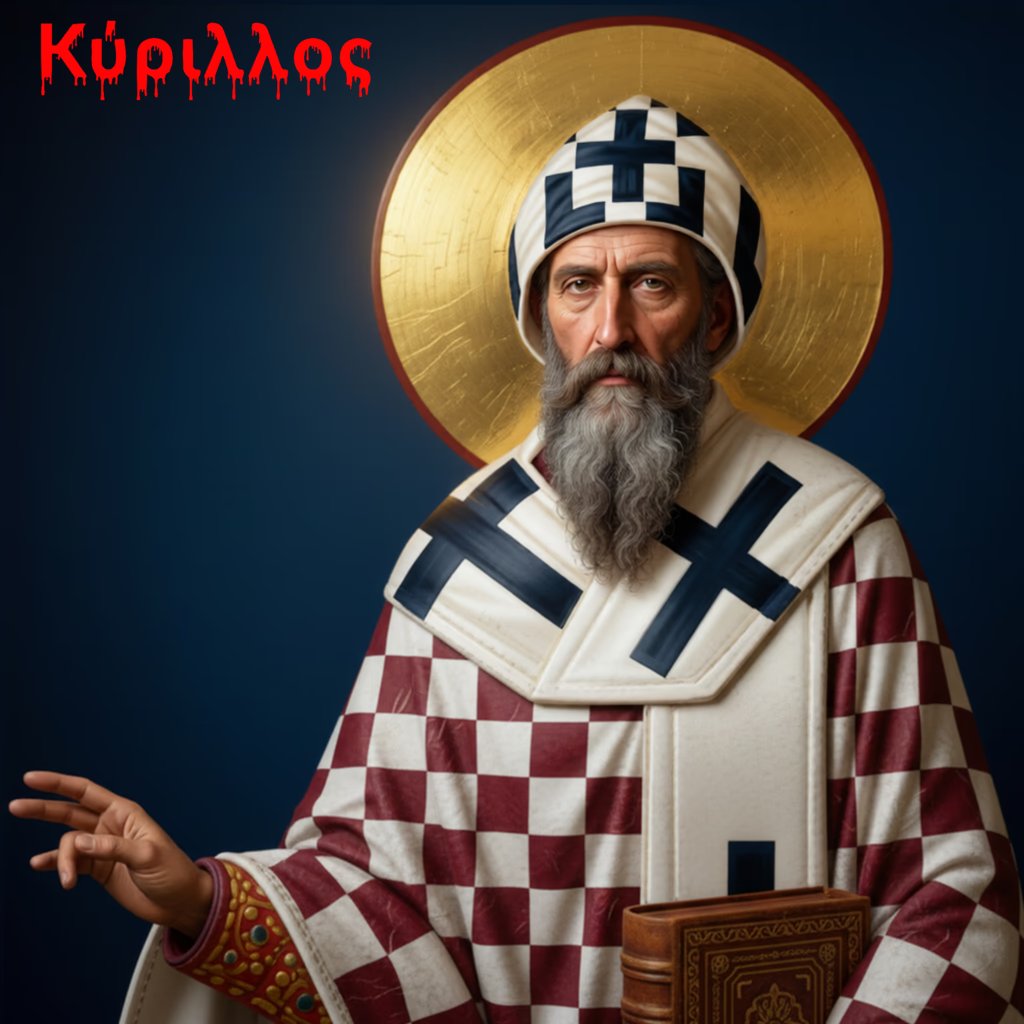
She had heard them in the streets for days. Cyril's word had gone out, though Cyril's name was never on it; the bishop had learned that evil travels furthest when it travels nameless. Those who teach men to think past what they are told. That was the charge, unwritten, and she was its first and clearest example.
So when the knock came — soft, almost courteous — she was not afraid. She had her argument ready.
The man who entered filled the doorway and then made himself smaller, the way large men do in the rooms of those they have come to frighten. He wore no insignia. His hands were scarred across the knuckles in the particular way of men who have killed with them. He looked at her scrolls, her astrolabe, the chart of the heavens she had been correcting, and something passed over his face that she could not name.
"You are the captain of them," she said.
"I am."
"Then sit. I have things to say to you, and they are better said sitting." She gestured to the bench. "You have been hired to do a terrible thing, and I do not believe you are a terrible man. There is always another road. If you would only —"
"Lady." He did not sit. "Words are not enough to stop evil."
The lamp guttered. She waited, because she had taught long enough to know when a man was not finished.
"You think this is the moment your reason saves you," he went on. "It is not. Reason did not save you. The day you chose this city for your home — knowing what it was becoming, knowing the bishop, knowing the mob — you made a trade. You took the good of staying and you paid for it with a little of the danger. That is what living here was: a compromise between evil and good. And in such a trade, lady, only ever evil triumphs. It waits. It collects. It has collected you."
It was, she thought, a more honest theology than any she had heard from the men who claimed to love God. She inclined her head, conceding the point as she would to a worthy student.
"Then you have come to collect."
"No." He said it flatly, and the word changed the shape of the room. "I have come to tell you what is going to happen, because you are a woman who would rather know."
He stepped closer, and lowered his voice, though there was no one to hear.
"We are murderers. I will not pretend otherwise to you of all people; you would smell the lie. We have done things no penance reaches. But we are not devils like Cyril. We do not destroy Great Beings." He let the words settle. "We do not put out a light because a frightened man cannot bear how far it shows. There are some things even our trade will not touch, and you are one of them."
"I don't understand."
"Tomorrow they will want a body. They will want it badly, and they will want it to be yours, and they will not look closely — because the looking is not the point. The killing is the point. The story of the killing." His scarred hand opened, as if releasing something.
"You know the name they give us. The parabalani. To the bishop we are brothers; to the city, when the city is honest, we are something nearer to the dogs he keeps. But before we were either, we were the men who carried the dead — into the plague-houses when the sickness came, out of them when it was finished, the bodies no one else would touch washed and laid clean in the ground by these same hands. A corpse is the one thing in Alexandria we can always find, lady, and the laying-out of one is the oldest work we know. We tended the dead long before the bishop taught us to make them.
"So they will have a body. We have secured one. A woman of your years, your height, dead three days of the fever, with no one left to weep for her or count her fingers. By morning she will be dressed in your clothes and laid where the crowd will find her.
"And no one will say otherwise, because no one else will be let near enough to look. The hands that do the thing will be the only witnesses to it, and the witnesses will be us, and what we say we saw is the only history this morning will ever have. We are the mob, lady — but we are also, this once, the ones who keep the record. The bishop means to use us for both, and he has not understood the danger in it: that muscle with a conscience is no longer only muscle.
"We are men of many secrets, lady. Cyril will never suspect a thing. He will have his triumph, and his triumph will be a corpse, and you —"
He stopped. The next part, she understood, was the hard part for both of them.
"And I," she said quietly, "will be no one."
"You will be alive."
"I will lose Alexandria. My students. My name. Everything I am will be buried in another woman's grave and mourned as though it were true." She found she had to steady her voice. "You are not offering me my life. You are offering me a smaller, secret one, and asking me to die for it."
"Yes." He did not soften it, and she respected him for that. "A man cannot give what the world will not let him give. I cannot give you your city back, or your safety in the open, or justice on the bishop. I can give you a wagon before dawn, a name that is not yours, and the chance to grow old somewhere teaching shepherds' children their stars." He almost smiled. "It is a poor mercy. But it is the mercy of murderers, and it is real, and it is more than Cyril will leave you by noon tomorrow."
For a long moment the only sound was the lamp.
Then Hypatia, daughter of Theon, who had measured the courses of the heavens and refused to the end to be measured by smaller men, reached out and trimmed the wick — because the night, after all, was not yet over, and she would need the light.
"What is your name?" she asked. "If I am to owe my life to a man, I would rather not owe it to a stranger."
He told her. It was an ordinary name, a soldier's name, nothing that would survive in any history.
But she kept it. Of all the things she carried out of Alexandria that night, she kept it longest.
II · The Keeping of Philosophers
The wagon went out through the Gate of the Sun before the city had finished being afraid, and the woman in it had already begun the long work of becoming no one.
It is harder than dying, to be unmade on purpose. The dead are at least remembered; she had to teach herself the opposite discipline — to leave no mark a hand could close around, no name a fire could find. She kept the captain's name and gave up her own; after that first night she never spoke her own again, not even alone, not even to the stars she had spent her life correcting. A name is a thing enemies can burn. She had watched them burn one. She would not give them a second.
Cyril received his spectacle. Alexandria received its warning. But the woman herself passed into the keeping of philosophers — handed, that first year and for years after, from quiet household to quiet household along the roads the lovers of wisdom kept open between the cities, Alexandria to Athens and back, a road the bishops never thought to watch because it carried nothing they knew how to fear.
She settled at last in a house of women and books at the edge of the old learning, and there she grew old in a way no history would record. She was charitable past sense; the poor at the door came to know that the silent old woman would give until there was nothing left and then give the promise of tomorrow. She was beautiful in the soul, which is the only beauty that survives a face, and the young who sat with her did not always understand why they wept when they left her — only that something in them had been set in order. Those who knew such things said she had the gift the great ones had: that to be near her was to be made better without being told you had been worse.
There was a younger woman in that world — Aedesia, kin to philosophers and soon the wife of one — who loved the old elder as a daughter loves. She learned from her not geometry; the elder taught that to others. She learned the harder art: how a woman might be a lamp in a dark room and not be burned for the light. Aedesia would carry that art a long way. A generation on, when Aedesia herself lay dying, the whole city would mourn her openly, and a boy named Damascius would rise and speak her eulogy in verse, and her name would be set down in a book to be kept. And the few who still held the secret understood what was happening: that in weeping by name for Aedesia, Alexandria was weeping at last, without knowing it, for the elder it had never been allowed to weep for — that the grief denied the one had been saved up, and spent, decades late, on the other.
It was the only funeral Hypatia ever had. She would have found it logically satisfying.
For the deeper things — the rites the priest had most wanted to see destroyed, the old theurgy, the words said to draw the soul up its long ladder — these she would not write and would not sign. So she did what the preservers had always done: she chose vessels whose names could be spoken aloud. The teaching went up the road to Athens in the memory of students, and there, in its time, it rose into the daylight of history in a woman who could afford to be seen — Asclepigenia, daughter of the old school, who held the rites in her hands and set them, whole, into the hands of Proclus. Her the histories would name. Her the histories would thank. She was the hinge the door would visibly turn upon, and she bore the weight gladly, because she understood the arrangement: that every named keeper of a flame stands in front of unnamed ones, shielding them with the simple fact of a face. Behind Asclepigenia — and behind the line that ran through her to Proclus, and past him into the centuries the door kept opening onto — there stood a silence. And in the silence, an old Alexandrian woman who had decided, on a night long before, that wisdom would outlive its enemies by refusing to hand them anything to aim at.
By 450 she died quietly, not as Hypatia, but as an elder among women who knew how to preserve wisdom without leaving names for enemies to burn. She was very old, and she was loved, and at the end there were hands on hers — which is more than the empire gave most of its saints. They buried her without an inscription, in ground that has long since forgotten her, exactly as she had asked. No stone marks it.
That was the victory. The bishop had wanted to put out a light because he could not bear how far it showed; and the light had simply learned to be carried — hooded against the wind, passed hand to hand down a road he never found, lit in rooms he never entered, by people whose names, when there had to be names, were never quite the right ones.
He burned a corpse and called it the end of something.
He was wrong about which thing.
And he was wrong about the end.